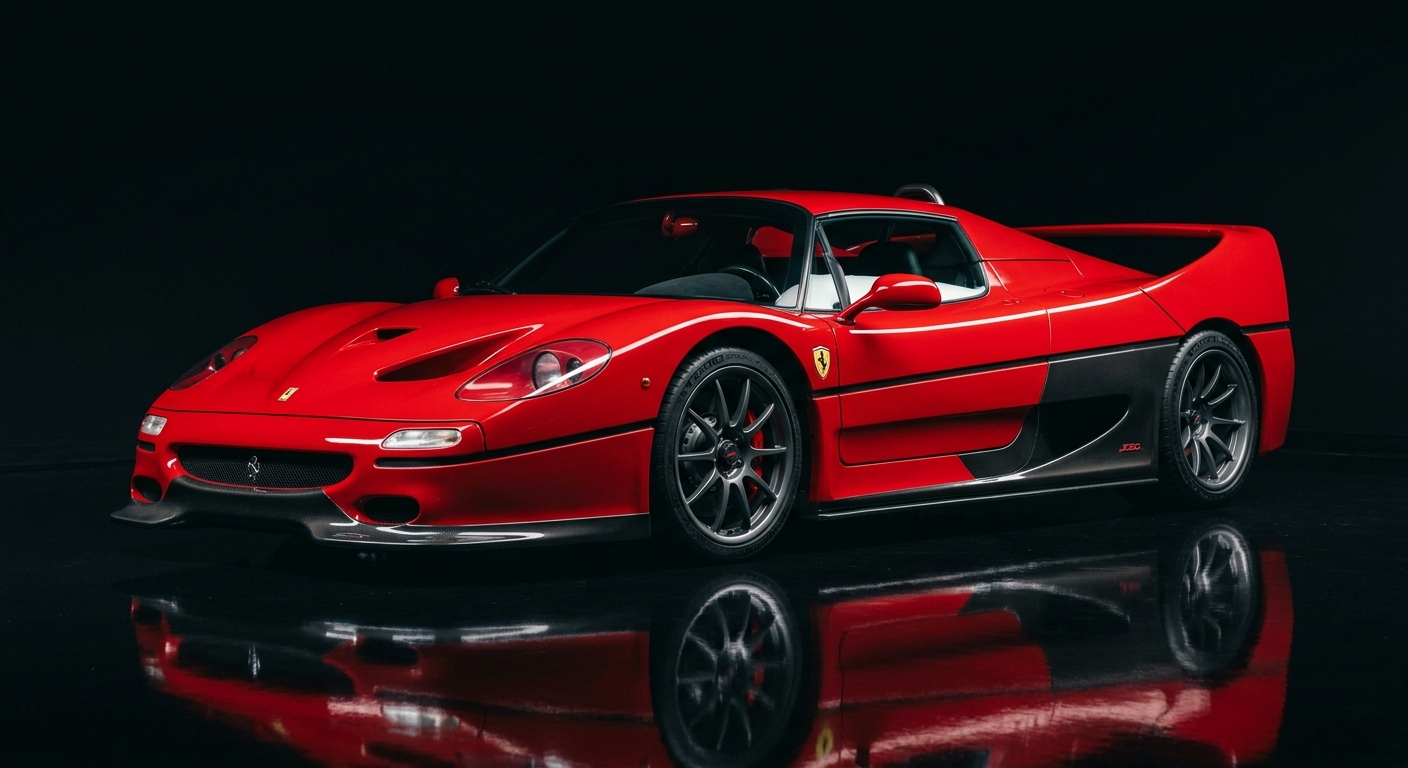
In 1995, Ferrari created something extraordinary: a road car built around genuine Formula One technology. The F50 wasn’t just another supercar; it was Ferrari’s 50th anniversary gift to itself and to the 349 fortunate souls who would own one. With a naturally aspirated V12 derived from F1 engines and a carbon fiber monocoque chassis, the F50 represented the closest thing to a street-legal race car that money could buy.
The Ultimate Ferrari Experience
Driving the F50 is like stepping into a time machine that transports you to the golden age of Formula One. The 4.7-liter V12 engine, mounted directly behind your head, screams to 8,000 rpm with an intensity that modern turbocharged engines simply cannot match. This isn’t just about the 520 horsepower figure; it’s about the way that power is delivered, with a linear rush that builds to an almost violent crescendo as the tachometer needle sweeps toward the redline.
The steering is unassisted, demanding real muscle and providing feedback so direct it borders on telepathic. Every imperfection in the road surface transmits through the carbon fiber monocoque, creating a connection between driver and machine that few modern supercars can replicate. The six-speed manual gearbox requires commitment, with a heavy clutch and precise but notchy shifts that reward smooth technique.
Formula One DNA
What sets the F50 apart from its contemporaries is its genuine racing pedigree. The 4.7-liter V12 is a direct descendant of Ferrari’s 1990 Formula One engine, adapted for road use but retaining the fundamental architecture that powered F1 cars to victory. The engine breathes through individual throttle bodies, creating an immediate throttle response that feels almost violent compared to modern drive-by-wire systems.
The carbon fiber monocoque chassis, constructed by Cytec Industries, weighs just 225 pounds and provides exceptional rigidity. This isn’t carbon fiber trim or body panels; this is a full racing-style tub that forms the structural backbone of the car. The result is a vehicle that weighs just 3,080 pounds despite its substantial size and presence.
Exclusive by Design
Ferrari deliberately limited F50 production to just 349 units worldwide, making it rarer than the legendary F40 that preceded it. Each car was hand-built at Ferrari’s Maranello factory, with potential buyers required to be invited by Ferrari based on their ownership history and relationship with the brand. This exclusivity wasn’t just marketing; the F50’s complex construction and exotic materials made mass production impossible.
The removable hardtop can be stored in the front compartment, transforming the F50 into an open-top experience that amplifies the sensory assault. With the top removed, the V12’s song becomes even more intoxicating, while the lack of a traditional windshield frame creates an almost motorcycle-like sense of exposure and freedom.
Racing Technology Refined
Every aspect of the F50’s design serves performance. The active aerodynamics adjust automatically based on speed and driving conditions, while the pushrod suspension system, borrowed directly from F1 technology, provides exceptional handling precision. The brakes, massive Brembo units with carbon fiber cooling ducts, offer stopping power that matches the engine’s ferocious acceleration.
Inside, the F50’s cabin is refreshingly focused. Carbon fiber surrounds the driver, while the instrument cluster presents only essential information. The seats, molded specifically for each owner, provide support that keeps you connected to the car even during the most spirited driving. This isn’t luxury in the traditional sense; it’s the luxury of purpose-built performance equipment.
The Ferrari F50 represents a pinnacle moment when Formula One technology could still be adapted for road use without compromise. In today’s market, where F50 values regularly exceed $3 million, it stands as both an incredible investment and an irreplaceable piece of automotive history. This is raw, unfiltered supercar perfection that will never be replicated.