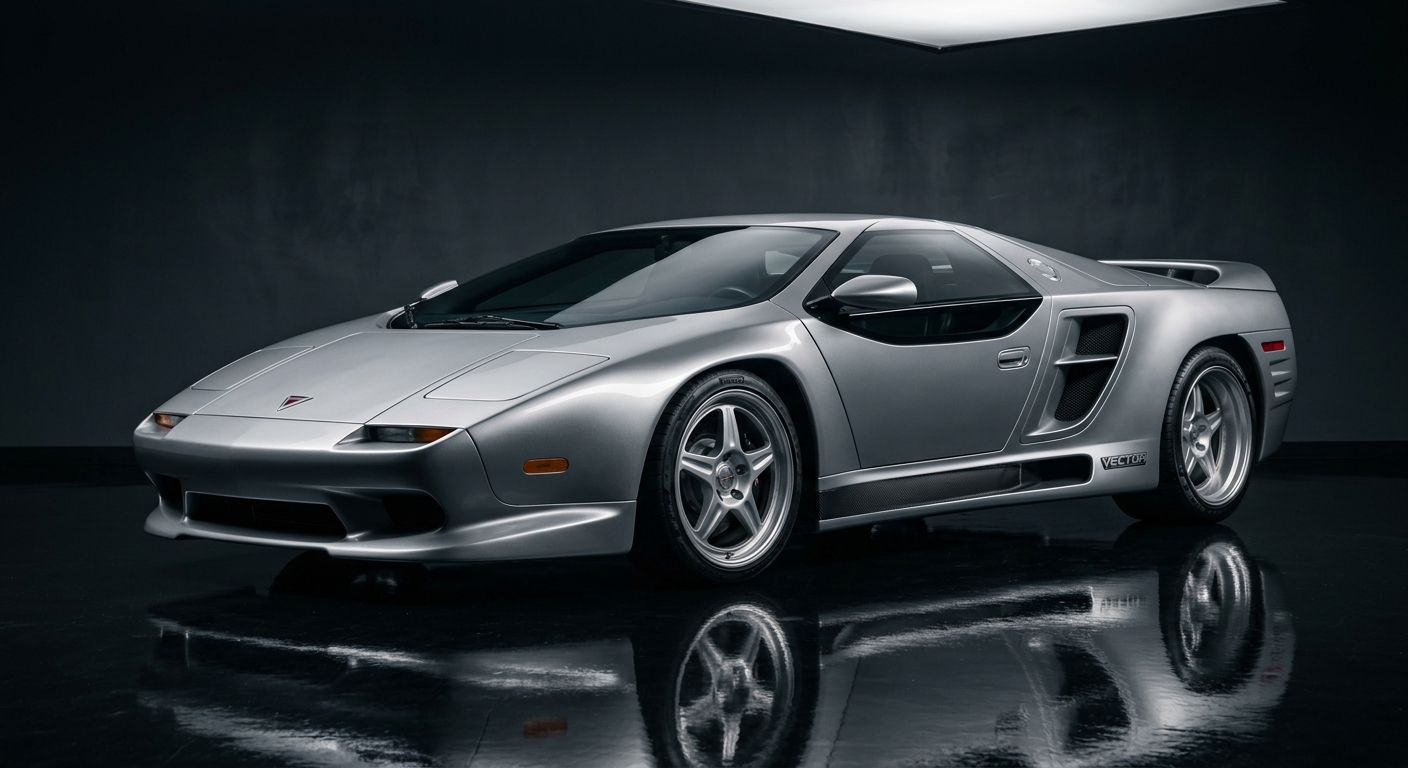
In the annals of American automotive excess, few machines have embodied pure, unfiltered insanity quite like the Vector M12. Born from the fevered imagination of Gerald Wiegert and built during Vector’s tumultuous final chapter, this angular monster represented America’s most ambitious attempt to build a no-compromise supercar. With its Lamborghini V12 heart and space-age aesthetics, the M12 was part supercar, part fighter jet, and entirely unhinged.
The Vector Legacy
Vector Aeromotive had built its reputation on creating some of the most extreme supercars ever conceived on American soil. The M12, launched in 2002, marked a dramatic departure from the company’s previous twin-turbo V8 monsters. Under new ownership following a complex corporate restructuring, Vector partnered with Lamborghini to source the legendary 5.7-liter V12 that powered the Diablo.
This wasn’t just badge engineering. The M12’s carbon fiber monocoque chassis was entirely Vector’s creation, designed to handle the 492 horsepower and 428 lb-ft of torque that the naturally aspirated Lamborghini V12 delivered. The result was a car that could theoretically reach 200 mph while looking like it had been designed by someone who watched too much science fiction.
Design Philosophy
The M12’s styling was pure Vector DNA, featuring the same angular, geometric approach that had defined the brand since the W8. Every surface seemed to have been carved from a single block of aerospace-grade aggression. The cockpit-style interior featured fighter jet-inspired switchgear and displays that looked more suited to launching missiles than launching down a highway.
Vector claimed extensive use of aerospace materials and manufacturing techniques, though the reality of their production capabilities was often more ambitious than practical. The M12’s body panels were carbon fiber, and the attention to aerodynamic detail was obsessive, even if some of those aerodynamic elements served more aesthetic than functional purposes.
Performance Reality
On paper, the M12 promised supercar performance that could rival anything from Maranello or Sant’Agata. The Lamborghini V12 provided proven reliability and a soundtrack that could wake the dead. Vector claimed a 0-60 mph time of 3.8 seconds and a top speed exceeding 200 mph, numbers that put it squarely in hypercar territory for 2002.
The reality proved more complex. While the engine was magnificent, Vector’s small-scale manufacturing meant that each M12 was essentially a hand-built prototype. Build quality varied significantly, and the company’s financial instability meant that customer support ranged from excellent to nonexistent, depending on when you bought your car.
The Driving Experience
Those lucky enough to experience an M12 in proper working order described it as absolutely visceral. The Lamborghini V12 delivered power in a linear, intoxicating rush that felt entirely different from the turbocharged violence of earlier Vector models. The sound was pure Italian opera, transmitted through Vector’s uncompromising chassis tuning.
The steering was heavy and direct, the suspension unforgiving, and the overall experience utterly analog. This was a car built for those who wanted their supercars to require commitment and skill, not electronic assistance and comfort features.
Market Position and Legacy
With an MSRP approaching $200,000, the M12 competed directly with established European exotics, but Vector’s reputation for financial instability and limited dealer network made it a risky proposition for potential buyers. Only a handful were ever produced before Vector ceased operations, making the M12 one of the rarest American supercars ever built.
Today, the few surviving M12s represent the absolute peak of American supercar ambition from the early 2000s. They’re rolling examples of what happens when unlimited vision meets limited resources, resulting in machines that are simultaneously brilliant and deeply flawed.
The Vector M12 stands as America’s most uncompromising supercar statement, a machine that prioritized raw performance and visual shock over practicality or profit margins. While Vector’s business model proved unsustainable, the M12 remains a fascinating glimpse into what happens when unlimited ambition meets Italian V12 fury. Finding one today is nearly impossible, but experiencing one is absolutely unforgettable.