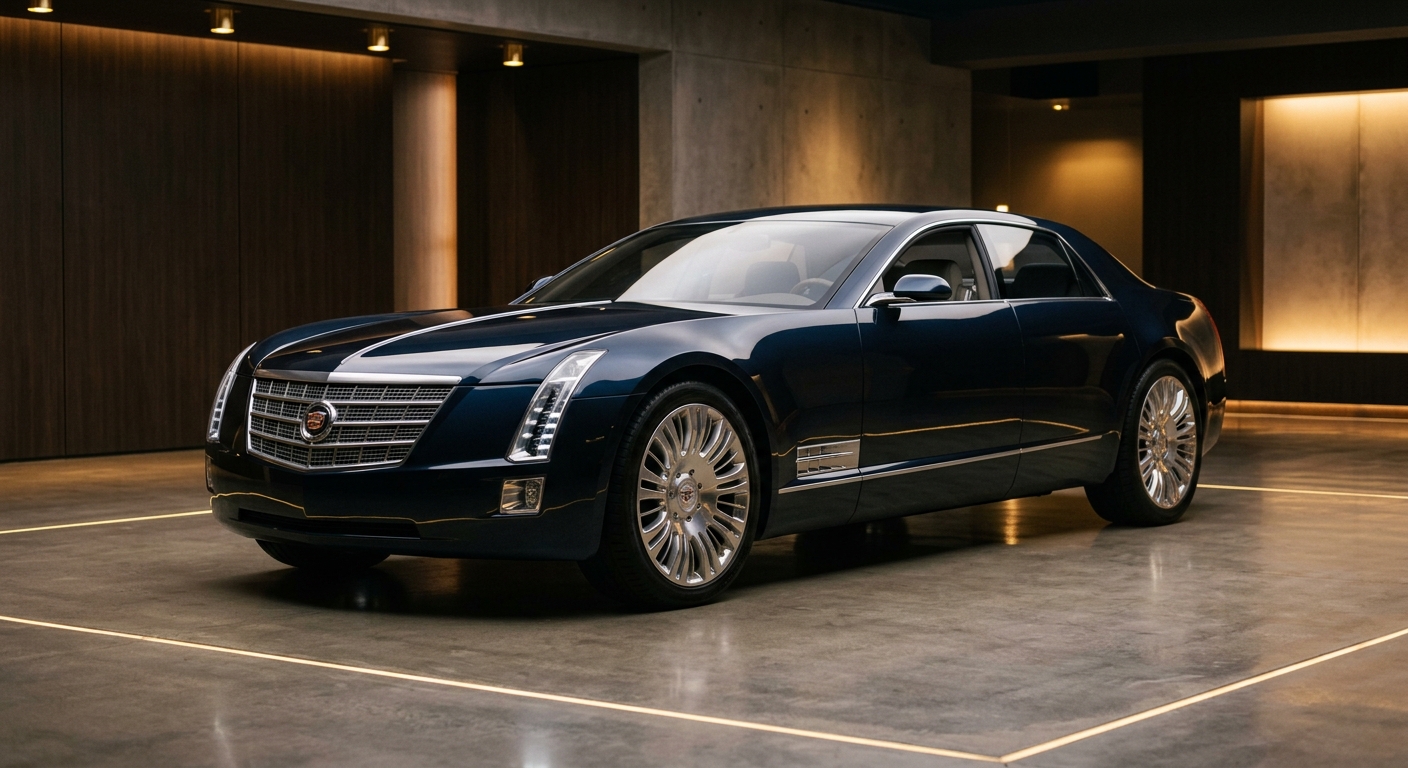
In 2003, when the world still believed in the endless possibilities of American engineering excess, Cadillac unveiled something that would make even the most jaded luxury car enthusiast stop and stare. The Sixteen wasn’t just another concept car destined for auto show floors; it was a statement of intent, a declaration that American luxury could still shock and awe in an age of increasing restraint.
This wasn’t merely a car with a big engine. This was Cadillac’s attempt to rewrite the rules of what constituted ultimate luxury, powered by a hand-built 13.6-liter V16 engine that produced 1,000 horsepower and redefined the very concept of automotive excess.
The Heart of Excess
At the center of the Sixteen’s appeal lay its extraordinary powerplant, a quad-turbocharged, all-aluminum V16 that represented the pinnacle of General Motors’ engineering ambitions. This wasn’t some marketing exercise; the engine was fully functional, capable of producing 1,000 horsepower and 1,000 lb-ft of torque while maintaining the refinement expected of a luxury flagship.
The engine employed cylinder deactivation technology that could shut down half the cylinders during light load conditions, theoretically allowing this mechanical leviathan to achieve reasonable fuel economy. In practice, economy was hardly the point. The Sixteen could accelerate from 0-60 mph in under 4 seconds while maintaining the whisper-quiet cabin ambiance that Cadillac customers demanded.
Design Language Revolution
The Sixteen introduced Cadillac’s “Art & Science” design philosophy in its most dramatic form. Sharp angles and precise lines replaced the soft curves that had defined American luxury for decades. The result was a car that looked like it had been carved from a single block of steel, with proportions that emphasized power and presence over traditional elegance.
At nearly 20 feet long, the Sixteen commanded attention through sheer scale. The interior featured hand-crafted materials throughout, with individual rear seats that could recline nearly flat and a passenger compartment that rivaled first-class airline suites in both space and amenity level.
Technology Integration
Beyond its mechanical prowess, the Sixteen showcased advanced technology that wouldn’t become mainstream for another decade. The infotainment system featured voice recognition, satellite navigation, and rear-seat entertainment systems with individual LCD displays. The climate control system offered four-zone capability, while the suspension utilized magnetic ride control for optimal comfort and handling balance.
The Reality of Dreams
Despite generating enormous enthusiasm from both press and potential customers, the Sixteen never reached production. The business case for a $300,000 Cadillac in 2003 proved challenging, and the subsequent economic shifts made such automotive excess increasingly difficult to justify. Yet the Sixteen’s influence on Cadillac’s future designs cannot be overstated; elements of its Art & Science philosophy would define every subsequent Cadillac model.
The concept represented the last moment when an American manufacturer could seriously consider building the ultimate luxury car without regard for market constraints or global economic realities. It was automotive excess in its purest form, uncompromised and unapologetic.
The Sixteen remains a fascinating glimpse into an alternative automotive timeline, one where American luxury manufacturers still dared to dream without limits. While it never reached production, its legacy lives on in every sharp line and bold angle of modern Cadillac design. Sometimes the cars that never were tell the most compelling stories of all.