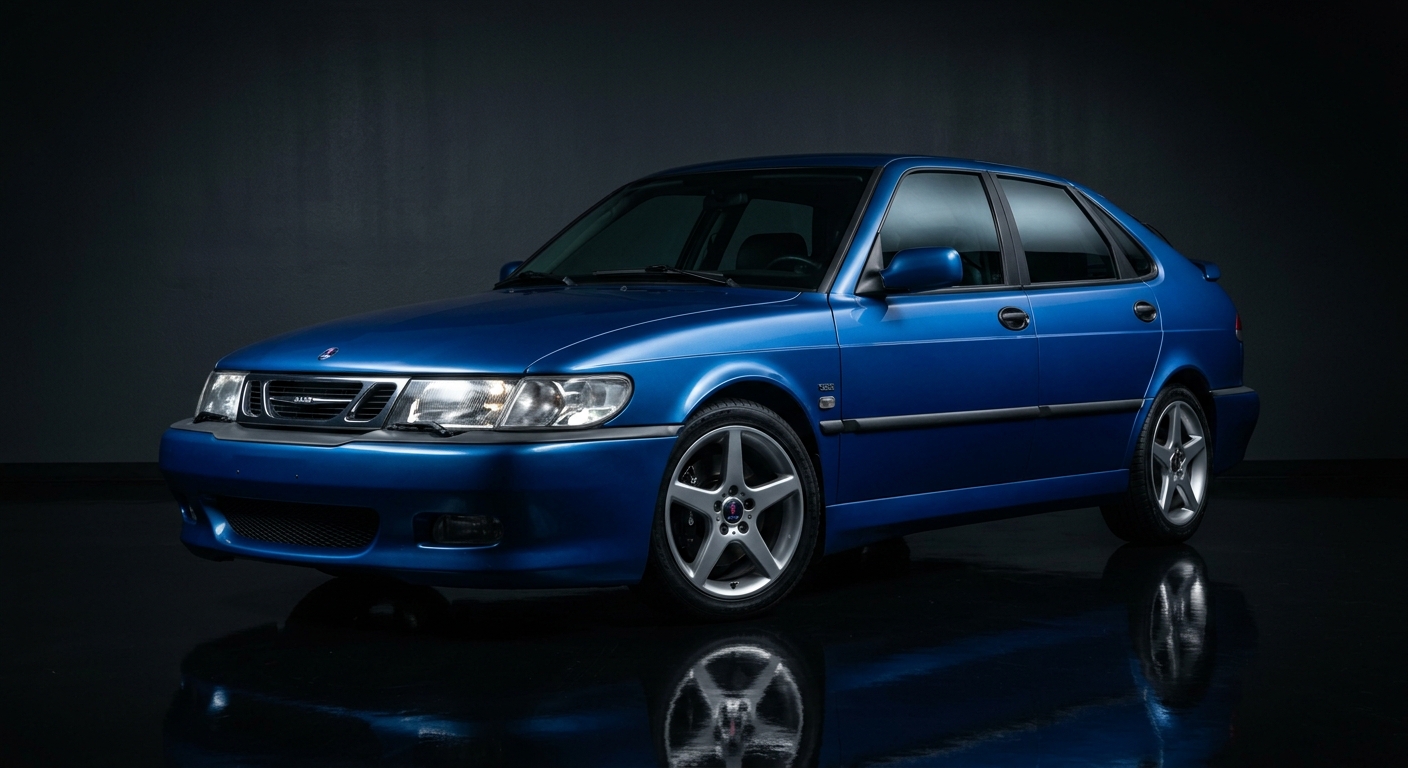
Before Saab became a footnote in automotive history, the Swedish marque delivered one final masterpiece that embodied everything the brand stood for: unconventional thinking, aerospace-inspired engineering, and turbocharged performance that could embarrass far more expensive machinery. The 2004 9-3 Viggen represented the culmination of decades of Saab’s performance philosophy, wrapped in a package that was equal parts practical and thrilling.
Named after the Swedish fighter jet, the Viggen wasn’t just another hot hatch with a badge. It was Saab’s declaration that quirky could also mean quick, and that Scandinavian sensibility didn’t have to sacrifice excitement for efficiency.
The Heart of a Fighter Jet
Under the Viggen’s hood lies a masterpiece of forced induction: a 2.3-liter turbocharged four-cylinder that produces 230 horsepower and 258 lb-ft of torque. But raw numbers don’t tell the whole story. This engine, developed from Saab’s rally heritage, delivers power in a uniquely Swedish way. The turbo lag is minimal, thanks to a sophisticated bypass valve system that keeps the turbo spinning even when you lift off the throttle.
The result is an engine that feels alive, responsive, and eager to rev. Unlike the peaky power delivery of many turbocharged engines of its era, the Viggen’s motor pulls cleanly from 2,000 rpm all the way to redline. It’s an intoxicating experience that makes every on-ramp feel like a rally stage.
Chassis Dynamics That Surprise
What separates the Viggen from mere tuner cars is its sophisticated chassis dynamics. Saab engineers didn’t just bolt on a bigger turbo and call it done. The suspension uses a unique combination of struts and wishbones, with specially tuned dampers and anti-roll bars. The result is a car that handles with precision while maintaining the compliance needed for daily driving.
The steering is particularly noteworthy. In an era when electric power steering was beginning to numb the driving experience, the Viggen’s hydraulic setup provides genuine feedback and weight. You can feel the front wheels searching for grip, sense the subtle changes in road surface, and place the car exactly where you want it.
The Viggen Experience
Driving a Viggen is like piloting a well-engineered weapon. The cockpit wraps around you with supportive Recaro seats and a dashboard that prioritizes function over flash. The ignition key still slots into the center console between the seats, a Saab quirk that reminds you this car marches to its own drummer.
On twisty roads, the Viggen reveals its true character. The chassis balance is remarkable, with just enough understeer to keep things safe but not enough to kill the fun. The limited-slip differential hooks up cleanly out of corners, and the brakes provide strong, fade-free stopping power even after repeated hard use.
A Rare Breed
Production numbers tell the story of the Viggen’s exclusivity. Only 4,600 examples were built during its three-year run, making it one of the rarest performance cars of its generation. Most were sold in Europe, with fewer than 1,000 making it to North American shores. Today, finding a clean, unmodified Viggen is like discovering buried treasure.
The rarity extends beyond mere production numbers. The Viggen represented Saab’s last hurrah as an independent performance brand. After General Motors fully absorbed the company, future Saab performance cars would share platforms and powertrains with other GM divisions. The Viggen was pure Saab, uncompromised and unfiltered.
The Viggen stands as proof that the best performance cars aren’t always the fastest or most expensive, but the ones that perfectly embody their maker’s philosophy. With values still reasonable and examples becoming increasingly rare, now might be the last chance to own this turbocharged piece of Swedish aviation heritage. Few cars have ever combined practicality and performance with such distinctive character.