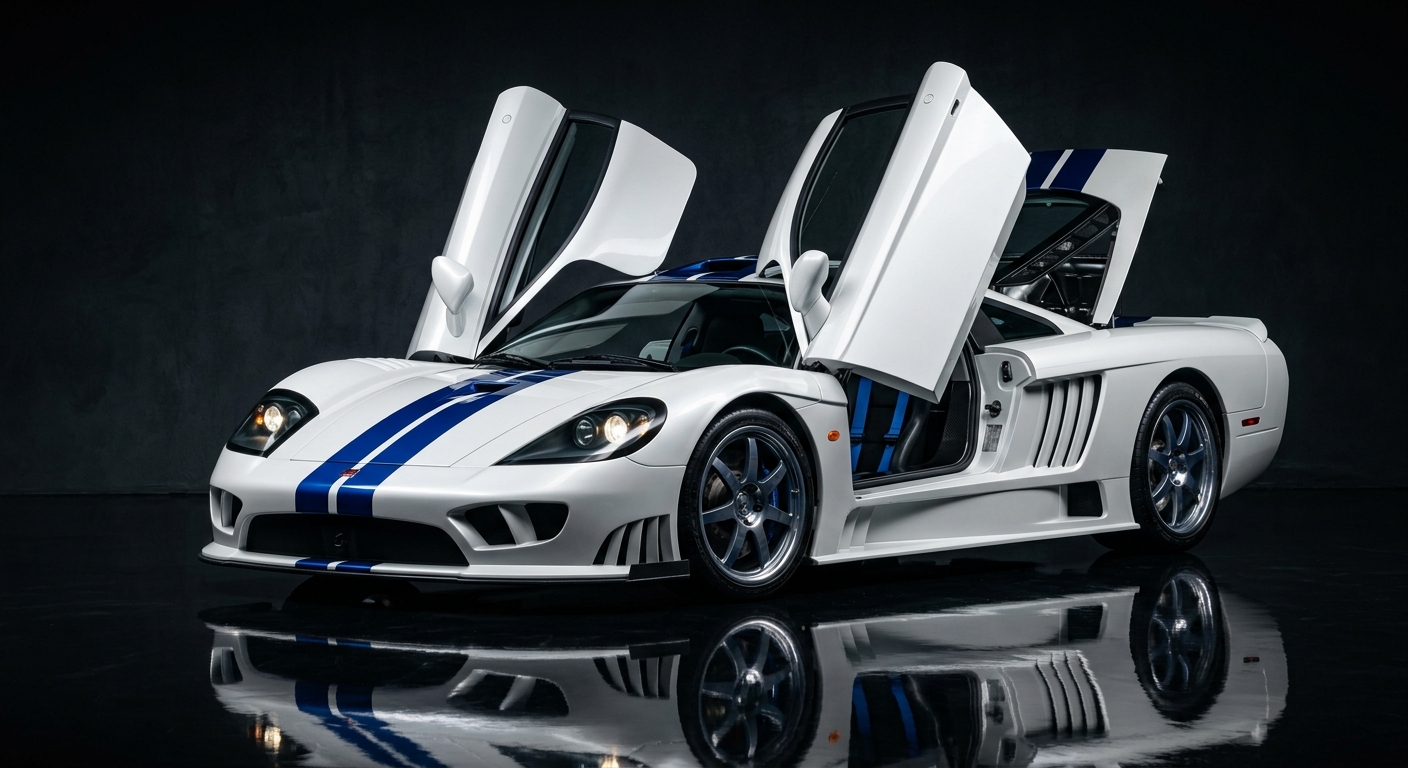
In 2004, while Europe’s supercar elite continued their centuries-old dance of refinement and tradition, a small American company in California was busy proving that sometimes the best approach is the most direct one. The Saleen S7 wasn’t just America’s answer to Ferrari and Lamborghini: it was a middle finger wrapped in carbon fiber, powered by pure American V8 fury.
Steve Saleen’s vision was beautifully simple: build a no-compromise racing car for the road, something that could embarrass the Europeans on their own turf while maintaining that distinctly American character of overwhelming power and unapologetic aggression. The result was a machine that looked like it escaped from Le Mans and sounded like thunder itself.
Raw Power, Pure Purpose
The S7’s heart is a naturally aspirated 7.0-liter Ford V8 that produces 550 horsepower and 525 lb-ft of torque. But numbers only tell part of the story. This isn’t the refined, high-revving scream of a European V12 or the turbo whoosh of a German flat-six. This is American muscle translated into supercar form: a deep, rumbling roar that builds to a thunderous crescendo as you approach the 6,500 rpm redline.
The engine sits behind the driver in true mid-engine fashion, its presence announced by the heat radiating through the cabin and the mechanical symphony that penetrates every conversation. This is drama you can feel in your chest, power you can smell in the air. It’s visceral in a way that modern supercars, with their sophisticated sound dampening and electronic refinement, simply cannot match.
Built for the Track, Barely Legal for the Street
Everything about the S7 screams racing pedigree. The carbon fiber monocoque chassis weighs just 2,750 pounds, creating a power-to-weight ratio that embarrasses cars costing twice as much. The suspension is fully adjustable, the aerodynamics are wind tunnel-tested, and the braking system could stop a freight train.
On the road, this racing DNA translates to an experience that’s equal parts exhilarating and exhausting. The steering is unassisted and heavy at low speeds, requiring real muscle to navigate parking lots. The suspension, even in its most compliant setting, transmits every imperfection in the pavement directly to your spine. The clutch is heavy, the throttle response is immediate and unforgiving, and the whole experience demands your complete attention.
But when you find the right road and the right moment to unleash the S7’s potential, everything makes sense. The acceleration is violent and intoxicating, launching you from 0-60 mph in just 3.8 seconds with a savagery that modern traction control systems have largely eliminated. The top speed of 200 mph feels entirely achievable, limited more by road length than mechanical capability.
American Ambition in Carbon Fiber
The S7’s design language speaks fluent aggression. Those massive air intakes aren’t styling exercises; they’re functional elements feeding a hungry engine and cooling system. The butterfly doors aren’t just for show; they’re the only practical way to enter and exit the low-slung cockpit. Every vent, wing, and curve serves a purpose, creating a form that follows function with stunning results.
Inside, the cabin is purposeful rather than luxurious. You sit low and surrounded by carbon fiber, with race-inspired seats that hold you firmly in place during aggressive driving. The controls are straightforward, the gauges are clear, and everything feels built to withstand serious use rather than impress passengers. This isn’t a grand tourer; it’s a weapon.
The Sound and the Fury
Perhaps more than any other element, it’s the S7’s soundtrack that defines the experience. The 7.0-liter V8 doesn’t just make noise; it creates an automotive opera that ranges from a burbling idle to a full-throated roar under acceleration. It’s a sound that announces your presence from blocks away and lingers in memory long after the car has passed.
This auditory assault is matched by the physical sensations of driving the S7. The steering wheel transmits every detail of the road surface, the throttle response is immediate and dramatic, and the whole car feels alive in a way that modern supercars, with their electronic intermediaries, struggle to match.
The Saleen S7 represents something increasingly rare in today’s automotive landscape: uncompromised vision realized without committee oversight or focus group approval. It’s brutally fast, impossibly loud, and utterly impractical for anything resembling normal use. In other words, it’s perfect exactly as it is, a reminder that sometimes the best approach to building a supercar is simply to build the fastest, most dramatic machine possible and let the rest sort itself out.