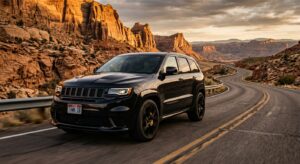
When Jeep decided to challenge the Chevy Tahoe and Ford Expedition in 2006, they didn’t just stretch a Grand Cherokee and call it a day. The Commander arrived as a bold statement of intent: a three-row SUV that looked like it could storm a beach or haul soccer teams with equal confidence. With its aggressive stance and trademark seven-slot grille, this was Jeep’s attempt to prove that utility didn’t have to mean boring.
The Commander represented Jeep’s biggest gamble in years, targeting families who needed space but refused to surrender their sense of adventure. Built on a stretched Grand Cherokee platform, it promised to deliver genuine off-road capability while providing seating for seven. The question was whether American families were ready for such an uncompromising approach to the three-row SUV segment.
Design Philosophy: Form Follows Function
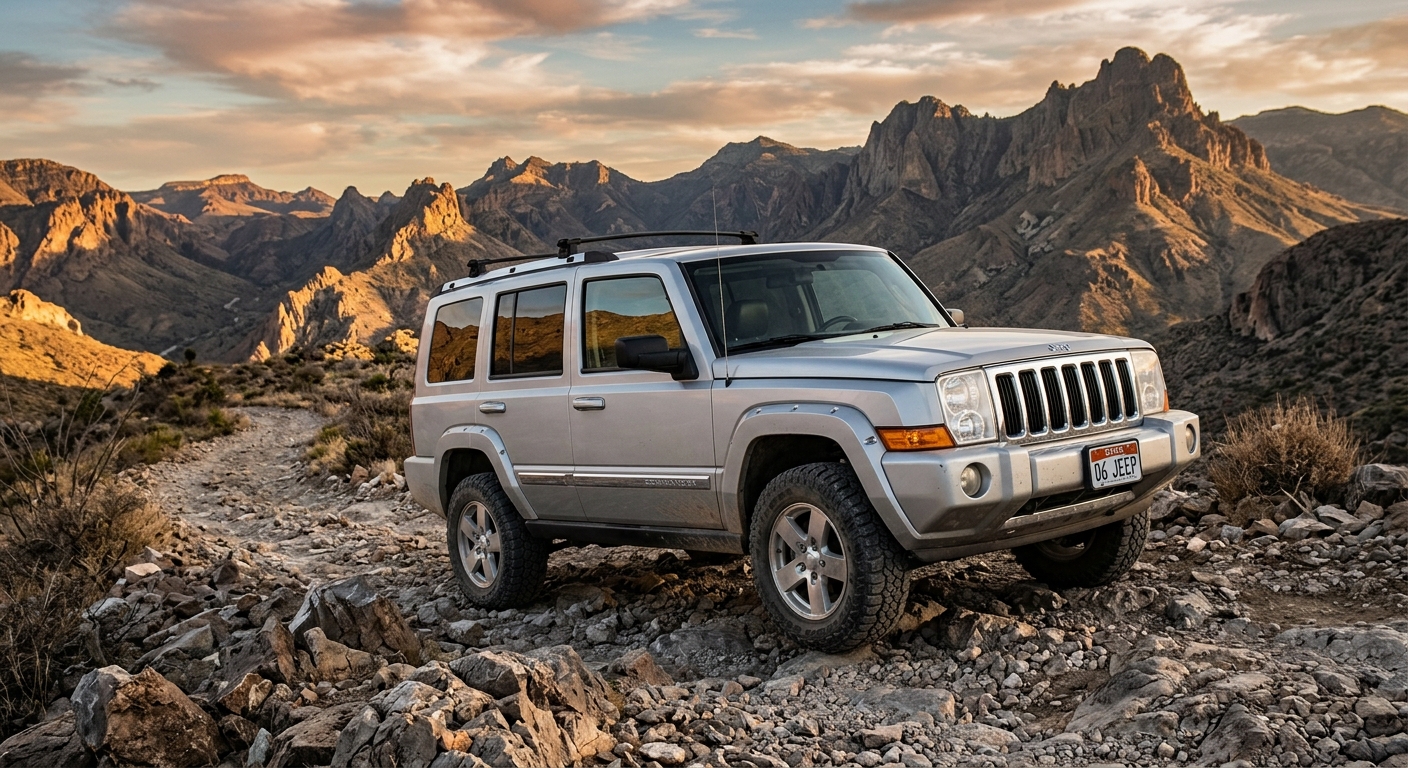
The Commander’s exterior design divided opinions from day one. Where competitors like the Honda Pilot and Toyota Highlander opted for smooth, car-like profiles, Jeep doubled down on truck-based aggression. The result was a vehicle that looked like it belonged on a military base as much as in a shopping mall parking lot.
The signature seven-slot grille dominated the front end, flanked by rectangular headlights that gave the Commander an almost menacing expression. The tall, upright greenhouse maximized interior space while maintaining Jeep’s traditional command seating position. Love it or hate it, the Commander’s design was unmistakably purposeful.
Interior Space and Practicality
Inside, the Commander delivered on its space promises. The first two rows offered generous room for adults, while the third row, though tight, could accommodate children or smaller adults in a pinch. The high seating position provided excellent outward visibility, and the upright architecture meant no one felt cramped in the vertical dimension.
Build quality varied throughout the cabin, with some hard plastics that felt appropriate for a work truck but less convincing in a family hauler. However, the logical control layout and robust feel of major components reinforced the Commander’s utilitarian character.
Performance: Hemi Power Meets Real-World Demands
The optional 5.7-liter Hemi V8 transformed the Commander from adequate to genuinely quick. With 330 horsepower on tap, this big SUV could hustle when needed, delivering satisfying acceleration that belied its 4,800-pound curb weight. The Hemi’s characteristic rumble provided an appropriate soundtrack for the Commander’s assertive personality.
The standard 3.7-liter V6, while adequate for light duty, struggled when fully loaded or faced with steep grades. Most buyers quickly discovered that the Hemi’s additional capability justified its premium, especially when towing became a regular requirement.
Off-Road Capability
Where the Commander truly distinguished itself was in genuine off-road scenarios. The available Quadra-Drive II system with electronic limited-slip differentials provided impressive traction in challenging terrain. Ground clearance and approach angles were genuinely truck-like, allowing the Commander to tackle trails that would strand most three-row competitors.
The solid rear axle, while compromising on-road refinement, delivered the durability and wheel articulation that serious off-roaders demanded. This was one of the few seven-seaters that could credibly claim real trail capability.
Daily Driving Reality
On pavement, the Commander’s truck-based architecture showed both strengths and weaknesses. The high driving position and commanding view of traffic were genuine assets, especially in urban environments. However, the live rear axle created a choppy ride quality over broken pavement, and the tall profile generated noticeable wind noise at highway speeds.
Fuel economy was predictably challenging, especially with the Hemi V8. EPA ratings of 13 city/19 highway reflected the Commander’s uncompromising approach to efficiency. In an era of rising fuel prices, this became an increasingly difficult sell to cost-conscious families.
The Commander represented Jeep at its most uncompromising, delivering genuine capability wrapped in an unapologetically bold package. While it never achieved the sales success of softer competitors, it proved that there was still room for honest utility in the three-row SUV segment. For families who needed space but refused to sacrifice their sense of adventure, the Commander offered a unique proposition that remains unmatched today.