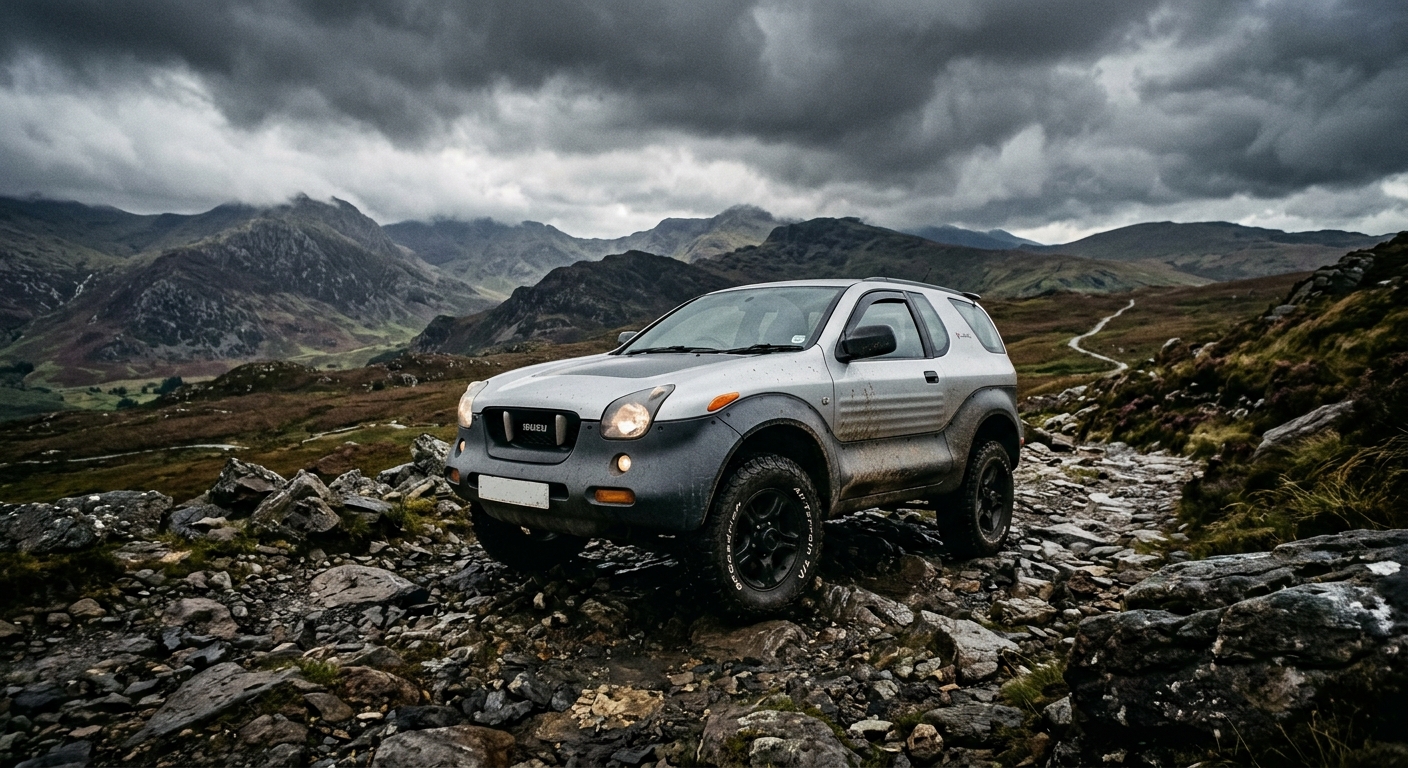
In the late 1990s, when SUV design played it safe with boxy utility or rounded family-friendliness, Isuzu decided to build something that looked like it had crash-landed from Mars. The VehiCROSS wasn’t just unusual, it was aggressively weird, combining concept car aesthetics with serious off-road hardware in a package that confused and delighted in equal measure.
What emerged was one of the automotive world’s most polarizing creations, a vehicle that either made you stop and stare in wonder or hurry past in bewilderment. Yet beneath that wild exterior lived the soul of a genuine off-road warrior.
Concept Car Reality
The VehiCROSS began life as a 1993 Tokyo Motor Show concept, a design study that nobody expected to see in showrooms. But Isuzu, perhaps in a moment of beautiful madness, decided to build it almost unchanged. The production version, launched in 1997 and continuing through 2001 in Japan with limited US sales from 1999-2001, retained the concept’s most distinctive elements.
The result was automotive origami in metal and plastic. Sharp creases ran everywhere, interrupted by bulging wheel arches wrapped in black cladding that looked like armor plating. The greenhouse was narrow and angular, giving occupants a tank-like view of the world. Chrome accents and body-colored panels broke up the visual mass, but nothing could disguise the fact that this SUV looked like nothing else on the road.
Serious Hardware Beneath the Styling
While the looks were purely conceptual, the mechanicals were pure Isuzu utility. The VehiCROSS shared its platform and running gear with the Trooper, meaning it inherited one of the most capable off-road chassis available. The 3.5-liter DOHC V6 produced 215 horsepower, adequate for the 4,000-pound curb weight and perfectly suited to the vehicle’s trail-conquering mission.
More importantly, the VehiCROSS featured Isuzu’s Torque-On-Demand four-wheel-drive system, which could automatically transfer power between front and rear axles as needed. Combined with generous ground clearance, short overhangs, and robust underbody protection, the VehiCROSS could tackle terrain that would humble more conventional SUVs.
The Driving Experience
On pavement, the VehiCROSS felt exactly like what it was: a capable off-roader with styling priorities that didn’t include aerodynamics. The upright seating position and narrow glass area created a unique driving environment, part spacecraft cockpit, part military vehicle. Visibility was compromised by the dramatic styling, but the commanding view forward helped offset the limited sight lines.
The V6 engine provided smooth, if not spectacular, acceleration. This wasn’t about straight-line speed; it was about capability and character. The four-speed automatic transmission was well-matched to the engine’s characteristics, though manual transmission enthusiasts were left wanting.
Where the VehiCROSS truly came alive was off the beaten path. The sophisticated four-wheel-drive system, combined with the vehicle’s excellent approach and departure angles, made it remarkably capable on challenging terrain. The narrow track, which looked odd on pavement, became an advantage on tight trails.
Living with Uniqueness
Daily life with a VehiCROSS required commitment to its unconventional nature. The two-door configuration and relatively small interior made it more lifestyle vehicle than practical family hauler. Rear seat access required athletic ability, and cargo space was limited compared to more conventional SUVs.
Reliability, thankfully, was typical Isuzu: solid and dependable. The mechanical components were proven in other applications, and the unusual styling elements were largely cosmetic rather than functional complications. Parts availability became an issue as Isuzu exited the US passenger vehicle market, but the mechanical similarities to the Trooper helped.
The VehiCROSS stands as proof that automotive diversity makes the world more interesting, even when the result challenges conventional wisdom. Its combination of concept car styling and genuine capability created something unique in a world of focus-grouped conformity. Today, clean examples command surprising money from collectors who appreciate its singular vision.