In the realm of 1990s supercars, few machines commanded attention quite like the Vector WX-3. Born from the mind of Gerald Wiegert, this angular predator represented America’s most radical interpretation of what a supercar could be, blending aerospace technology with uncompromising performance in a package that looked like it had rolled straight out of a classified military hangar.
The Stealth Fighter Philosophy
Vector Aeromotive Corporation didn’t build cars so much as they constructed ground-based aircraft. The WX-3, introduced in 1993, carried forward the company’s obsession with aerospace engineering and military-grade construction. Every surface angle, every material choice, and every technical specification reflected Wiegert’s conviction that supercars should be engineered like fighter jets.
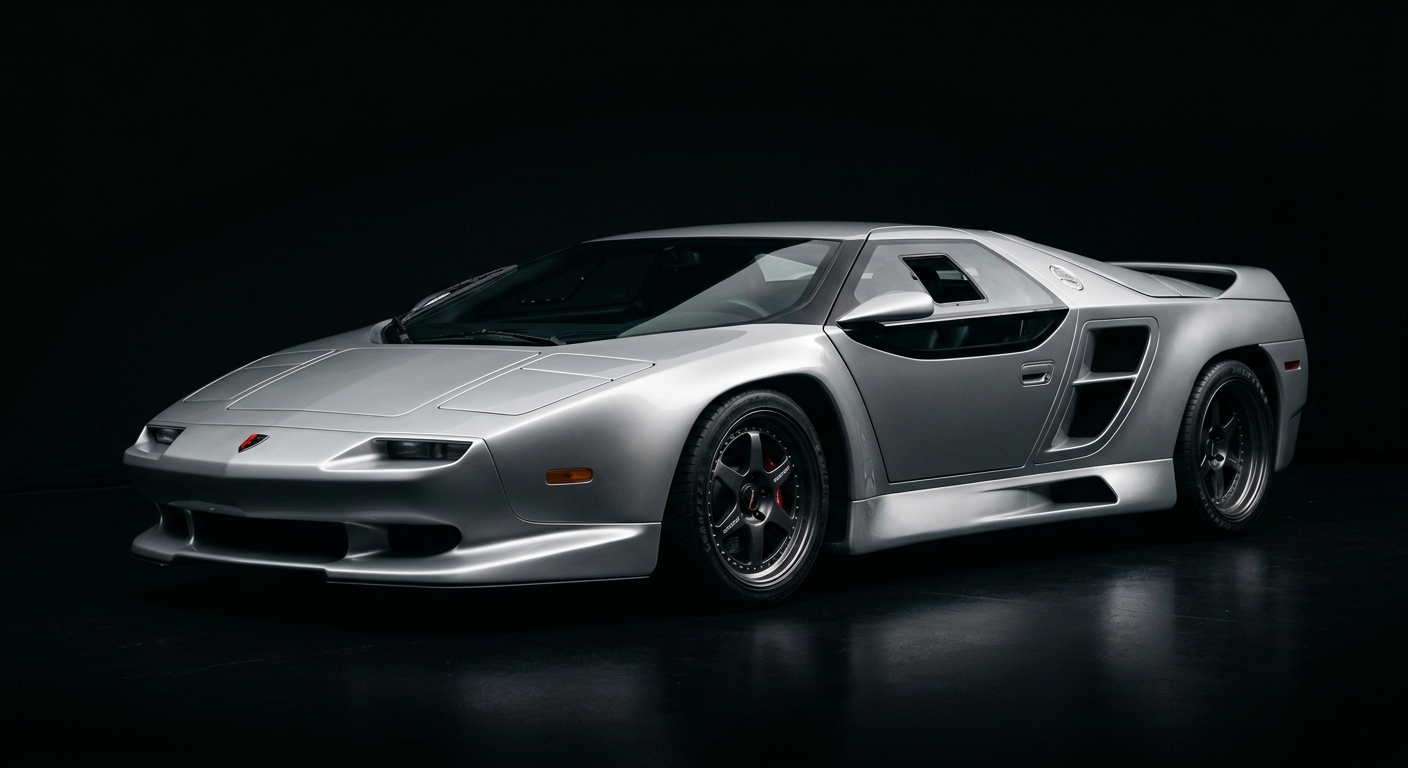
The WX-3’s silhouette remains one of the most aggressive ever penned. Its knife-edge nose cuts through air with surgical precision, while the dramatically raked windscreen and angular side glass create a cockpit that feels more like a fighter pilot’s office than a traditional car interior. The rear haunches flow into a truncated tail that houses twin exhaust outlets, each one capable of breathing fire when the twin-turbo V8 awakens.
Twin-Turbo Fury
Beneath the WX-3’s aerospace-inspired bodywork lurked a heavily modified Chevrolet V8, but calling it a simple small-block would be like calling the SR-71 Blackbird a simple airplane. Vector’s engineers subjected the 5.7-liter engine to extensive modifications, adding twin turbochargers, intercoolers, and enough additional hardware to push output to a claimed 625 horsepower.
The power delivery matched the car’s visual intensity. Unlike the smooth, linear acceleration of European exotics, the WX-3 delivered its performance with American brutality. The twin turbos spooled with audible urgency, and when boost pressure peaked, the acceleration felt more like a catapult launch than conventional automotive propulsion.
Aerospace Construction Methods
Vector’s commitment to aerospace technology extended far beyond marketing hyperbole. The WX-3’s chassis incorporated honeycomb aluminum construction techniques borrowed directly from aircraft manufacturing. Carbon fiber panels, aircraft-spec fasteners, and military-grade electrical systems created a car that felt fundamentally different from anything else on the road.
The interior continued this theme with toggle switches, digital displays, and control layouts that prioritized function over comfort. Drivers didn’t simply get in a Vector; they strapped into it like pilots preparing for combat missions. The driving position placed occupants low and forward, with excellent visibility over the angular nose but limited rearward vision through the narrow rear glass.
On the Edge of Sanity
Driving the WX-3 required commitment and respect. The car’s responses were immediate and unfiltered, with steering that transmitted every road surface irregularity directly to the driver’s hands. The suspension setup favored handling precision over comfort, creating a machine that felt alive and slightly dangerous at all times.
Performance numbers told only part of the story. While the WX-3 could theoretically reach over 200 mph and accelerate to 60 mph in under 4 seconds, the experience transcended mere statistics. This was a car that made every drive feel like a test flight, where the boundary between automotive transportation and aerospace vehicle dissolved completely.
Rarity and Legacy
Vector’s ambitious vision ultimately proved too extreme for mainstream success. Production numbers remained microscopic, with fewer than two dozen WX-3 examples ever completed. Each car represented thousands of hours of hand-assembly and custom fabrication, making them among the most exclusive supercars ever built.
Today, the WX-3 stands as perhaps the most uncompromising American supercar ever created. While other manufacturers chased European sophistication or Japanese reliability, Vector pursued a uniquely American vision of what extreme performance could look like when filtered through aerospace engineering and military-industrial aesthetics.
The Vector WX-3 remains automotive extremism in its purest form, a machine that prioritized uncompromising performance and aerospace aesthetics over comfort or practicality. While other supercars offered sophistication, Vector delivered raw American intensity that few drivers could fully exploit. For those seeking the most unfiltered driving experience money could buy, the WX-3 represented the ultimate expression of 1990s supercar excess.