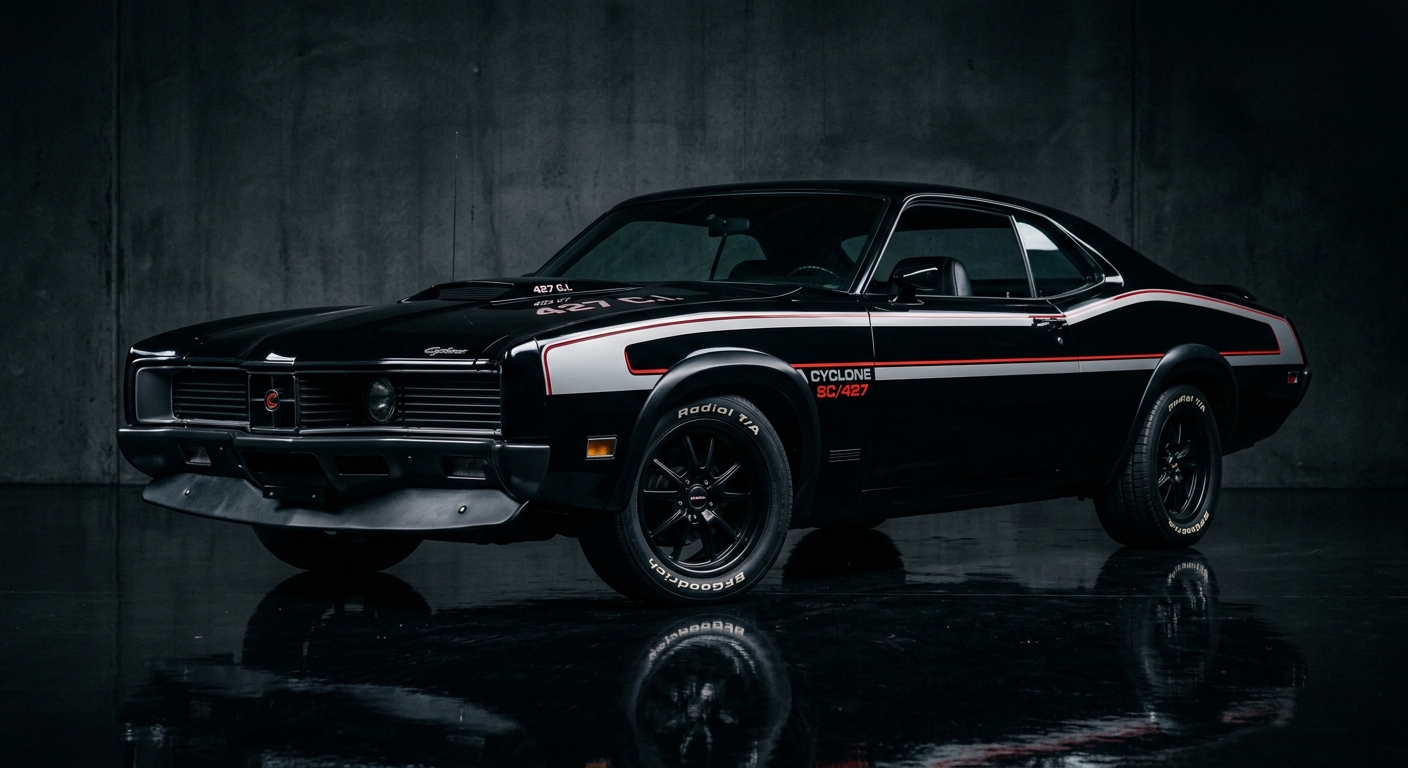
In 1991, when most American manufacturers had abandoned the muscle car formula in favor of efficiency and emissions compliance, a small company called Cyclone emerged with audacious plans to revive the glory days of tire-smoking V8 performance. The SC/427 represented everything the original muscle car era stood for: raw power, minimal electronics, and an unapologetic commitment to straight-line speed.
The Cyclone Story
Founded by former Ford engineers who had worked on the original Boss engines, Cyclone Automotive operated out of a modest facility in Michigan with the singular goal of creating authentic muscle cars for the modern era. The SC/427 was their flagship, built in extremely limited numbers using a combination of period-correct engineering and careful attention to the details that made classic muscle cars so compelling.
The 427 cubic inch V8 at the heart of the SC/427 was a masterpiece of old-school engineering. Built using traditional casting methods and featuring a solid lifter camshaft, dual-plane intake manifold, and Holley four-barrel carburetor, it produced a thunderous 485 horsepower and 520 lb-ft of torque. This was power delivered in the most visceral way possible, with none of the electronic intervention that was beginning to creep into performance cars of the early 1990s.
Driving Experience
Behind the wheel, the SC/427 feels like a time machine back to 1969. The steering is heavy and direct, requiring real effort at parking lot speeds but communicating every nuance of the road surface once you’re moving. The clutch pedal demands commitment, and the four-speed manual transmission shifts with the mechanical precision of a rifle bolt.
Fire up the 427 and the idle immediately announces this car’s intentions. The cam profile creates a lumpy, aggressive rhythm that vibrates through the entire chassis. Under acceleration, the SC/427 transforms into something primal. The rear wheels break loose with minimal provocation, and keeping the car pointed straight requires constant attention and respect for the enormous torque being delivered to the pavement.
What makes the SC/427 special isn’t just its power, but how that power is delivered. There’s no lag, no waiting for turbos to spool or computers to calculate optimal timing. Mash the throttle and 485 horses respond instantly, launching the car forward with a violence that modern performance cars, for all their sophistication, struggle to match in terms of pure visceral impact.
Design and Construction
Cyclone based the SC/427 on a custom chassis that borrowed heavily from classic muscle car proportions while incorporating modern safety improvements. The bodywork, crafted from fiberglass for weight savings, featured aggressive flares to accommodate the wide rear tires necessary to put the power down. The interior was purposefully spartan, with bucket seats, a four-point roll bar, and instrumentation focused entirely on the essentials: speed, RPM, oil pressure, and water temperature.
Only 147 examples of the SC/427 were ever built before Cyclone ceased operations in 1993. Financial constraints and increasingly strict emissions regulations made it impossible for the small company to continue, but their brief existence produced one of the most authentic muscle car experiences available in the 1990s.
The Cyclone SC/427 represents muscle car purity distilled to its absolute essence, a final hurrah for an era when horsepower was king and subtlety was for import cars. With only 147 ever built, finding one today is like discovering automotive archaeology, but for those lucky enough to experience the SC/427, it delivers an uncompromising reminder of what made the muscle car era so intoxicating. This is American performance at its most elemental and unforgettable.