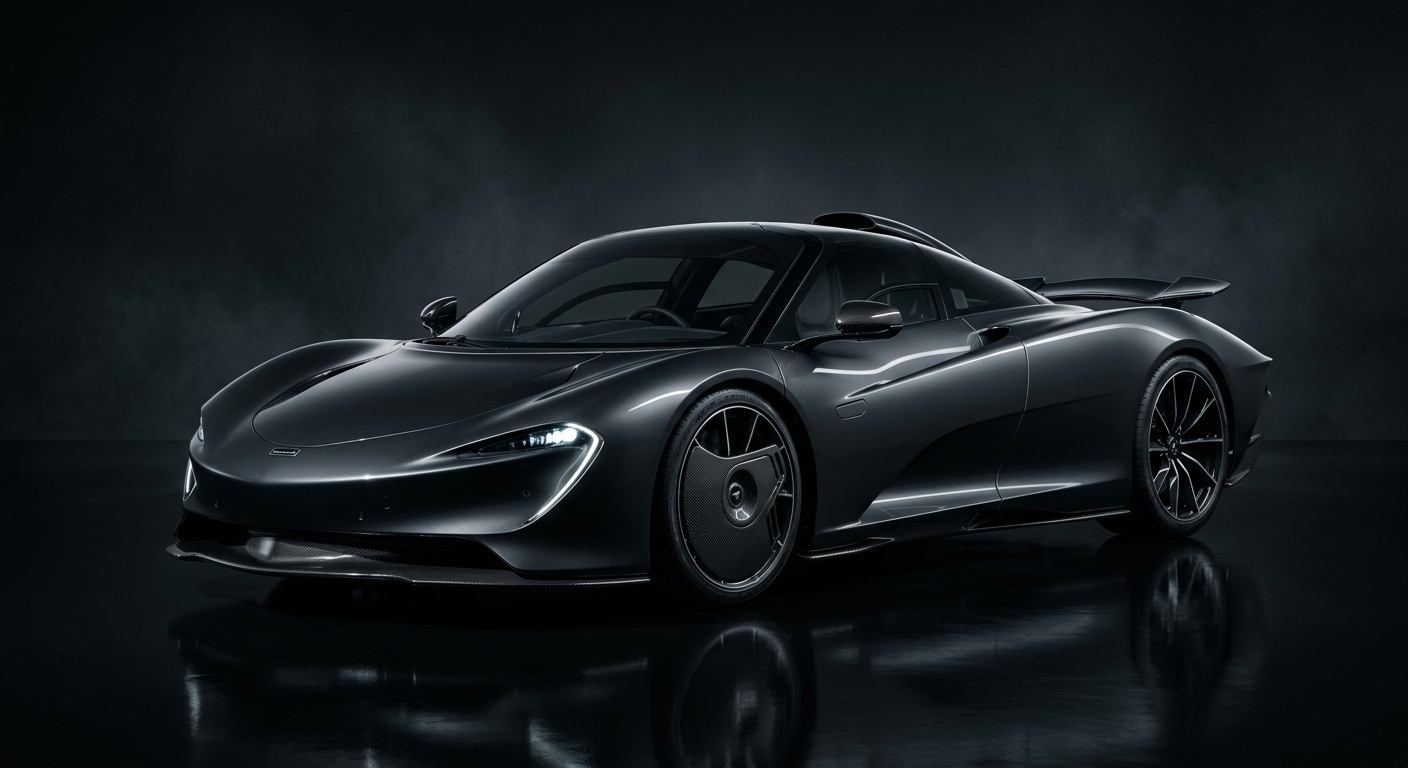
In the world of hypercars, aerodynamic efficiency usually takes a backseat to raw aggression and visual drama. The McLaren Speedtail flips this convention on its head, presenting a shape so pure and purposeful it appears to have been carved by the wind itself. This is McLaren’s vision of the ultimate grand tourer, where 250mph capability meets three-seat luxury in a package that redefines what a hypercar can be.
Form Follows Function
The Speedtail’s teardrop profile isn’t just beautiful, it’s scientifically perfect. McLaren’s aerodynamicists spent countless hours in wind tunnels crafting a shape that slices through air with minimal disturbance. Every curve serves a purpose, from the elongated nose that channels airflow around the cockpit to the distinctive tail that tapers to almost nothing, minimizing wake turbulence.
But this isn’t merely an exercise in wind-cheating. The Speedtail represents McLaren’s most luxurious creation, featuring a three-seat configuration with the driver positioned centrally, flanked by two passenger seats. Carbon fiber construction keeps weight to a minimum while providing the structural rigidity necessary for such extreme performance.
Hybrid Hypercar Excellence
At the heart of the Speedtail lies a sophisticated hybrid powertrain combining McLaren’s twin-turbo V8 with an electric motor system. The result is a combined output of 1,035 horsepower, channeled through the rear wheels via an eight-speed dual-clutch transmission. This isn’t just about straight-line speed, though the Speedtail’s 250mph top speed certainly makes a statement.
The electric assistance provides instant torque fill, eliminating turbo lag and delivering seamless acceleration from any speed. In electric mode, the Speedtail can operate in near silence, transforming from hypercar to luxury cruiser at the touch of a button. This duality defines the car’s character: brutal performance when demanded, refined comfort when desired.
Technology and Craftsmanship
Inside the Speedtail, technology and luxury merge seamlessly. The central driving position offers an unparalleled connection to the road, while the passenger seats provide a unique shared experience of extreme performance. Carbon fiber construction extends throughout the interior, complemented by the finest leather and metalwork.
Advanced aerodynamics extend beyond the body shape. Active aero elements adjust automatically to optimize either high-speed stability or efficiency, while the sophisticated suspension system adapts to driving conditions in real-time. Every system works in harmony to deliver an experience that’s both visceral and refined.
Driving the Future
On the road, the Speedtail feels like nothing else. The central seating position provides perfect balance and an unobstructed view forward, while the hybrid powertrain delivers acceleration that feels almost violent in its intensity. Yet this is also a car capable of covering continents in supreme comfort, its aerodynamic efficiency translating to remarkable stability at any legal speed.
The steering communicates every nuance of the road surface, while the brakes provide stopping power worthy of the performance on offer. This is a hypercar that doesn’t punish its occupants, instead offering a glimpse into a future where extreme performance and everyday usability need not be mutually exclusive.
The Speedtail isn’t just McLaren’s fastest road car, it’s a statement about the future of hypercars where aerodynamic perfection meets hybrid efficiency. With only 106 examples built, this is exclusivity with a purpose, delivering an experience that’s both brutally fast and surprisingly refined.