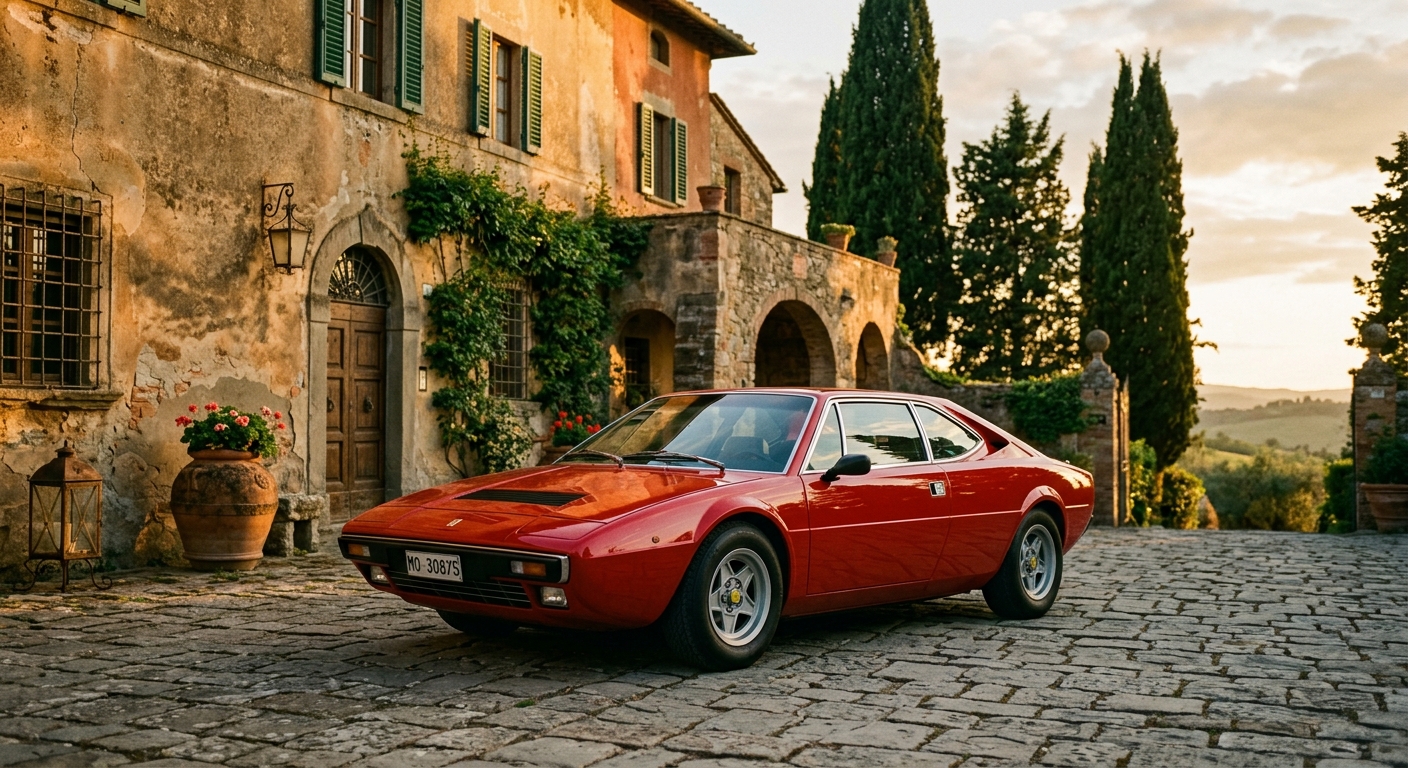
In the pantheon of Ferrari history, few cars have been as misunderstood upon arrival yet as prophetic in hindsight as the 1975 Dino 308 GT4. This angular, Bertone-designed 2+2 introduced Ferrari’s legendary V8 bloodline to the world, though it would take decades for enthusiasts to fully appreciate its significance. What seemed like a departure from Ferrari’s curvaceous tradition was actually the foundation stone of the company’s most successful era.
The Revolutionary V8
Beneath the GT4’s controversial wedge shape beats the heart that would define Ferrari for generations: the 2,926cc V8 that started it all. This wasn’t just any V8, but a masterpiece of engineering that would evolve into the powerplant behind icons like the 308 GTB, F355, and eventually the 458 Italia. In 1975 specification, it produced 255 horsepower, delivered through a distinctive exhaust note that was both more civilized and more urgent than Ferrari’s traditional V12s.
The engine’s compact dimensions allowed for a lower hood line and better weight distribution, fundamentals that would prove crucial to Ferrari’s future mid-engine designs. Behind the driver, the V8 breathes through four Weber carburetors, creating a symphony of mechanical music that announces its presence with authority.
Bertone’s Bold Vision
Marcello Gandini’s design for the 308 GT4 was nothing if not brave. Where previous Ferraris flowed with organic curves, the GT4 cut through air with sharp edges and geometric precision. The result was polarizing: purists dismissed it as too angular, too Germanic, too un-Ferrari. Yet time has revealed the genius in Gandini’s approach. The design was aerodynamically efficient, structurally sound, and unmistakably modern.
The interior reflects similar forward-thinking, with clean lines and functional ergonomics that prioritized the driver experience. The 2+2 configuration was controversial among Ferrari traditionalists, but it made the car more practical for real-world ownership while maintaining the essential mid-engine dynamics that define a proper sports car.
Driving the Foundation
Behind the wheel, the 308 GT4 reveals why it became the template for Ferrari’s future. The steering is precise and communicative, feeding back every detail of the road surface. The V8’s power delivery is progressive and predictable, making it more accessible than the sometimes explosive V12s of the era. This was Ferrari’s first attempt at building a supercar that mere mortals could drive quickly without fear.
The suspension strikes a balance between comfort and control that was revolutionary for Ferrari. While still firm by modern standards, the GT4 could handle daily driving duties while maintaining the sharp reflexes expected of a Maranello creation. The five-speed manual transmission requires technique but rewards smooth operation with satisfying mechanical precision.
Historical Significance
The 308 GT4’s importance extends far beyond its own production run of 2,826 units. It established the architectural and philosophical foundation for Ferrari’s most successful period. Every V8 Ferrari that followed, from the beloved 308 GTB to the track-focused F430 Scuderia, owes its existence to the lessons learned with the GT4.
Perhaps more importantly, the GT4 proved that Ferrari could evolve without losing its soul. The angular styling that seemed so foreign in 1975 now appears prophetic, predicting the geometric precision of modern supercars. The practical 2+2 layout demonstrated that Ferrari could expand its appeal without diluting its performance credentials.
The 308 GT4 stands as proof that revolutionary cars are rarely appreciated in their own time. What seemed like heresy in 1975 now appears as prophecy, and the car that launched Ferrari’s V8 dynasty deserves recognition as one of the most important Ferraris ever built. For collectors seeking significance over flash, few classic Ferraris offer more substance per dollar.