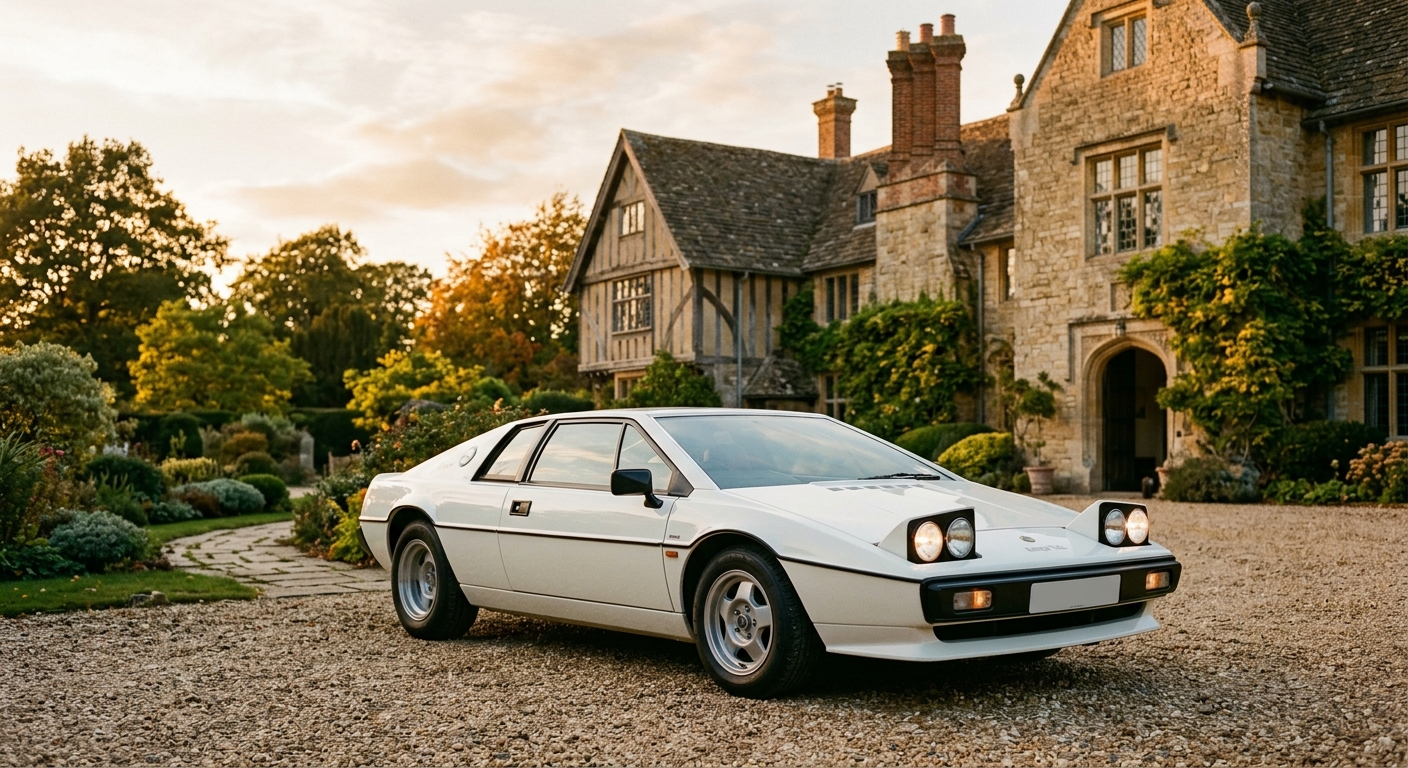
In an era when most supercars still clung to flowing curves and classical proportions, Lotus shocked the automotive world with something that looked like it had been folded from paper by a master origamist. The Esprit S1, penned by Giorgetto Giugiaro at the height of his creative powers, didn’t just break the mold: it shattered it into a thousand angular fragments and reassembled them into automotive art.
The Wedge That Changed Everything
When the Esprit debuted in 1976, its radical geometry made every other supercar look positively baroque. This wasn’t evolution; it was revolution with a steering wheel. Giugiaro’s design language spoke in sharp consonants where others used flowing vowels, creating a visual tension that made the car appear to be moving even when stationary.
The 1978 S1 represents the purest expression of this vision, before practicality forced compromises on later models. Every surface serves a purpose, every line has intent. The nose cuts through air like a blade, while the rear haunches suggest coiled power waiting to be unleashed.
Lotus Engineering Philosophy in Action
Colin Chapman’s famous dictum to “add lightness” found perfect expression in the Esprit’s construction. The fiberglass body, while challenging to manufacture consistently, delivered supercar performance from relatively modest power figures. At just 2,200 pounds, the S1 could embarrass cars with twice its horsepower through corners that left heavyweight exotics wallowing.
The backbone chassis, a Lotus specialty, provided exceptional rigidity while keeping weight minimal. This wasn’t just about straight-line performance: this was about creating a car that rewarded skill and punished arrogance in equal measure.
The Driving Experience
Behind the wheel of an Esprit S1, you’re not so much driving as conducting a mechanical orchestra. The 2.0-liter four-cylinder Lotus 907 engine may lack the symphonic complexity of a Ferrari V8, but it delivers its power with surgical precision. The five-speed manual transmission requires deliberate inputs, rewarding smooth technique with crisp, positive shifts.
The steering, unassisted and direct, telegraphs every nuance of the road surface to your fingertips. Modern drivers accustomed to electronic intervention might find this level of mechanical intimacy overwhelming, but those who adapt discover a connection between man and machine that’s increasingly rare in today’s digital age.
Cultural Impact and Legacy
The Esprit’s cultural significance extends far beyond its mechanical achievements. When Roger Moore piloted the submarine version in “The Spy Who Loved Me,” the car achieved immortality that no amount of advertising could have purchased. Suddenly, every schoolboy’s bedroom wall needed an Esprit poster alongside their Ferrari Countach.
Yet the S1’s influence on automotive design proved more lasting than its Hollywood fame. The wedge aesthetic it pioneered influenced everything from the DeLorean DMC-12 to modern supercars that still employ angular design languages today. Giugiaro’s vision didn’t just create a car; it created a visual vocabulary that designers still reference decades later.
The Esprit S1 represents automotive design at its most uncompromising: a pure expression of form following function, wrapped in bodywork that still looks futuristic nearly five decades later. It’s not the fastest classic supercar you can buy, nor the most practical, but it might just be the most visually striking. In a world of increasingly homogenized supercars, Giugiaro’s angular masterpiece remains a reminder that true automotive art requires the courage to be different.