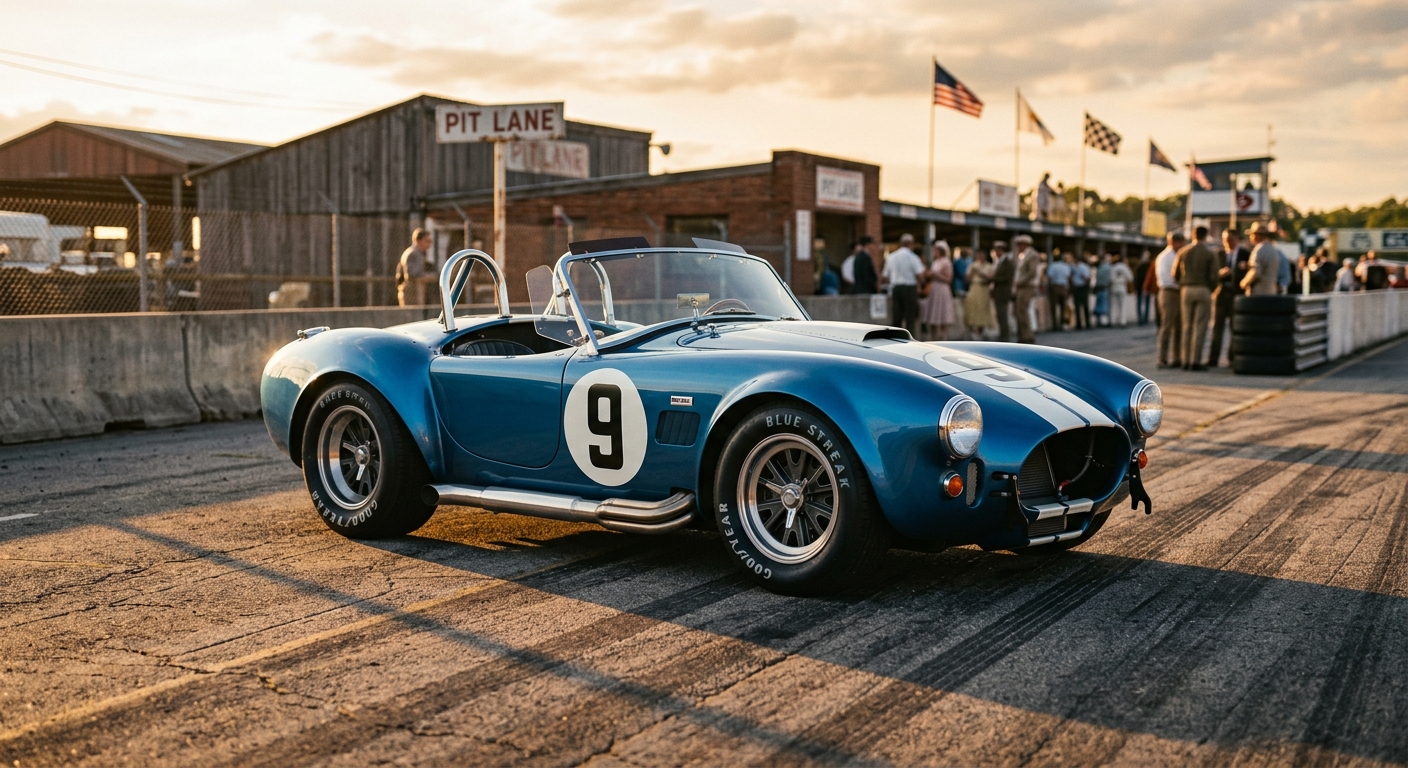
In 1965, Carroll Shelby unleashed something truly terrifying upon the world: the Cobra 427 SC, a car so viscerally powerful and brutally honest that it rewrote the rules of American performance. This wasn’t just another muscle car; it was a barely civilized racing machine that happened to be street legal. With its massive 427 cubic-inch big block V8 crammed into a lightweight British roadster body, the 427 SC represented the pinnacle of Shelby’s mad scientist approach to automotive engineering.
The Birth of a Legend
The Cobra story began with Carroll Shelby’s vision to combine American V8 power with European handling finesse. By 1965, the original 289 Cobra had already established itself as a formidable competitor, but Shelby wanted more. The introduction of the 427 big block created a monster that could embarrass Ferraris and Corvettes with equal ease. The “SC” designation stood for “Semi Competition,” though in reality, there was nothing semi about this car’s performance capabilities.
Only 348 street-legal 427 SCs were ever produced, making each one a precious artifact of American automotive history. The car’s development was driven by Shelby’s racing program, where lessons learned on tracks like Le Mans and Daytona were directly applied to the street version. This racing pedigree wasn’t just marketing speak; it was evident in every aspect of the car’s design and performance.
Engineering Brutality
The heart of the 427 SC was Ford’s legendary 427 cubic-inch V8, producing approximately 425 horsepower in street tune. This massive engine, originally developed for NASCAR competition, was squeezed into the Cobra’s compact AC Ace-derived chassis with minimal concessions to comfort or refinement. The result was a power-to-weight ratio that remained unmatched for decades.
The chassis itself was a work of functional art, featuring a ladder-frame construction with massive 4-inch diameter main rails. The suspension used unequal-length A-arms front and rear, with coil springs and tube shocks. Massive Girling disc brakes at all four corners provided stopping power that was revolutionary for its time, though still barely adequate for the car’s tremendous acceleration capabilities.
The Driving Experience
Driving a 427 SC was, and remains, an exercise in controlled terror. The car would launch from standstill to 60 mph in just 4.2 seconds, a figure that was simply staggering in 1965. The steering was heavy but precise, requiring real physical strength to manage at low speeds but coming alive with feedback once the car was in motion.
The 427’s torque curve was virtually flat from 2,000 rpm onward, meaning that sudden throttle applications could break the rear wheels loose at almost any speed. This wasn’t a car for the faint of heart or the inexperienced driver. It demanded respect and rewarded skill, but punished mistakes with potentially lethal consequences.
The exhaust note was nothing short of apocalyptic. The side-mounted pipes delivered an uncorked big block symphony that could be heard for miles. Inside the cockpit, the sound was overwhelming, contributing to the car’s reputation as a sensory overload machine. The heat from those side pipes also made the cabin uncomfortably warm, adding to the car’s uncompromising character.
Racing Heritage and Legacy
The 427 SC’s racing credentials were impeccable. Cobras dominated SCCA competition throughout the mid-1960s, and the 427’s additional power made it nearly unbeatable in the right hands. The car’s success on the track translated directly to its street credibility, establishing the Cobra as the ultimate American performance car of its era.
Today, original 427 SCs are among the most valuable American classics ever built, with pristine examples commanding seven-figure prices. The car’s influence extends far beyond its production numbers, inspiring countless replicas and establishing the template for the American sports car: maximum power, minimal weight, and an uncompromising focus on performance above all else.
The 1965 Cobra 427 SC remains the ultimate expression of American automotive excess, a car that prioritized raw performance above all else. It’s a machine that demands respect, rewards skill, and punishes complacency with equal measure. For those seeking the purest, most visceral driving experience ever offered in a street car, nothing else comes close to the terrifying brilliance of Shelby’s masterpiece.