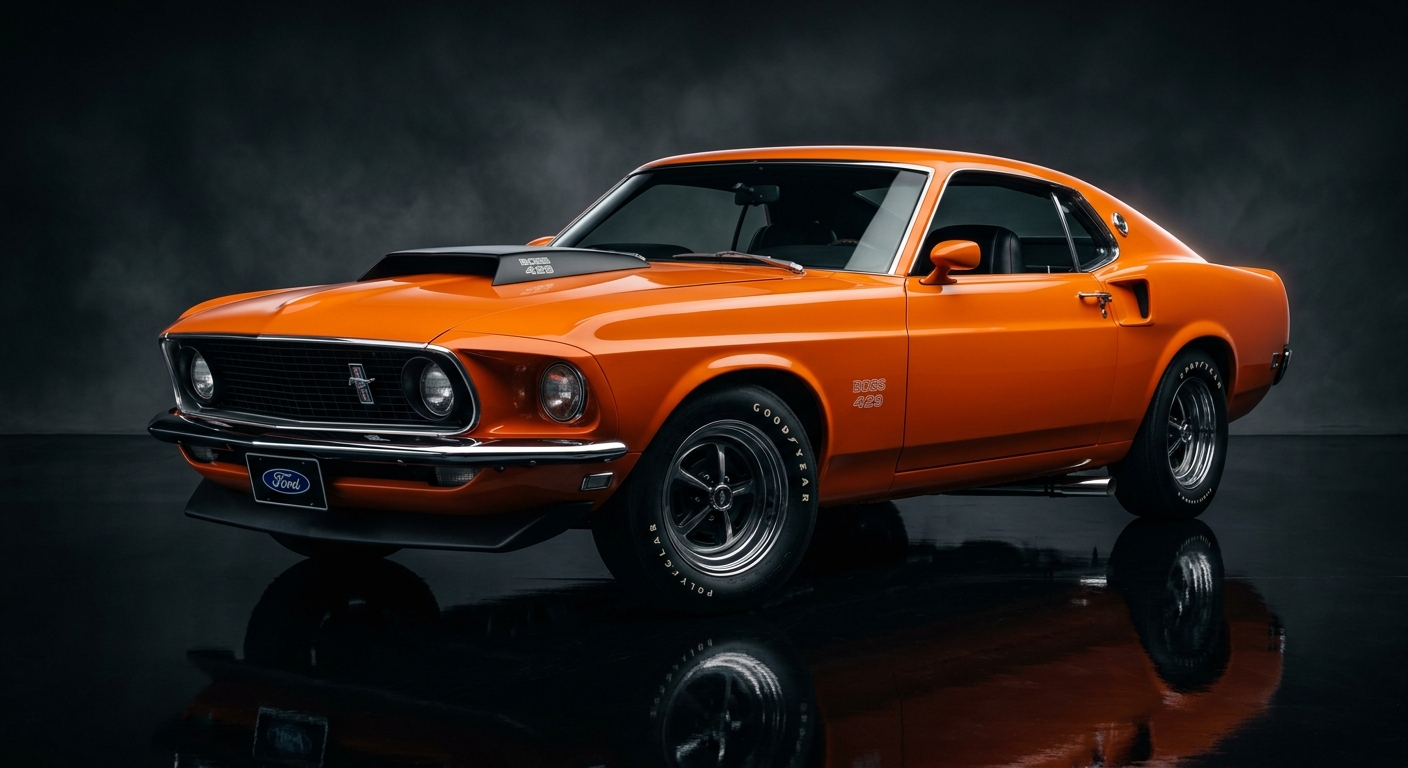
In 1969, Ford needed to homologate their massive 429 cubic inch Semi-Hemi engine for NASCAR competition. The solution was typically American: stuff the biggest, baddest motor they had into their most popular pony car and sell just enough to meet racing requirements. The result was the Boss 429, a machine so potent it redefined what a factory Mustang could be.
The Heart of Darkness
The Boss 429’s engine wasn’t just big, it was revolutionary. Ford’s 429 Semi-Hemi featured crescent-shaped combustion chambers and canted valves that allowed for massive airflow. With forged internals, solid lifters, and an aggressive cam profile, this motor was built for war. Ford rated it conservatively at 375 horsepower, but dyno testing revealed the true output was closer to 500 horsepower at the flywheel.
The engine was so large that extensive modifications were required to fit it in the Mustang’s engine bay. The shock towers had to be relocated, the inner fenders were extensively reworked, and even the battery had to be moved to the trunk. Kar Kraft, Ford’s specialty vehicle contractor, performed these modifications by hand, making each Boss 429 a semi-custom creation.
Built for Business
Behind the wheel, the Boss 429 was an intimidating experience. The hydraulic cam meant it idled roughly, shaking the entire car at a stop. The heavy clutch required serious leg strength, and the close-ratio four-speed demanded attention in traffic. This wasn’t a car for casual cruising; it was a purpose-built weapon that happened to be street legal.
Once rolling, the Boss 429 transformed into something otherworldly. The torque hit like a freight train, and the sound from the dual exhausts was nothing short of apocalyptic. Quarter-mile times in the high 13s were achievable with minimal modifications, making it one of the fastest production cars of the muscle car era.
Suspension and Handling
Ford equipped the Boss 429 with heavy-duty suspension components including staggered rear shocks, a front stabilizer bar, and Magnum 500 wheels wrapped in F70-14 Wide Oval tires. The suspension was tuned for straight-line stability rather than cornering prowess, reflecting the car’s drag strip DNA.
Limited Production Legend
Only 1,359 Boss 429 Mustangs were produced across 1969 and 1970, making them among the rarest and most valuable muscle cars today. Each car was hand-assembled by Kar Kraft in Brighton, Michigan, and featured unique identification numbers and documentation. The low production numbers were intentional, as Ford only needed to build enough cars to satisfy NASCAR’s homologation requirements.
Today, survivors command astronomical prices at auction, with pristine examples selling for over $200,000. The combination of rarity, NASCAR pedigree, and brutal performance has made the Boss 429 the holy grail of Mustang collecting.
The Boss 429 represents the absolute peak of muscle car excess, a machine built without compromise for pure, devastating performance. It’s an automotive time capsule that reminds us when manufacturers would go to extraordinary lengths just to go racing. For collectors lucky enough to own one, they possess not just a car, but a piece of American automotive mythology.