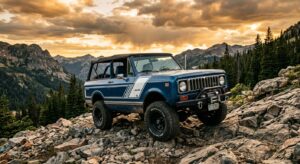
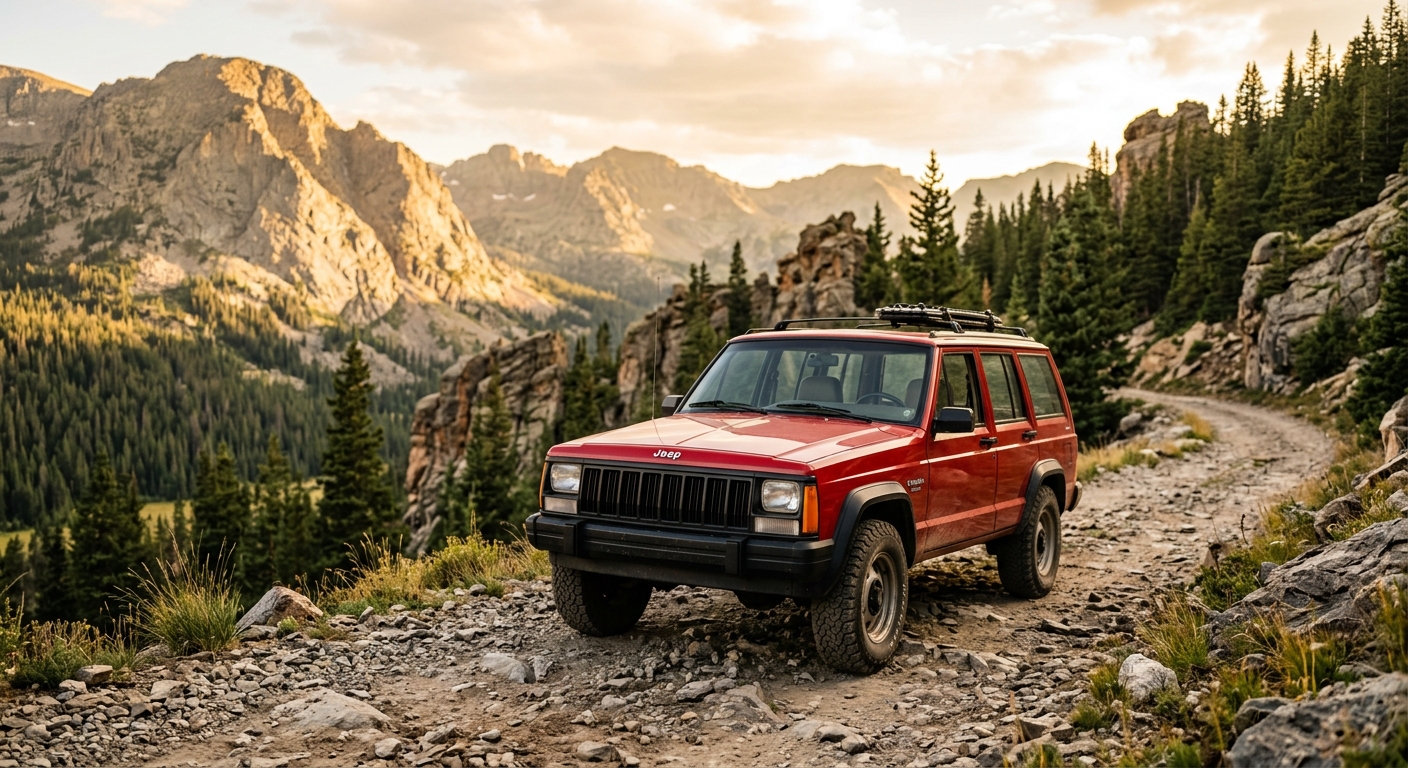
Long before every suburban driveway hosted a compact crossover, there was the Cherokee XJ. This boxy, no-nonsense SUV didn’t just define a segment, it created one entirely. Between 1984 and 2001, Jeep’s revolutionary unibody compact SUV proved that you could have genuine off-road capability without the bulk and thirst of a full-size truck.
Revolutionary Construction
What made the Cherokee XJ truly groundbreaking wasn’t its looks, though those clean lines have aged remarkably well. It was what you couldn’t see that mattered. While traditional SUVs rode on separate truck frames, the Cherokee pioneered unibody construction for serious off-roaders. This meant better on-road manners, improved fuel economy, and a lower center of gravity, all without sacrificing the ruggedness Jeep buyers demanded.
The result was a vehicle that could navigate narrow city streets during the week and tackle the Rubicon Trail on weekends. By 1992, the Cherokee had established itself as the thinking person’s SUV, offering genuine capability in a package that didn’t require a commercial driver’s license to park.
Heart of Gold
Under the Cherokee’s angular hood lay one of the most reliable engines ever produced: the 4.0-liter inline-six. This powerplant, refined over decades of use, delivered 190 horsepower and 225 lb-ft of torque with legendary durability. It wasn’t particularly smooth or sophisticated, but it was nearly indestructible. Many Cherokee owners report odometers rolling past 300,000 miles with nothing more than routine maintenance.
The 4.0-liter’s torque curve was perfectly suited to SUV duty, delivering strong low-end grunt for towing and off-road work. Paired with either a five-speed manual or four-speed automatic, it provided adequate performance for its era while maintaining respectable fuel economy for such a capable machine.
Capability That Actually Worked
Where the Cherokee truly excelled was off the beaten path. The available Quadra-Trac and Command-Trac four-wheel-drive systems offered genuine trail capability. Ground clearance was generous, approach and departure angles were excellent, and the solid rear axle provided the articulation needed for serious rock crawling.
Yet unlike many off-road specialists, the Cherokee remained civilized on pavement. The unibody construction provided better ride quality than body-on-frame competitors, while the compact dimensions made it genuinely useful as a daily driver. This combination of capability and livability would become the template for every compact SUV that followed.
Practical Perfection
Inside, the Cherokee prioritized function over flash. The dashboard was straightforward and durable, with controls that made sense even with gloved hands. Rear seat space was adequate for adults on short trips, generous for children. The cargo area, while not enormous, was well-shaped and featured a low load floor that made loading heavy items manageable.
Build quality was typical of Chrysler in the early 1990s, which meant some corners were cut in pursuit of affordability. Interior materials were basic, and electrical gremlins occasionally surfaced. But the fundamental bones of the Cherokee were sound, and most issues were easily remedied by any competent mechanic.
Cultural Impact
The Cherokee XJ arrived just as American families were discovering they wanted the commanding view and security of an SUV without the penalty of truck-based construction. It hit the sweet spot perfectly, offering enough capability to feel genuinely rugged while remaining practical for everyday use.
This formula proved so successful that it spawned an entire industry. Every compact crossover on the road today owes a debt to the Cherokee XJ, which proved the market existed for right-sized SUVs that could handle both school runs and camping trips with equal aplomb.
The Cherokee XJ wasn’t the fastest, prettiest, or most luxurious SUV of its era, but it was unquestionably the most influential. It proved that Americans wanted capable, right-sized SUVs that could handle both suburban duties and weekend adventures without compromise. Every crossover in your neighborhood owes its existence to this boxy pioneer.