In 1971, Lamborghini unveiled a concept car so radical, so utterly alien, that it redefined what a supercar could look like. Five years later, the production Countach LP400 arrived to fulfill that impossible promise. This wasn’t just a car; it was a vision of the future wrapped in impossibly sharp Italian steel.
The Birth of the Wedge
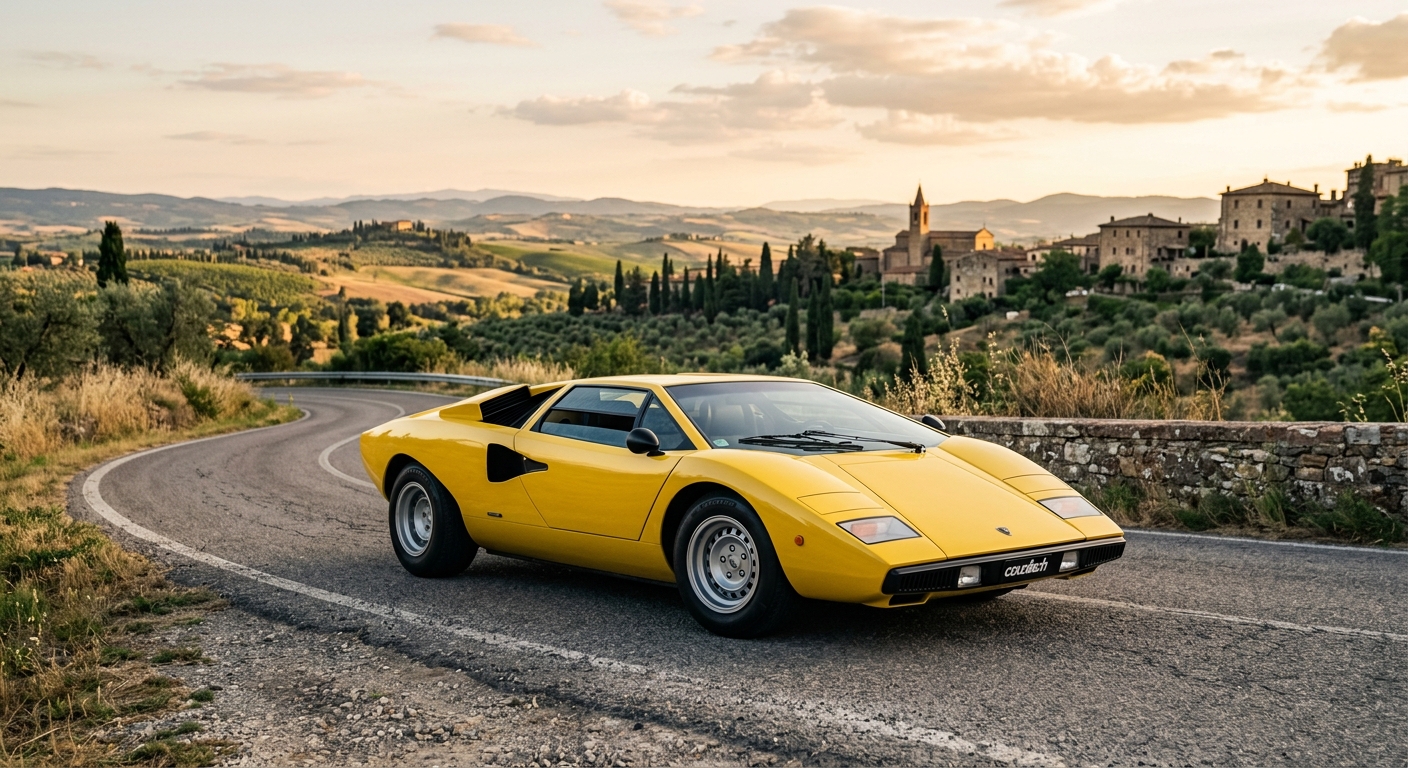
Marcello Gandini’s design for Bertone was nothing short of revolutionary. Where Ferrari’s cars flowed with sensual curves, the Countach attacked the air with geometric precision. Its knife-edge profile, standing just 42 inches tall, looked like it had been carved from a single block of aluminum by someone who understood that straight lines could be more seductive than curves.
The name itself came from a Piedmontese exclamation of astonishment, roughly equivalent to “wow” or something considerably more colorful. It was the reaction of everyone who first laid eyes on this automotive spaceship, and it remains appropriate nearly five decades later.
The V12 Symphony
Behind the driver sits Lamborghini’s 3.9-liter V12, a naturally aspirated masterpiece that produces 375 horsepower. In the context of the mid-1970s, this was staggering power. The engine breathes through six Weber carburetors, creating a soundtrack that begins as a whisper at idle and builds to an operatic crescendo at 7,000 rpm.
The driving experience is pure and unfiltered. There’s no power steering, no electronic aids, just you, the steering wheel, and 375 horses waiting to be unleashed. The clutch is heavy, the gear change requires commitment, and the throttle response is immediate and violent. This is analog supercar driving in its purest form.
Function Follows Form
The Countach’s famous scissor doors weren’t just a styling exercise; they were a practical solution to the car’s extreme width and the impossibly thick sills required for structural rigidity. Parking lots became performance venues as owners executed the theatrical ritual of the Countach entrance.
Visibility is, charitably speaking, challenging. The rear window is a letterbox, the side windows are gun slits, and the front windshield is more helicopter than car. Most owners learned to reverse by opening the scissor door and looking back over their shoulder, a technique that only added to the car’s theatrical presence.
Cultural Impact
The Countach LP400 became the poster car for an entire generation. It graced bedroom walls worldwide, starred in movies, and established the template for every Lamborghini that followed. Its influence extends far beyond automotive design; it represents the optimistic futurism of the 1970s made manifest in metal and glass.
Only 158 examples of the original LP400 were built between 1974 and 1978, making it the rarest and most sought-after of all Countach variants. Each car was essentially hand-built, with subtle differences between examples that reflect the artisanal nature of Italian supercar production in this era.
The Countach LP400 isn’t just a car; it’s automotive mythology made real. Every drive is an event, every arrival a statement, every moment behind the wheel a reminder of when supercars were built by artists, not algorithms. This is the car that taught the world what impossible looks like.