If there was ever a single year that defined the golden age of American muscle cars, 1970 would be it. And standing at the absolute summit of that legendary year was the Chevrolet Chevelle SS 454, a machine that combined devastating straight-line performance with surprisingly sophisticated engineering. This was peak muscle car, the moment when Detroit’s horsepower wars reached their crescendo before emissions regulations and insurance companies brought the party to an end.
The LS6 Legend
The crown jewel of the 1970 Chevelle SS lineup was the LS6 454 engine option, officially rated at 450 horsepower and 500 lb-ft of torque. Those numbers were conservative, as GM was trying to keep insurance companies and regulators at bay. In reality, most LS6 engines produced closer to 500 horsepower, making them among the most powerful production engines of the era. The LS6 was essentially a detuned version of Chevrolet’s racing engines, featuring solid lifters, a radical camshaft, and 11.25:1 compression ratio.
Behind the wheel, the LS6 Chevelle was an experience that bordered on terrifying. The engine’s torque curve was so aggressive that it could break the rear tires loose at will, and the car’s 13.8-second quarter-mile times were achieved despite primitive tire technology. The exhaust note was pure theater, a deep, rumbling symphony that announced your presence from blocks away.
More Than Just Brute Force
What separated the 1970 Chevelle SS from its contemporaries wasn’t just raw power, but the sophistication of its platform. The A-body architecture was GM’s sweet spot, offering better weight distribution than the larger B-bodies while providing more interior space than the compact F-bodies. The SS package included heavy-duty suspension components, power steering, and four-wheel disc brakes on LS6-equipped cars.
The interior struck the perfect balance between performance focus and everyday usability. The optional bucket seats provided excellent support, while the dashboard was clean and functional. The Hurst shifter for the M22 Rock Crusher four-speed transmission was a tactile delight, offering precise, mechanical engagement that connected the driver directly to the drivetrain.
Design That Defined an Era
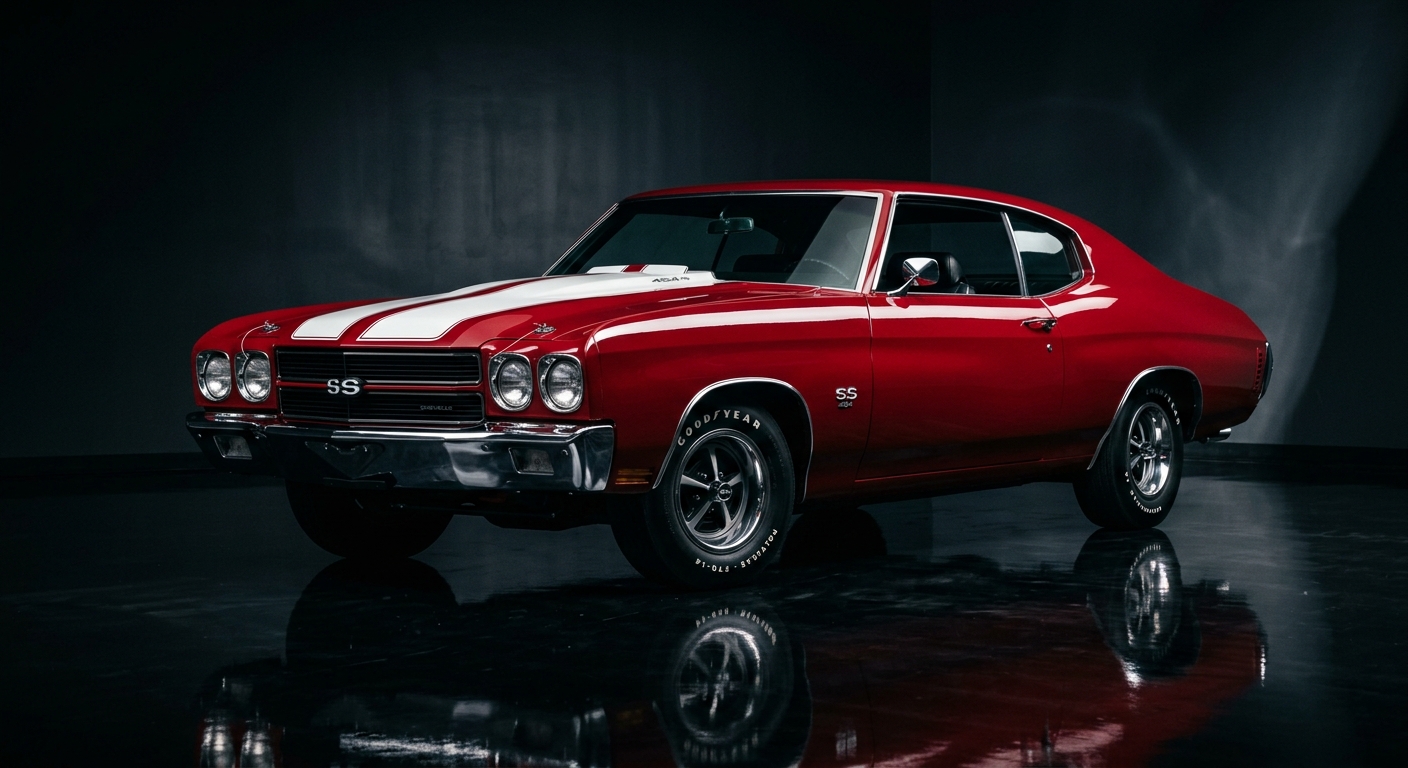
Visually, the 1970 Chevelle SS was muscular without being overwrought. The dual hood bulges weren’t just for show, they provided necessary clearance for the massive air cleaner assembly. The SS grille, blacked-out rear panel, and subtle spoiler all contributed to a cohesive design that looked fast even when standing still. The car’s proportions were perfect, with a long hood, short deck, and wide stance that communicated its intentions clearly.
Color options included some of the most iconic muscle car hues ever offered, from Cranberry Red to Forest Green, with racing stripes available to add even more visual drama. The cowl induction hood, when optioned, created a distinctive appearance that became synonymous with high-performance Chevelles.
The End of an Era
The 1970 model year represented the last hurrah for unrestricted American muscle. By 1971, compression ratios were lowered, and power figures began their steady decline. The LS6 option was discontinued after just two years, making the 1970 Chevelle SS 454 LS6 one of the rarest and most desirable muscle cars ever produced, with only 4,475 examples built.
Today, these cars command enormous respect and equally enormous prices. A numbers-matching LS6 Chevelle can easily exceed six figures at auction, and even lesser SS 454 variants are highly sought after. The combination of rarity, performance, and historical significance has cemented the 1970 Chevelle SS as one of the most important American performance cars ever built.
The 1970 Chevelle SS 454 LS6 stands as perhaps the greatest achievement of America’s muscle car era, a perfect storm of engineering ambition and cultural timing. While it may lack modern refinement, its raw authenticity and historical significance make it an automotive treasure that captures the spirit of an era when horsepower was king and subtlety was optional. For those fortunate enough to experience one, it’s a visceral reminder of what made American muscle cars legendary.