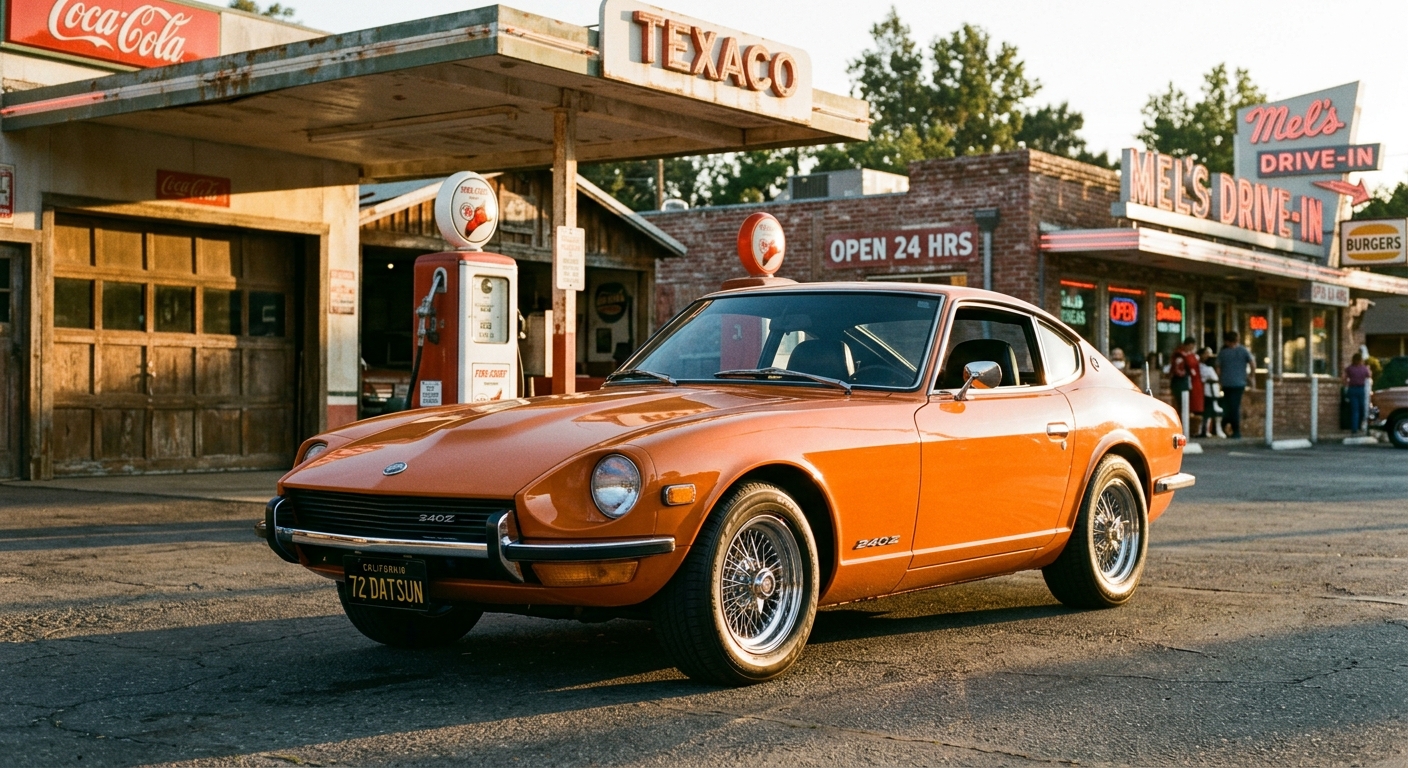
In 1970, when the Datsun 240Z arrived on American shores, it didn’t just compete with European sports cars, it rewrote the rulebook entirely. Here was a machine that offered Jaguar E-Type looks, Porsche 911 performance, and MG reliability at half the price of its European rivals. The 240Z proved that Japan could build more than just economical transportation.
The Perfect Storm of Design and Engineering
The 240Z’s genesis began with Yutaka Katayama, Nissan’s American division president, who recognized America’s hunger for affordable performance. Working with designer Albrecht Goertz, famous for the BMW 507, the team created a silhouette that was unmistakably purposeful. The long hood, short deck proportions weren’t just beautiful, they were functional, housing Nissan’s robust L24 inline-six while maintaining perfect 50/50 weight distribution.
Under that sculpted hood lived a 2.4-liter SOHC straight-six producing 151 horsepower, fed by twin SU carburetors. While not groundbreaking on paper, the L-series engine was bulletproof reliable and responded beautifully to modifications. More importantly, it was mated to a crisp-shifting 4-speed manual transmission and independent suspension at all four corners.
Driving the Dream
Behind the wheel, the 240Z feels immediate and honest. The steering is direct, with just enough weight to communicate what the front wheels are doing without requiring gym membership. The clutch is light, the shifter precise, and the seating position perfect for spirited driving. At 2,400 pounds, the Z feels nimble and eager, with enough power to make highway merging effortless and canyon carving genuinely thrilling.
The suspension strikes an admirable balance between comfort and control. While not as sophisticated as a contemporary Porsche, the MacPherson strut front and independent rear setup provides predictable handling with moderate understeer that transforms into delightful oversteer with proper throttle application. The rear-wheel-drive layout and well-balanced chassis make the 240Z a natural teacher for driving enthusiasts.
Interior and Comfort
Inside, the 240Z eschews luxury for functionality. The cockpit wraps around the driver with a purposeful array of gauges, including a 160-mph speedometer and 7,000-rpm tachometer. The seats, while not heavily bolstered, provide adequate support for spirited driving. Build quality, while not German-precise, was leagues ahead of contemporary British sports cars, with electrical systems that actually worked and panel gaps that remained consistent.
Cultural Impact and Legacy
The 240Z’s impact extended far beyond its specifications. It single-handedly changed American perceptions of Japanese automobiles, proving that the Land of the Rising Sun could produce desirable, exciting cars. Racing success in SCCA competition further enhanced its reputation, with drivers like Bob Sharp proving the Z-car’s competitive mettle against established European marques.
Production numbers tell the story of the 240Z’s success: over 160,000 units found homes between 1970 and 1973, making it one of the best-selling sports cars of its era. Unlike many classics that were exotic when new, the 240Z was attainable transportation that happened to be thrilling.
The 1972 Datsun 240Z remains one of automotive history’s greatest success stories, a car that delivered on every promise while establishing Japan as a serious player in the global sports car market. Its combination of reliability, affordability, and pure driving joy created a template that manufacturers still chase today. More than 50 years later, the 240Z stands as proof that the best sports cars aren’t always the most expensive ones.