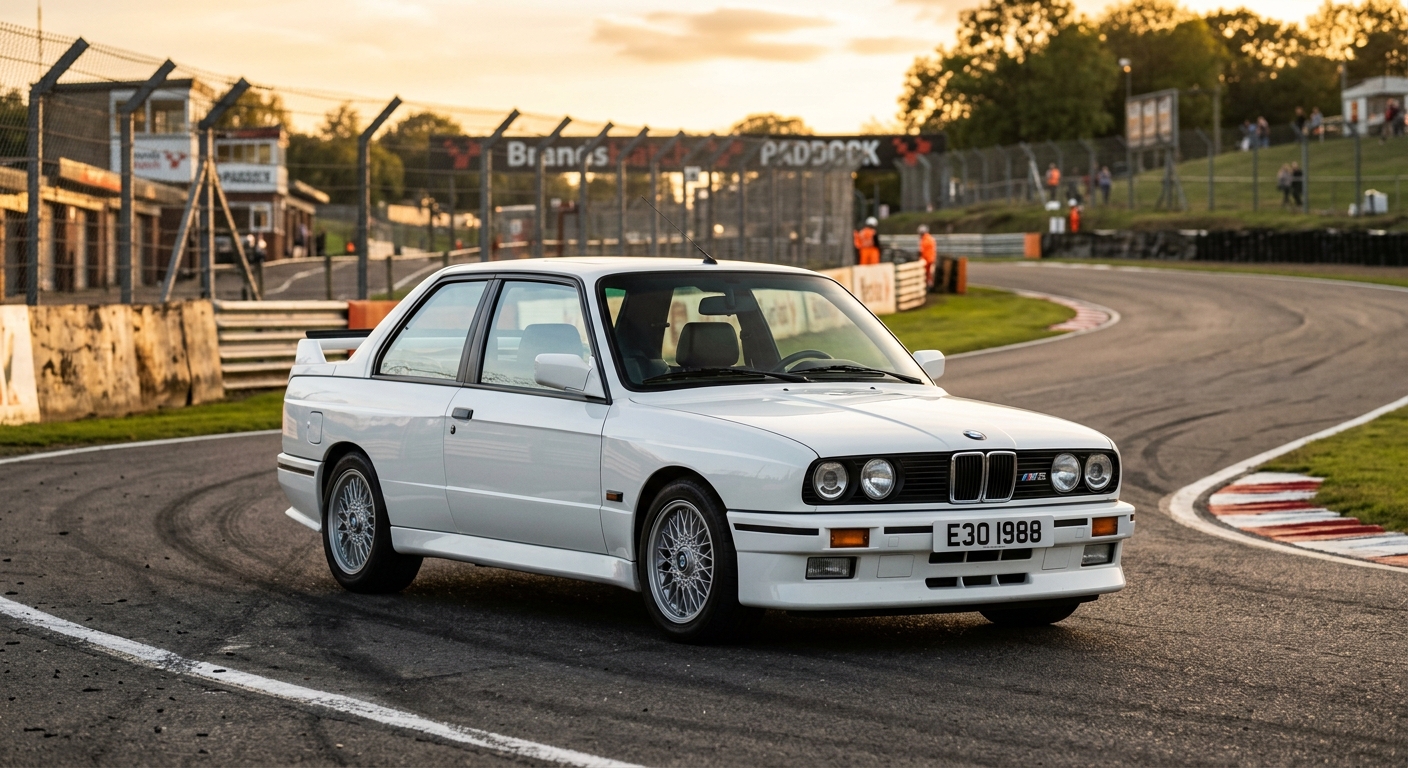
In 1988, BMW needed to build 5,000 road cars to homologate their touring car racer. What they created instead was a legend that would define the very essence of the M Division for decades to come. The E30 M3 wasn’t just a compliance car: it was a masterpiece of engineering focus that proved you could build a race car for the road without compromise.
Born to Race, Built to Thrill
The E30 M3’s existence stems from BMW’s desire to dominate touring car racing in the 1980s. Homologation rules required manufacturers to build street versions of their race cars, and BMW’s Motorsport division took this challenge seriously. They didn’t simply tune an existing 3 Series: they reimagined it entirely.
Under the flared hood sits the S14 engine, a naturally aspirated 2.3-liter four-cylinder that produces 192 horsepower and 170 lb-ft of torque. These numbers might seem modest by today’s standards, but the S14’s character is everything. It’s an engine that rewards commitment, with peak power arriving at 6,750 RPM and a redline that beckons you to explore every last revolution.
The five-speed Getrag manual transmission is perfectly matched to the engine’s personality, with short, precise throws that make every gear change feel like a mechanical celebration. There’s no automatic option because there shouldn’t be: this car demands your full participation.
Aggressive Aesthetics with Purpose
Every visual modification serves an aerodynamic or cooling purpose. The flared fenders accommodate wider wheels and tires, while the front air dam and rear spoiler were developed in BMW’s wind tunnel. The result is a car that looks purposeful without resorting to flashy graphics or unnecessary ornaments.
Inside, sport seats hold you firmly in place, while the dashboard layout prioritizes function over fashion. The analog gauges provide clear information, and the overall cabin feels focused on the driving experience. It’s spartan compared to modern luxury cars, but that’s precisely the point.
Driving Dynamics That Define a Generation
Behind the wheel, the E30 M3 reveals its true nature. The steering is hydraulically assisted but retains perfect feel and feedback. You know exactly what the front wheels are doing at all times, and the car responds to inputs with surgical precision.
The suspension strikes an remarkable balance between comfort and performance. On smooth roads, the M3 feels civilized enough for daily use. Push harder, and it transforms into something that feels genuinely connected to its racing origins. The rear end can be coaxed into controlled slides with throttle modulation, but the car always feels manageable and predictable.
Braking performance is strong for its era, with good pedal feel and fade resistance during spirited driving. The overall package feels cohesive in a way that many modern performance cars struggle to match, despite their superior technology.
The Sound of Motorsport
The S14 engine note is distinctive and memorable. At idle, it sounds businesslike but not harsh. Under acceleration, it develops a hard-edged wail that perfectly matches the car’s aggressive personality. It’s not the smoothest four-cylinder ever built, but its character is undeniable.
The E30 M3 represents automotive purity in its most distilled form: a car built with singular purpose that somehow transcends its original mission to become something timeless. In an era of increasingly complex performance cars, the original M3 reminds us that the best driving experiences often come from the perfect balance of power, weight, and driver engagement. This isn’t just a classic car, it’s the blueprint for every great sports sedan that followed.