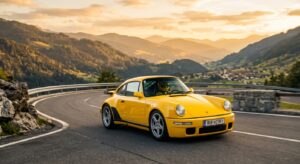
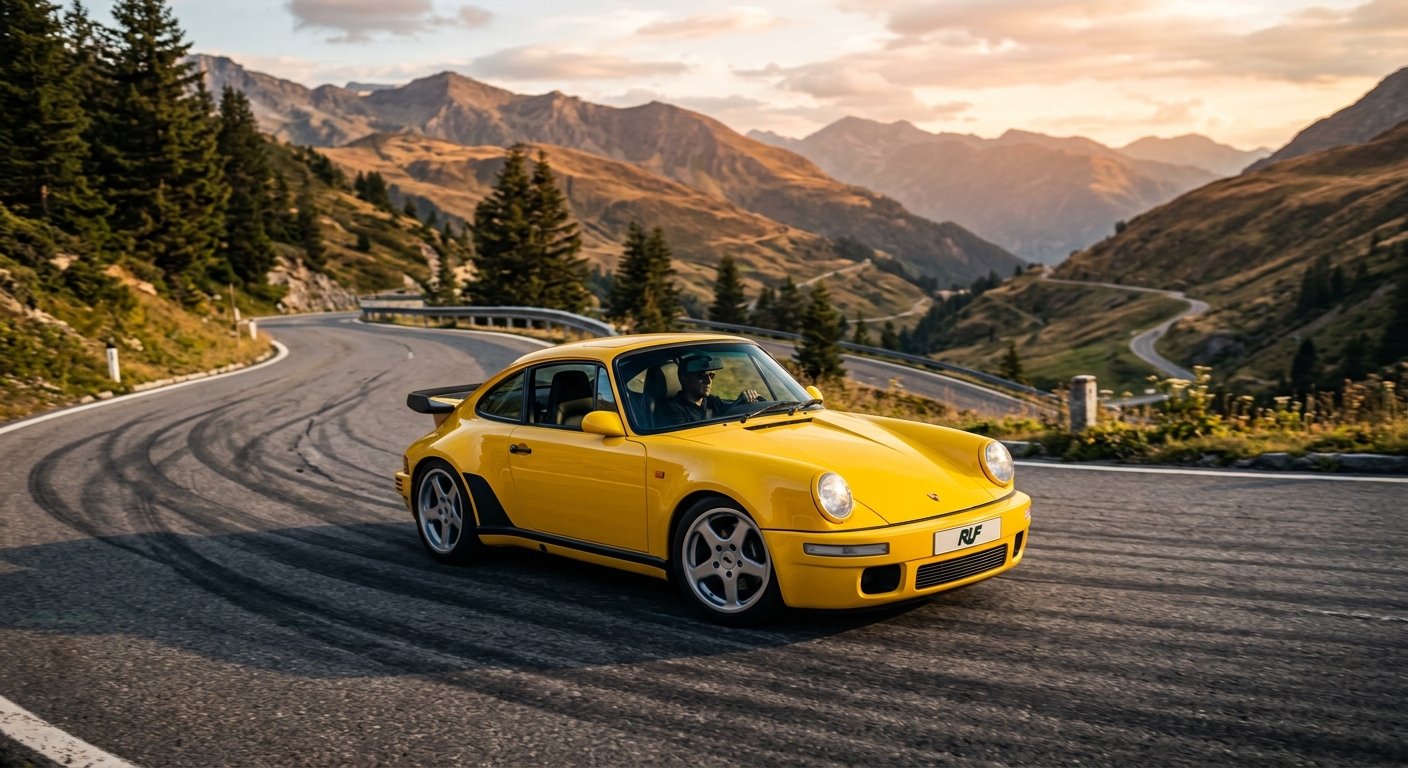
In 1987, while Ferrari and Lamborghini were busy crafting their latest exotic masterpieces, a small German tuning house in Pfaffenhausen was quietly building something that would make both Italian giants look pedestrian. Alois Ruf Jr. took a humble Porsche 911 Carrera 3.2 and transformed it into the CTR, a canary yellow missile that would become known as the Yellowbird and rewrite the rulebook on what a production car could achieve.
When Stefan Roser piloted the CTR to a verified top speed of 211 mph at Ehra-Lessien in April 1987, it didn’t just break records, it obliterated them. This wasn’t just fast, this was otherworldly, making the Yellowbird the fastest production car on Earth and establishing Ruf as more than just another Porsche tuner.
The Alchemy of Speed
The magic begins with Ruf’s heavily modified 3.4-liter flat-six, twin-turbocharged and intercooled to produce 469 horsepower and 408 lb-ft of torque. But raw numbers only tell part of the story. This engine was a masterpiece of engineering precision, featuring twin KKK turbochargers, a custom intake system, and Ruf’s own engine management that delivered power with the suddenness of lightning and the persistence of thunder.
Unlike modern turbocharged engines with their sophisticated boost control and anti-lag systems, the CTR’s powerplant was refreshingly analog in its delivery. Turbo lag was very much part of the experience, a brief moment of anticipation before the full fury was unleashed. When those turbos spooled up, the Yellowbird would launch forward with an intensity that could catch even experienced drivers off guard.
A Body Built for Battle
Visually, the CTR was unmistakably a 911, but one that had been through Ruf’s performance laboratory. The bodywork, while retaining the classic 911 silhouette, featured subtle but purposeful modifications. Wider wheel arches accommodated the broader track, while the famous whale-tail spoiler wasn’t just for show, it was essential aerodynamic equipment for a car capable of genuine 200+ mph speeds.
The interior maintained much of the 911’s classic charm but with Ruf’s performance touches. Recaro seats hugged occupants during spirited driving, while the dashboard featured additional gauges to monitor boost pressure and other vital signs of the highly-tuned engine. Everything felt purposeful, focused on the driving experience above all else.
The Legend Lives On
Today, the original CTR Yellowbird occupies a unique position in automotive history. It proved that a small, independent manufacturer could not only compete with the established supercar elite but completely outclass them. Only 29 examples were ever built, making each one a precious artifact of 1980s automotive excellence.
The car’s legend was further cemented by its starring role in countless automotive documentaries and the famous Faszination film, where Stefan Roser demonstrated the CTR’s incredible capabilities on the Nürburgring with a driving display that was equal parts skill and controlled chaos.
The Ruf CTR Yellowbird remains one of the most significant supercars ever built, a machine that proved small manufacturers could rewrite the rules of performance. Its combination of raw speed, analog character, and exclusivity creates a legend that grows stronger with each passing year. For those who experienced the CTR in its heyday, no modern supercar quite captures the same sense of barely controlled chaos and pure automotive excitement.