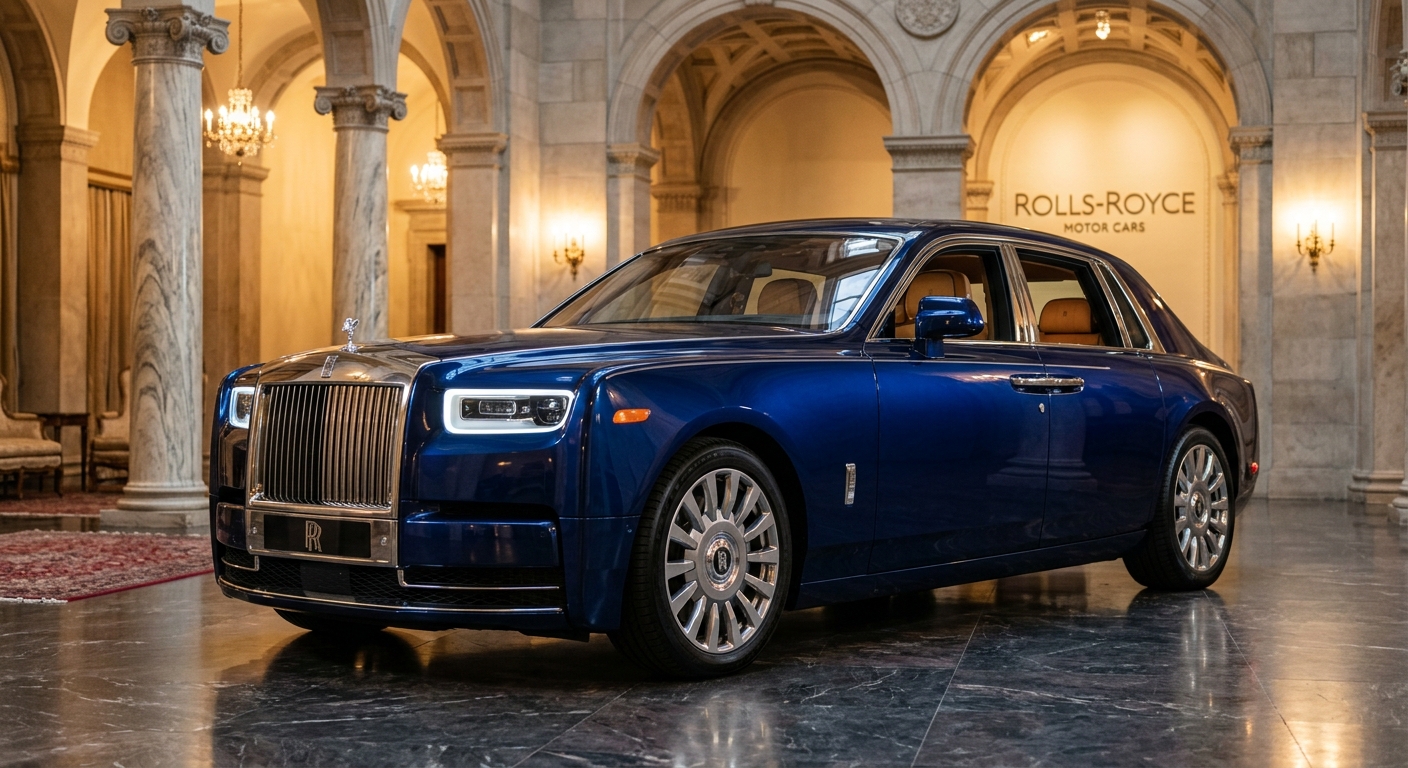
In a world where automotive luxury has become increasingly democratized, the 2017 Rolls-Royce Phantom VIII stands as an uncompromising monument to what happens when cost becomes irrelevant and perfection becomes the only acceptable outcome. This is not merely a car; it’s a rolling testament to human craftsmanship elevated to an art form.
The eighth-generation Phantom represents a complete reinvention of the nameplate that has served as the gold standard for luxury motoring since 1925. Built on Rolls-Royce’s new aluminum Architecture of Luxury platform, the Phantom VIII combines old-world craftsmanship with cutting-edge technology in ways that would make its predecessors both proud and envious.
A Cathedral on Wheels
Settling into the Phantom’s rear compartment is less like entering a car and more like being welcomed into a private sanctuary. The silence is so profound it’s almost unsettling, with Rolls-Royce’s engineers having added over 130 kilograms of sound deadening material to create what they call “the quietest motor car in the world.” At highway speeds, the cabin registers just 56 decibels, quieter than most libraries.
The rear seats, where most Phantom owners spend their time, are individual thrones upholstered in the finest leather money can buy. Each hide is selected from bulls raised in regions free from barbed wire and insect bites, ensuring an unblemished surface worthy of the Phantom name. The massage function is so subtle and refined that it feels more like a gentle caress than mechanical manipulation.
The Gallery: Art Meets Automotive
Perhaps the most striking feature of the new Phantom is “The Gallery,” a continuous piece of glass that spans the entire width of the dashboard, encasing bespoke artworks commissioned specifically for each car. Whether it’s hand-painted silk, precious metal sculptures, or intricate marquetry, The Gallery transforms the cabin into a mobile art exhibition. It’s a feature that exemplifies Rolls-Royce’s philosophy that true luxury lies in the unique and unrepeatable.
The craftsmanship extends to every surface. The wood veneers are book-matched across multiple panels, creating seamless patterns that flow like liquid across the interior. The chrome work is hand-polished to a mirror finish, and even the umbrellas stored in the doors are handmade and monogrammed.
Effortless Power
Beneath the Phantom’s imposing hood lies a twin-turbocharged 6.75-liter V12 engine producing 563 horsepower and a staggering 664 lb-ft of torque. Yet the numbers tell only part of the story. This engine was designed not for drama but for absolute refinement. The power delivery is so smooth and linear that acceleration feels less like propulsion and more like the world gently moving around you.
The eight-speed automatic transmission is calibrated for serenity rather than sport, with gear changes so imperceptible they might as well be telepathic. The air suspension system continuously adjusts to road conditions, creating a ride quality that Rolls-Royce famously describes as “magic carpet ride.” It’s not hyperbole; the Phantom genuinely seems to hover above the road surface, isolating its occupants from the vulgarities of the outside world.
Modern Technology, Invisible Integration
The Phantom VIII is thoroughly modern beneath its classical exterior. The infotainment system features a 12.3-inch touchscreen that retracts into the dashboard when not in use, preserving the interior’s analog aesthetic. When active, it provides access to navigation, entertainment, and vehicle settings through an interface that’s surprisingly intuitive for such a complex machine.
The night vision system, adaptive cruise control, and four-wheel steering are all present, but their operation is so seamless that they fade into the background. This is technology in service of the experience rather than technology for its own sake.
The 2017 Phantom VIII represents the absolute pinnacle of automotive luxury, a machine that justifies its astronomical price through uncompromising attention to detail and an experience that simply cannot be replicated at any lower price point. This is luxury not as a feature list but as a philosophy made manifest in steel, leather, and wood.