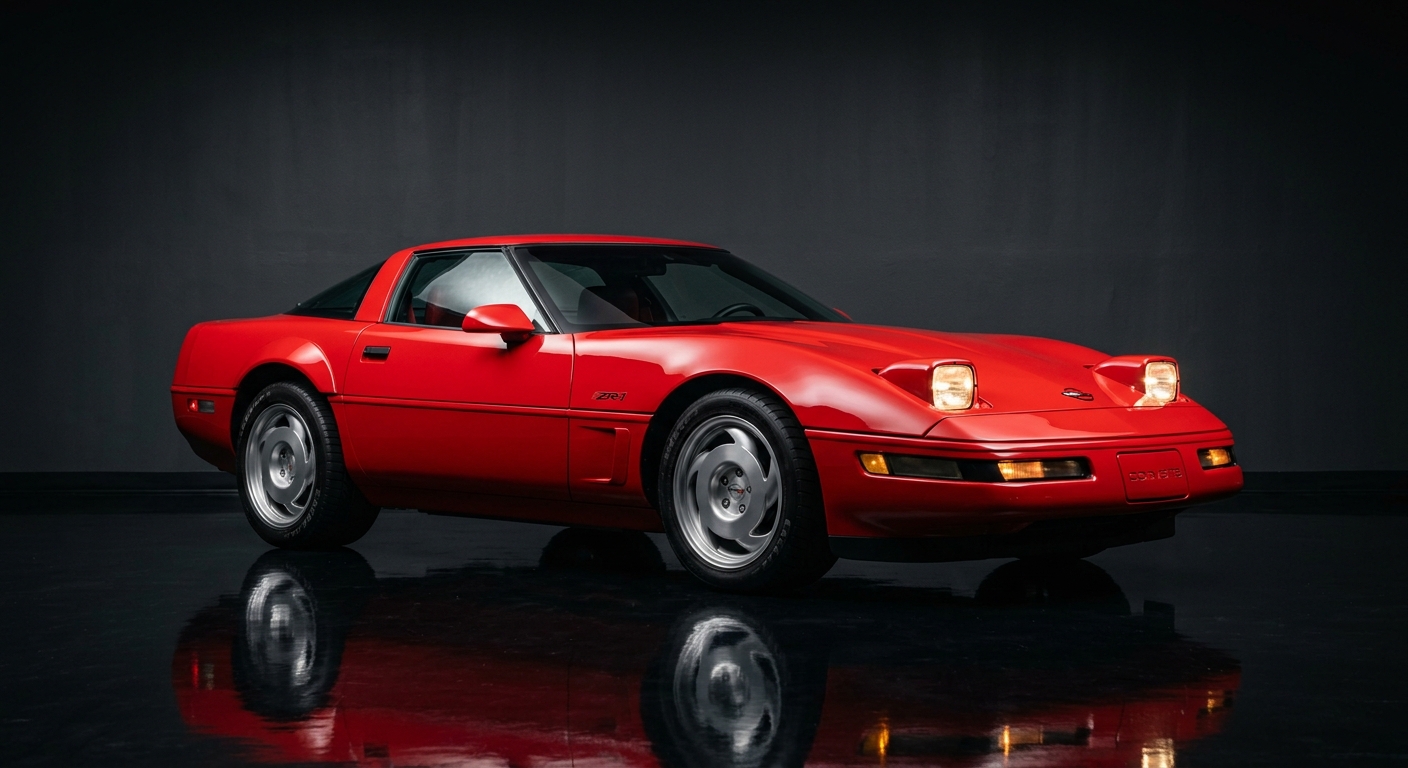
In 1990, Chevrolet unleashed something extraordinary onto American roads. The ZR-1 wasn’t just another Corvette variant, it was a statement of intent that transformed America’s sports car from a weekend cruiser into a legitimate supercar contender capable of embarrassing exotic machinery costing twice as much.
The Heart of a Beast
At the center of the ZR-1’s transformation sits the legendary LT5 engine, a 5.7-liter V8 that represented the pinnacle of naturally aspirated American performance. Developed in partnership with Lotus and built by Mercury Marine, this wasn’t your typical pushrod V8. The all-aluminum, dual-overhead-cam powerplant produced 375 horsepower and 370 lb-ft of torque, figures that were absolutely staggering for 1990.
The LT5’s party trick was its dual-personality nature. A valet key limited the engine to 210 horsepower for casual driving, while the full-power key unleashed the beast within. This engineering marvel featured 32 valves, individual throttle bodies for each cylinder, and a rev limit that stretched to an unheard-of 7,000 rpm for a Corvette.
King of the Hill Performance
The numbers spoke for themselves. The ZR-1 could rocket from 0-60 mph in just 4.2 seconds and achieve a top speed of 180 mph, making it faster than Ferrari’s 348 and Porsche’s 911 Turbo. More importantly, it could sustain these speeds, thanks to extensive aerodynamic work and a sophisticated cooling system.
The wider body wasn’t just for show. The ZR-1’s rear track was widened by 3 inches to accommodate massive 315/35ZR17 Goodyear Eagle ZR tires, while the front wore 275/40ZR17s. This footprint, combined with a heavily revised suspension featuring selective ride control dampers, gave the ZR-1 cornering capabilities that finally matched its straight-line performance.
Driving the Dream
Behind the wheel, the ZR-1 delivers an experience that bridges two eras of automotive performance. The cabin is pure C4 Corvette, with its distinctive digital dashboard and sport seats, but the driving dynamics are something else entirely. The steering is precise and communicative, the brakes are strong and progressive, and the engine’s response is immediate and intoxicating.
What sets the ZR-1 apart from other muscle cars of its era is its sophistication. This isn’t a car that overwhelms with brute force alone, it’s a precision instrument that happens to pack serious punch. The LT5 engine note is distinctive, more mechanical and purposeful than the rumbling V8s of its contemporaries.
Legacy and Impact
The ZR-1 ran from 1990 to 1995, with only 6,939 examples produced. Each carried a price premium of nearly $30,000 over the standard Corvette, making it a $60,000 proposition when new. That premium bought exclusivity, performance, and bragging rights that lasted well into the next decade.
Today, the C4 ZR-1 is recognized as the car that saved the Corvette’s reputation and established the template for future high-performance variants. It proved that American manufacturers could build world-class sports cars when they committed the engineering resources and attention to detail.
The C4 ZR-1 stands as one of the greatest performance bargains ever created, offering supercar performance at a fraction of exotic car prices. Even today, clean examples can be found for less than half the price of contemporary European competition, making this the ultimate thinking enthusiast’s muscle car.