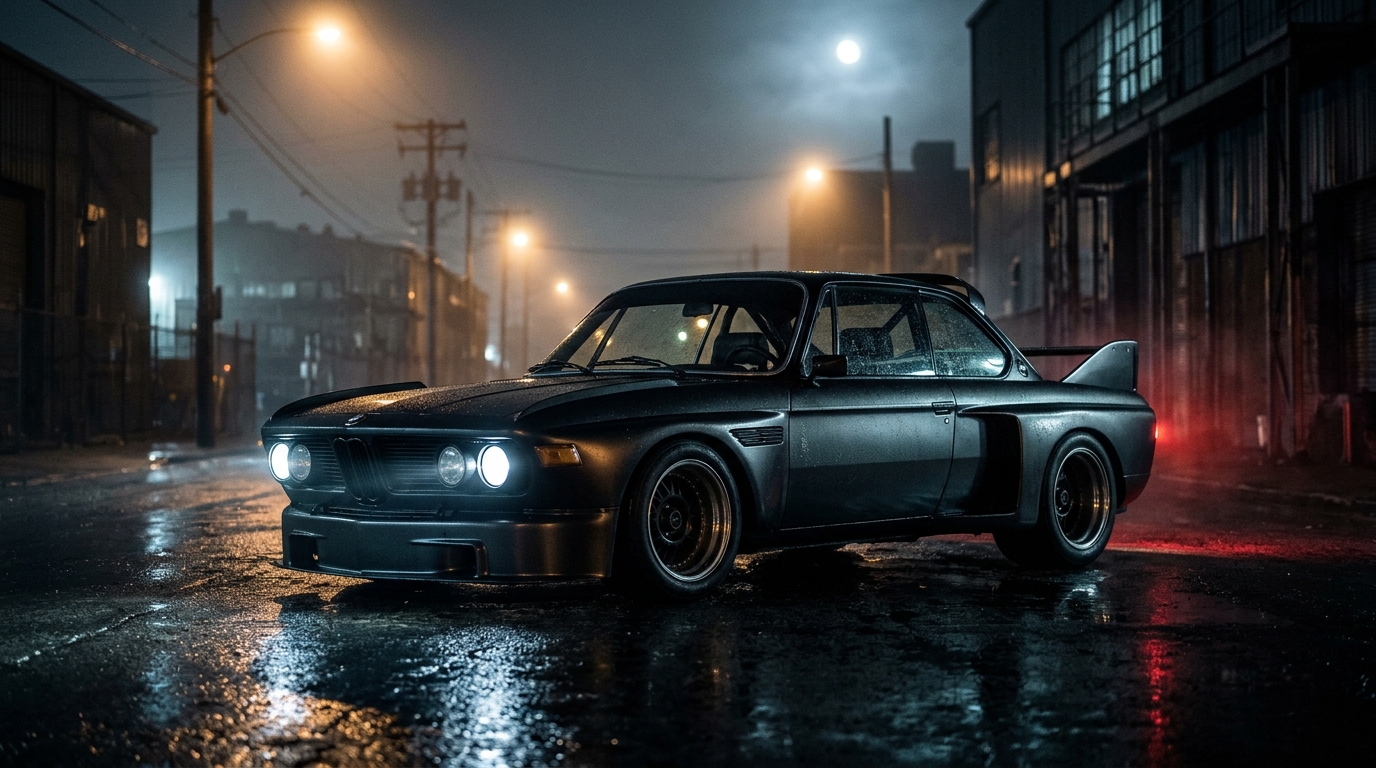
It is past midnight, and the only sound on this empty ring road is the soft, hollow rasp of a carbureted straight-six echoing off a concrete underpass. The 3.0 CSL slides through pools of sodium light like it was designed for exactly this, long, low and slightly menacing, with a pillarless greenhouse that catches every streetlamp. Racing legend says this car earned its Batmobile nickname under the floodlights at Le Mans. After a night behind the wheel, the name makes perfect sense.
Born to Go Racing
The CSL is not really a road car that went racing. It is a racing car that BMW had to sell to the public. The letters stand for Coupe Sport Leicht, and the lightness is the whole point. Based on the E9 coupe, the CSL was built so BMW could homologate a lighter, faster body for the European Touring Car Championship. Steel was thinned out, the door skins, bonnet and boot lid were swapped for aluminium, and sound deadening and rear-seat trim were stripped away. Early cars shed roughly 200 kg compared with a standard 3.0 CS, leaving a curb weight in the neighborhood of 1,200 kg.
The 1972 model year is the car in its purest, simplest form. These were the first CSLs, wearing the 3.0-litre M30 straight-six in 180 horsepower trim, before the later 3.2-litre cars and the famous aero package arrived in 1973 and 1974. Early cars also kept thin-gauge sheet steel and little in the way of luxury, which is exactly why collectors prize them today.
The Batmobile Wing That Came Later
The nickname belongs mostly to the final evolution, the cars that sprouted a towering rear wing, front fins, a roof spoiler and a rear spoiler for homologation. Those aero parts were shipped loose in the boot of road cars to keep them legal in Germany, then fitted by the racers. A 1972 car does not have the full bat-suit, but it carries the same bloodline, and it is the lean, uncluttered starting point of the whole story. Dr. Jochen Neerpasch and the newly formed BMW Motorsport GmbH turned that foundation into one of the most successful touring cars in history, winning the European Touring Car Championship in 1973, 1975, 1976 and 1977 and taking the Spa 24 Hours.
Driving It After Dark
Night driving a 1972 CSL is a lesson in how much attention a car demands when you strip it of electronics. The headlights are period-correct halogen units, but even good ones cannot match modern LED lighting. The beam is warm and wide rather than sharp, and on a dark country road you feel the limits of your vision and instinctively slow your hands and feet. That is not a flaw. It makes every sweeper feel earned.
The thin pillars are the real joy. Because the C-pillar and roof are so slender, and there is no center B-pillar, the glasshouse feels enormous. At night, the streetlights wash over you in long, slow ribbons, and you can see the road bending ahead with a clarity modern cars simply cannot offer. Visibility to the rear is just as generous, so you always know who is behind you.
Then there is the sound. The M30 six idles with a smooth, deep thrum that turns urgent and metallic above 4,000 rpm. Through a tunnel at 2 a.m. it is intoxicating, a creamy, hard-edged soundtrack with no turbo hiss, no artificial enhancement and no sound deadening to dull it. Fed by two Zenith carburetors on the earliest cars, the six pulls cleanly to its limit, and the exhaust note bounces back at you off every wall.
The steering is unassisted and communicative, and the car feels remarkably light on its feet. With almost no weight over the nose compared with its rivals, it turns in with a quickness that belies its age. The brakes are modest by modern standards, so you plan stops early, but the chassis is balanced and honest. Push too hard and the rear steps out gently, a reminder that this is a car from an era of drivers, not driver aids.
Living With a Legend
Practicality is not the point, but it is not entirely absent either. The CSL still seats four, though the rear is cozy, and the lightweight interior is spartan compared with a standard coupe. It is loud, it is raw, and it needs warming up. Rust is the great enemy of these cars, and genuine CSLs are among the most carefully authenticated classics anywhere. Of the roughly 1,265 built, the early cars were assembled with Karmann bodies in Germany, and that provenance matters enormously to collectors. Today, good examples command serious six-figure money, and the best can climb well beyond that.
Why It Still Matters
Few cars connect a road-going coupe so directly to a racing dynasty. The CSL proved that a production car could be reduced, refined and sharpened into a world champion without losing its elegance. It laid the groundwork for the M cars that followed, and for a lineage that runs straight through the M3 to today. After dark, with the streetlamps flickering past and the six singing in your ears, that legacy is not a history lesson. It is a living, breathing thing.
Editor’s verdict: The 1972 3.0 CSL is the purest expression of BMW’s racing soul, a lightweight coupe that turns a midnight drive into a history lesson you can feel through the wheel. It is expensive, raw and demanding, and every bit of it is why you will never forget it. If you ever get the chance to hear that six sing through a tunnel after dark, take it.