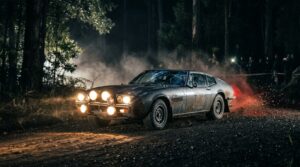
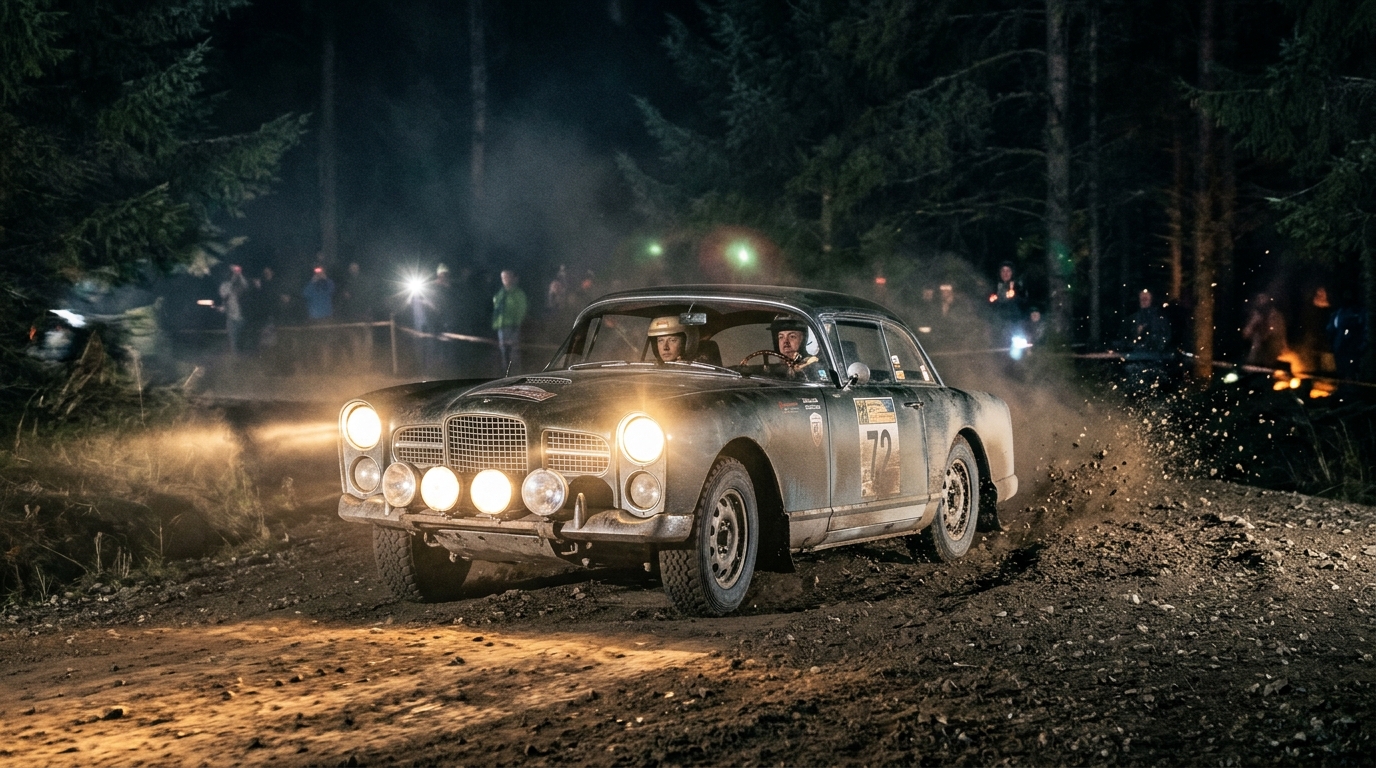
Picture a French mountain road at 2 a.m., a fog bank rolling off the pass, and a long-nosed Parisian coupe thundering through the dark with a Chrysler V8 rumbling in its chest. This is the world the Facel Vega was built for: night stages, fast autoroutes, and playboys who wanted Hemi-bred muscle wrapped in couture steel. The HK500 is the car that proves a boutique French coachbuilder could humble Ferraris and Aston Martins after sunset.
A Note on the 1972 Badge
Let’s be precise, because Facel Vega history rewards precision. Facel S.A. built the HK500 from 1958 to 1961, and the company folded in 1964 after the troubled Facellia affair. There is no factory-built 1972 HK500. When one turns up in a 1972 listing, it is a decade-old car living a long second life, typically a restored or period-modified example in the hands of an enthusiast, wearing the specification of its 1958-1961 origin. That is the car we are driving tonight: a surviving HK500 in its 1972 chapter, when these cars were cheap used exotics and the myth was quietly being born.
The Giant Killer’s Pedigree
Jean Daninos founded Facel (Forges et Ateliers de Construction d’Eure-et-Loir) and turned a metal-stamping business into France’s most glamorous automaker. The recipe was shamelessly practical: a tubular steel chassis, hand-finished bodywork, a gorgeous cabin of leather and wood, and a big American V8 from Chrysler’s DeSoto and Chrysler line because no French engine could deliver the torque. The result was a car that could out-accelerate and out-run most European grand tourers of the era. Owners included Pablo Picasso, Ava Gardner, Stirling Moss, and Joan Fontaine. Moss reportedly drove his across Europe, a testament to its long-distance competence.
Night Driving Impressions
Slide behind the thin, large-diameter wheel and the cabin glows like a jewel box. The dashboard is an aircraft-style panel of round Jaeger-type gauges and a row of toggle-style switchgear, all backlit in a soft, dim illumination that is gentler on night vision than modern screens. You sit low, with a long hood stretching ahead and slim pillars all around, so visibility is excellent for a car of the period.
The headlights are the weak point, as you would expect from 1950s lighting. The stacked quad lamps throw a warm, yellowish pool that is adequate for a spirited cruise but demands respect on unlit rural roads. Modern owners often fit period-correct halogen conversions, which transform confidence after dark without spoiling the look. Even so, there is a romance to driving by that amber glow, the road unspooling in a tunnel of light while the engine murmurs ahead.
And the sound. The 383 cubic inch Chrysler RB-series V8 is not a screamer. It is a deep, loping rumble, rich and smooth, amplified in the quiet of a nighttime street into something that bounces off stone walls and shuttered shopfronts. Open the throttle on an empty autoroute and the car surges with effortless, tidal torque. The pushbutton-era Torqueflite automatic, or the optional manual with overdrive, keeps the pace relaxed rather than frantic.
On the Move: Pace and Poise
The HK500 was quick for its day, with a top speed in the neighborhood of 140 mph and a sprint to 60 mph in roughly 8 seconds. Those are big numbers for 1958, and they still feel brisk. The chassis is rigid by period standards, but this is a heavy grand tourer, not a sports car. It leans into corners, rewards smooth inputs, and punishes sudden ones. Four-wheel disc brakes arrived on the HK500 as a notable upgrade, with Dunlop discs giving stopping power well ahead of rivals still relying on drums. Steering is a recirculating-ball unit, and power assistance makes parking tolerable.
At night, the car’s character crystallizes. Traffic thins, the road opens, and the long wheelbase and big torque make mile-munching a pleasure. It is a machine built for crossing a continent in one go, headlights sweeping the horizon.
Living With One
Parts are the challenge. The Chrysler drivetrain is easy to source and service, but body panels, trim, and Facel-specific components are scarce and expensive. Rust is the enemy, and the hand-built nature of the car means no two are identical. Values have climbed steadily over the decades, and a sound HK500 now commands serious money at auction. If you find a good one, buy it before the next owner does.
The Facel Vega HK500 is not a perfect car, but it is an unforgettable one, a hand-built French thoroughbred with an American heart that wears midnight beautifully. Find a good example, point it at an empty road after dark, and let that Chrysler V8 remind you why the giant killer earned its legend.