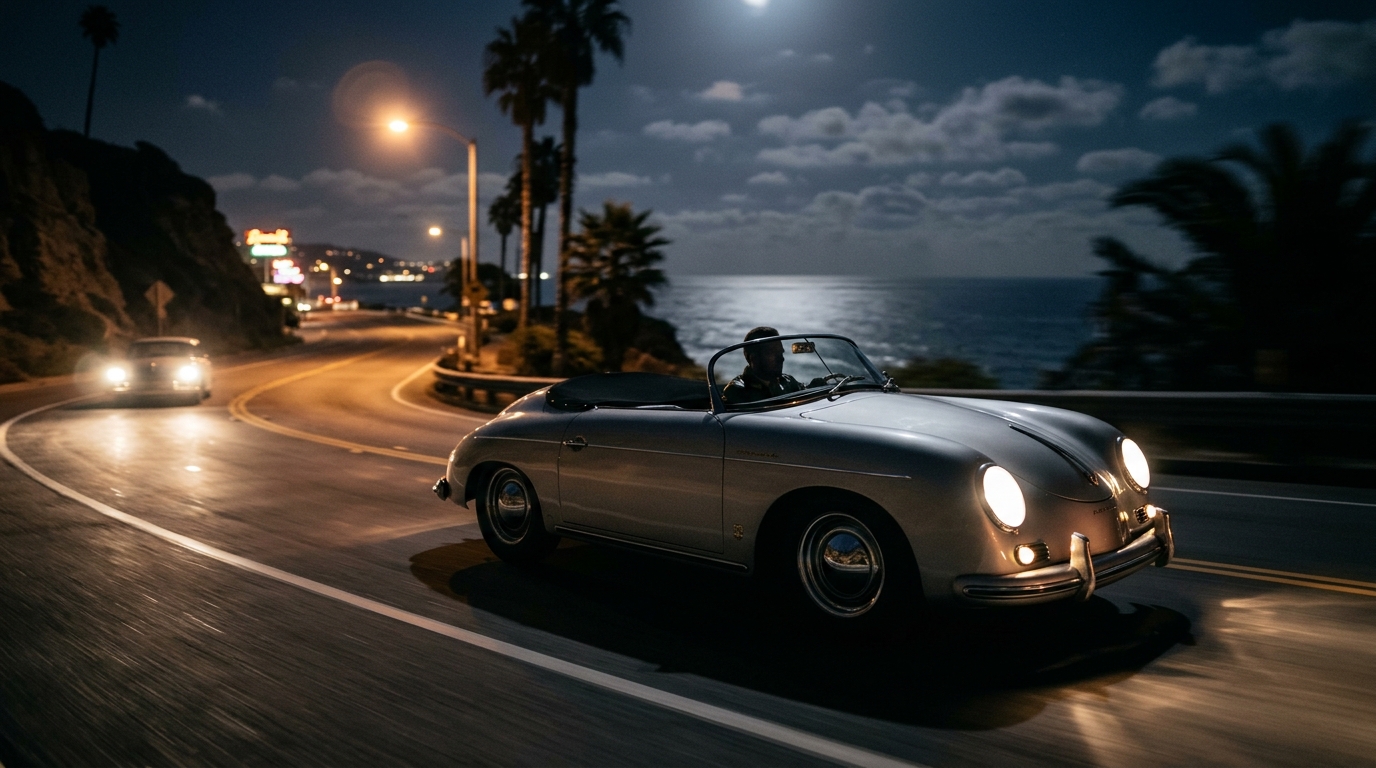
It is a few minutes past midnight on the Pacific Coast Highway, and the only sounds are the surf off to the right and a flat, rhythmic thrum from behind your shoulders. The 1957 Porsche 356A Speedster has no roof worth mentioning, no radio worth hearing, and no reason to be anywhere except exactly where it is. This is the car that taught America what a Porsche was, and after dark it makes the most sense it ever will.
How a Cheap Idea Became a Legend
The Speedster exists because of one man, Max Hoffman, Porsche’s influential US importer in New York. In the early 1950s he argued that American buyers, especially in California, wanted a lighter, cheaper, more spartan open Porsche they could drive to the club on Saturday and race on Sunday. Porsche built it, and the 356 Speedster debuted in late 1954 at a base price around $2,995, undercutting the Cabriolet considerably. The 356A arrived for 1956 with a revised chassis, a bigger 1,600cc engine range, and a smoother ride, and the 1957 model year sits right in the heart of that run.
The Speedster’s recipe was subtraction. It had a dramatically raked, low-cut windshield that could be unbolted for racing, a thin bucket-style seat, minimal side curtains instead of wind-up windows, and a lightweight, flimsy-looking folding top. Less weight meant more speed, and the car won countless SCCA class victories through the late 1950s. Roughly 1,171 Speedsters were built in 1957 and about 4,145 across the full production run from 1954 to 1958 before the Convertible D replaced it.
Driving It After Dark
Slide in and you sit low, with your elbow near the door’s top edge and the tall, thin steering wheel almost horizontal in your lap. Turn the key, press the starter, and the air-cooled flat-four catches with a busy, mechanical chatter that settles into a steady burble. At night, that sound fills the cabin and bounces off every wall and guardrail. With no roof sealing you in, you hear everything, including the cooling fan whirring behind you like a small turbine.
Power is modest by any modern yardstick. The base 1,600cc Normal engine makes about 60 horsepower, while the Super version, fitted to many Speedsters, makes about 75. With the car weighing under 1,900 pounds, that is enough to feel properly quick on a twisty road. The four-speed gearbox has long throws and a gentle, slightly notchy action, and the Porsche-synchronized shifts reward patience over aggression. It feels fastest not on a straight line but in corners, where the light steering and tiny mass let you flick it down a canyon road with fingertip pressure.
Seeing and Being Seen
Here is the honest part of a night drive in a 1957 car. The headlights are tall, round sealed beams set deep in the fenders, and they provide a warm, yellowish glow that is a world away from modern LED projectors. They show you the road ahead well enough at sensible speeds, but you learn quickly to match your pace to what the lights can reveal. Oncoming headlights wash across that low windshield and force you to squint. The tiny, round taillights mean modern traffic sees you late, so a Speedster at night rewards a calm, attentive driver.
What you give up in lighting, though, you gain in atmosphere. Under a string of orange streetlights, the swollen fenders and chrome trim glow like something poured rather than stamped. Parked at a roadside overlook, with the engine ticking as it cools, it is one of the most photogenic shapes ever put on four wheels.
Living With It
Do not expect comfort. Cabin heat is a fickle affair, wind noise at highway speed is constant, and the thin top offers little insulation on a cold coast night. Luggage space is a small front trunk and a shelf behind the seats. Yet the Speedster’s charm lies in the way every mechanical event is audible, visible and tactile. It is a car you wear rather than sit in.
Values reflect that mystique. Genuine, well-restored cars regularly change hands for well into six figures, and the best examples exceed that comfortably. Replicas are plentiful, so provenance and matching numbers matter enormously.
Editor’s verdict: The 1957 Porsche 356A Speedster is slow on paper and spellbinding in practice, a lightweight, open-air machine whose real magic is felt at night with the coast on one side and the flat-four chattering behind you. It is impractical, expensive and a little flimsy, and none of that matters once you are rolling under the streetlights. Buy the experience, not the numbers.