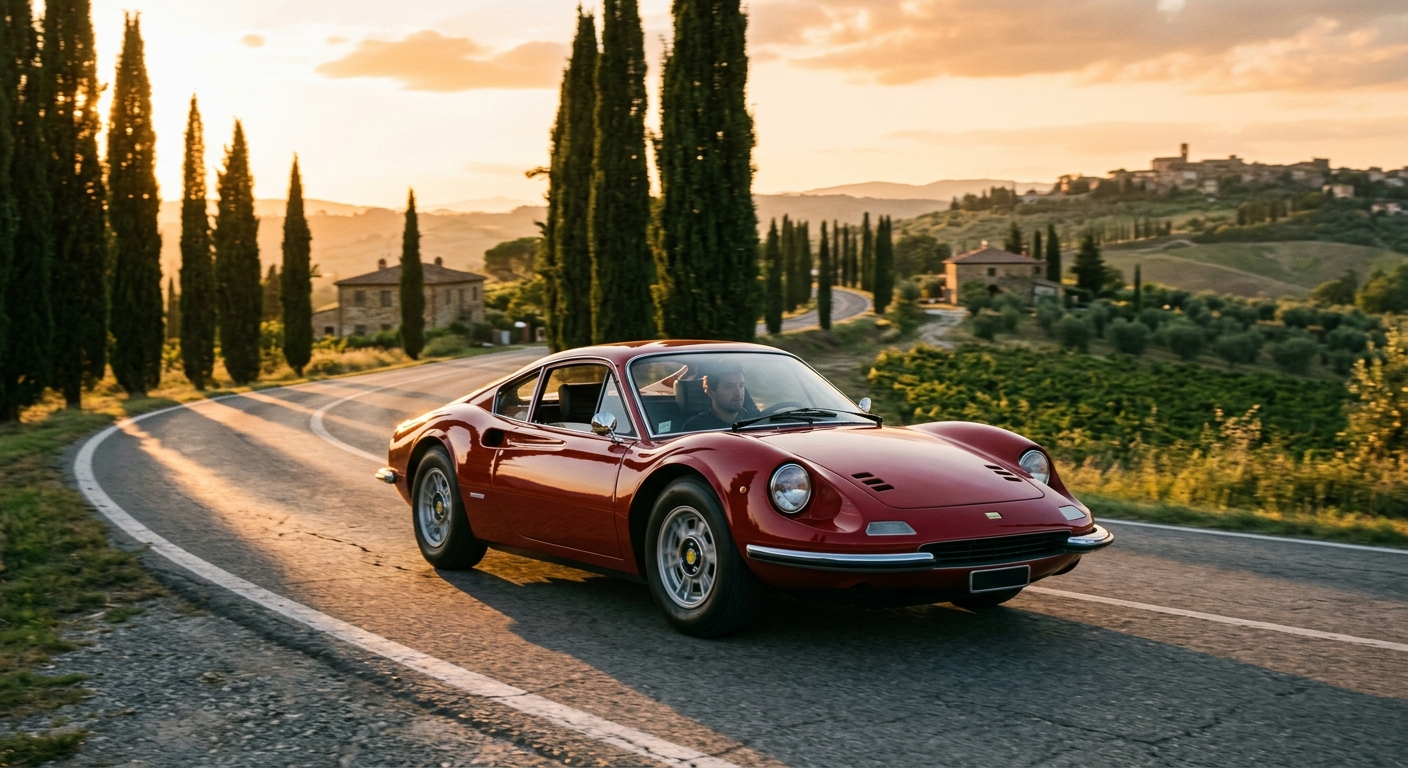
In 1969, Ferrari created something extraordinary that wasn’t officially a Ferrari at all. The Dino 246 GT emerged as a tribute to Enzo’s late son Alfredino, powered by a jewel-like V6 engine that sang a different song from Maranello’s traditional V12 symphony. This mid-engine masterpiece would redefine what a sports car could be, blending accessible performance with otherworldly beauty.
Design Philosophy and Engineering Excellence
The 246 GT represented a radical departure from Ferrari’s front-engine grand touring tradition. Pininfarina’s design, refined from the earlier Dino Berlinetta Speciale concept, created one of the most harmonious automotive forms ever conceived. Every curve flows naturally into the next, from the distinctive flying buttresses to the elegant Kamm tail, creating a silhouette that remains breathtaking more than five decades later.
At the heart of the Dino lies a 2.4-liter V6 engine, transversely mounted behind the driver. This powerplant, derived from Ferrari’s Formula 2 racing program, produces 195 horsepower through a quartet of Weber carburetors. The engine’s aluminum construction and dry sump lubrication system demonstrate the same engineering principles found in Ferrari’s racing machines, albeit in a more compact and refined package.
The Driving Experience
Behind the wheel, the 246 GT reveals its true character as a precision instrument rather than a brute force machine. The steering is telepathic, communicating every nuance of the road surface through the thin-rimmed wheel. The mid-engine layout provides near-perfect weight distribution, allowing the car to change direction with balletic grace that was revolutionary for its era.
The V6 engine’s voice is unique in the Ferrari catalog, producing a higher-pitched mechanical symphony that builds to an urgent crescendo at the 7,500 rpm redline. While lacking the earth-shaking torque of larger V8s and V12s, the Dino’s power delivery is linear and predictable, encouraging spirited driving rather than intimidating the pilot.
Interior Craftsmanship
Inside, the 246 GT showcases Italian craftsmanship at its finest. The cockpit wraps around the driver with purposeful intimacy, featuring deeply bolstered seats upholstered in supple leather. The dashboard, with its array of Veglia instruments and distinctive gated shifter, creates an environment that’s both functional and emotionally engaging.
Despite its compact dimensions, the cabin doesn’t feel claustrophobic. Large glass areas provide excellent visibility, while the thoughtful control layout ensures that everything falls naturally to hand. This is a car designed for driving pleasure above all else.
Historical Significance and Legacy
The Dino 246 GT played a crucial role in Ferrari’s evolution, proving that smaller displacement engines could deliver genuine sports car performance. It bridged the gap between Ferrari’s racing heritage and the emerging market for more accessible sports cars, influencing every mid-engine Ferrari that followed.
Production ran from 1969 to 1974, with approximately 2,295 examples built. The 246 GT established the template for the modern sports car: mid-engine layout, precise handling, and stunning aesthetics combined in a package that was dramatic yet usable. Its influence can be traced through every subsequent mid-engine Ferrari, from the 308 GTB to today’s F8 Tributo.
The Dino 246 GT remains one of the most desirable classics ever created, combining breathtaking aesthetics with genuine sports car performance. Its mid-engine layout and sublime handling characteristics established a template that continues to influence supercar design today. For those seeking automotive art that rewards spirited driving, few cars match the Dino’s combination of beauty, rarity, and pure emotional appeal.