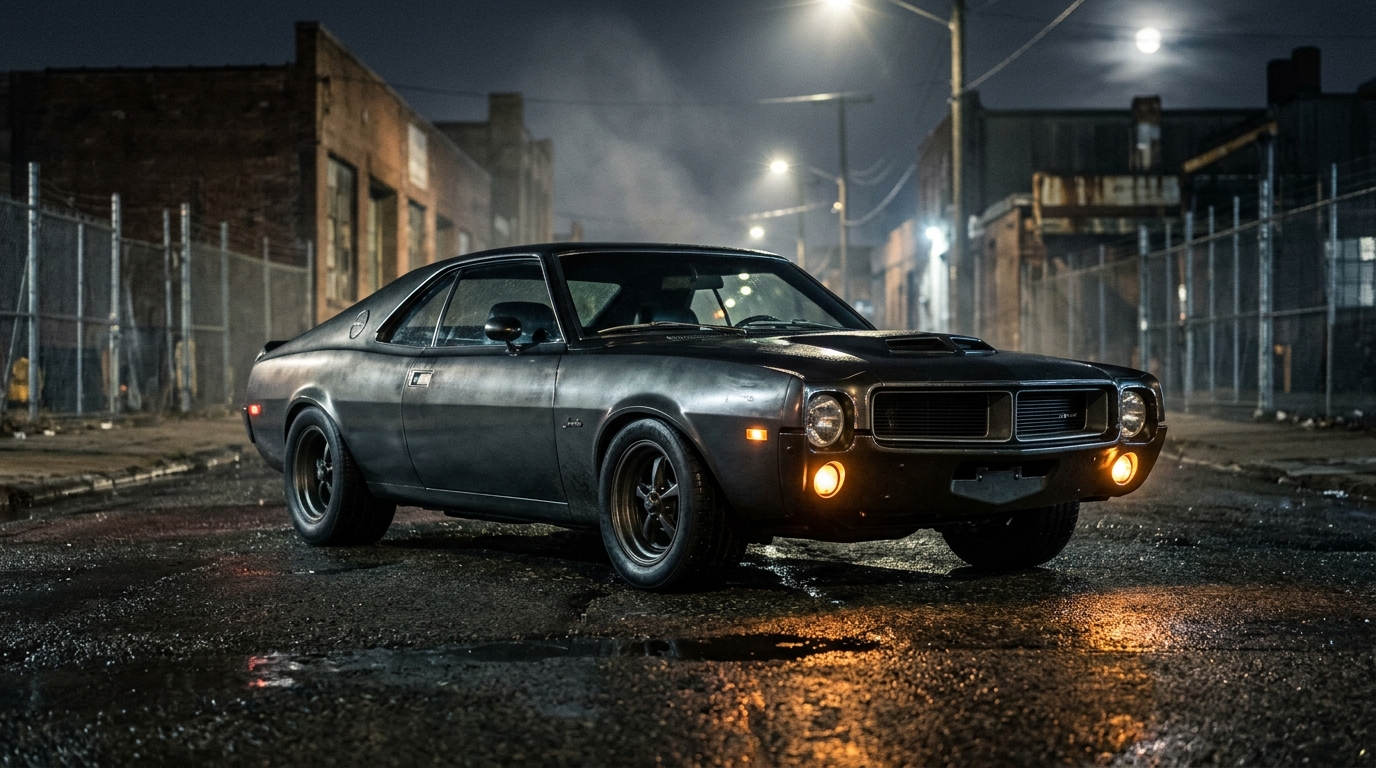
It is just past midnight and the only things moving on this empty boulevard are moths circling the sodium lamps and a Javelin idling at the curb, its long hood ticking as it cools. Everyone remembers the Mustang and the Camaro, but on nights like this the little brand from Kenosha, Wisconsin, makes a stubborn case for itself. The 1969 AMC Javelin was the underdog that showed up to a gunfight with a clever knife, and after dark it looks better than it has any right to.
The Underdog Arrives
American Motors launched the Javelin in the fall of 1967 as a 1968 model, and by 1969 it had settled into its stride. AMC was the perennial fourth-place automaker, squeezed by Ford, GM and Chrysler, and the Javelin was its bold answer to the pony car boom. Designer Dick Teague gave it a tidy, fastback-flavored shape with a long hood, short deck and a sculpted nose that looked more European than Detroit. Where rivals chased sheer size, the Javelin stayed compact and handsome, with a roofline that catches streetlight beautifully.
For 1969 the lineup was simple. The base Javelin used a 232 cubic inch inline six, while the Javelin SST offered a 290 V8 as the step-up, with the 343 V8 and the 390 V8 sitting at the top of the food chain. The 343 in four-barrel form made 280 horsepower, while the 390 was rated at 315 horsepower and a hefty 425 lb-ft of torque. A buyer could add the Go Package, which bundled the 343 or 390 with power front disc brakes, heavy-duty suspension, wide-oval tires and a handling-oriented setup. It was a proper performance recipe from a company nobody expected it from.
Driving It After Dark
Climb in at night and the cabin greets you with a warm glow from the simple, hooded gauge cluster. The dash is clean and logical, with big round instruments that are easy to read when the world outside is black. A 1969 Javelin does not hide behind electronics. You turn the key, the 390 coughs awake with a deep, loping burble, and that exhaust note bounces off dark storefronts in a way that makes every empty intersection feel like a stage.
The 390 delivers its torque in a thick, confident wave. Roll into the throttle and the Javelin squats and pulls, the four-barrel opening up with a hollow, gulping bark that builds to a hard-edged howl. It is not a razor-sharp sports car, but it is wonderfully alive. The steering is manual-feeling in the best way, light enough to flick through a sweeping on-ramp yet chatty enough to tell you what the front tires are thinking. With the Go Package the car feels planted, and the front discs give real confidence when you are hauling down from speed in the dark.
Headlights, Visibility and the Night Mood
Be honest about the lighting: 1969 sealed-beam headlamps are not modern projectors. The Javelin runs round twin sealed beams set into that distinctive grille, and on a dark country road they throw a warm, yellowish pool of light that rewards a moderate pace. High beams help, and the generous glasshouse gives good visibility for a pony car, with relatively slim pillars and a clear view over the long hood. The real magic is the atmosphere. The chrome trim and curved glass pick up every passing lamp, and the car seems to glow from the inside out as you roll through town.
At speed on an empty highway the Javelin feels settled and unhurried. The dash lamps wash the cabin in a soft amber, the engine hums in the background, and the road unspools in your headlight cones. This is the kind of drive that made the golden age of American cars so seductive: no screens, no chimes, just you, a V8 and the dark.
Racing Pedigree and Legacy
The Javelin was not just a boulevard cruiser. AMC went racing in the SCCA Trans-Am series, partnering with Ronnie Kaplan’s Kaplan Racing and later with Roger Penske’s team, and the Javelin became a genuine contender. Mark Donohue drove for Penske and carried the Javelin to Trans-Am victories in the early 1970s, giving the underdog badge real credibility. That racing heritage is why a clean 1969 Javelin carries such appeal today: it represents the scrappy challenger that punched above its weight.
Production numbers were modest compared with the big three. The 1969 model year saw roughly 56,000 Javelins leave the line, a small but respectable share that makes survivors rarer than their Ford and Chevy cousins. Collectors have noticed. A tidy SST with the right engine now commands strong money, and examples with the 390 and Go Package are especially prized.
Editor’s verdict: The 1969 AMC Javelin is the pony car for people who like to root for the underdog, and it rewards that loyalty with a fantastic V8 soundtrack and distinctive styling. Come for the Trans-Am story, stay for the midnight burble under a sodium lamp. It is rarer, cheaper and quirkier than its famous rivals, and that is exactly the point.