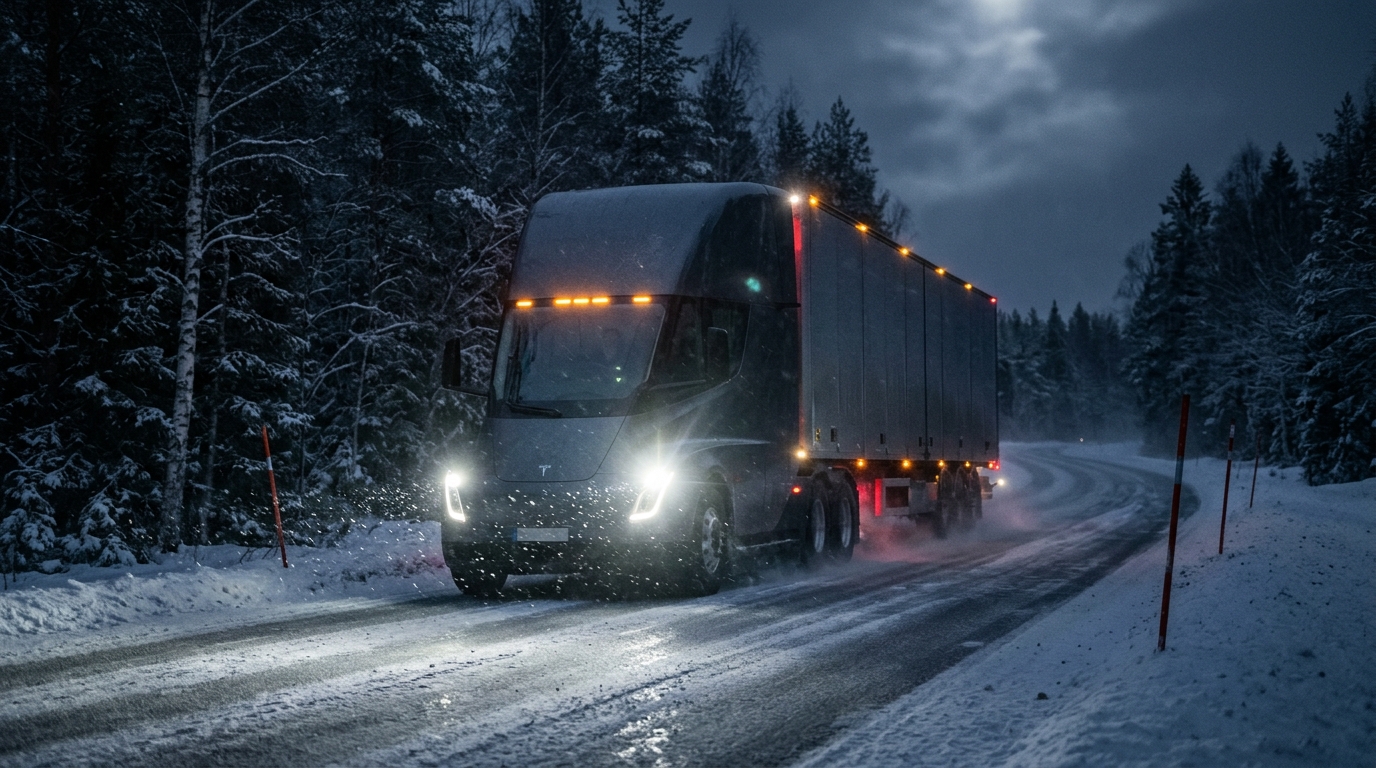
It is 2 a.m. on an empty interstate, and the loudest thing around is the hiss of tires on cold asphalt. The truck that just slid past you weighs tens of thousands of pounds and made almost no sound doing it. That is the strange, quietly unsettling magic of the Tesla Semi after dark.
A Truck Built Around the Driver
Tesla unveiled the Semi in November 2017, promising a Class 8 electric tractor with a 300 or 500 mile range and a 0-60 mph time of five seconds without a load. Production slipped repeatedly, and a small number of units were delivered to PepsiCo in December 2022. The 2021 model year sits in an awkward but fascinating place: it is the year the Semi’s design was publicly refined, and Tesla showed an updated cab and interior that year, even though customer deliveries lagged well behind the original promises. When we talk about the 2021 Semi, we are talking about the generation that proved the concept on paper and on prototype roads.
The cab is the headline. The driver sits in the center of the cab, a layout familiar from the McLaren F1 but wildly unfamiliar in a truck. Two touchscreens flank the driver, one on each side, and there is no traditional instrument cluster. Walk-in height means you can stand upright and step to either side. At night, that central position changes how the world looks. You see equal amounts of road on both sides, which feels oddly symmetrical and calming when the highway narrows around construction cones.
The Swedish Safety Connection
Our night-angle hook nods to a philosophy rather than a badge. Volvo pioneered the idea that a vehicle’s job is to protect the human inside it, and the Semi leans into that mindset. The cab uses a strong structure with a steeply raked, wide windshield, and the central seating position keeps the driver well clear of side impacts. Tesla’s driver-assist suite includes automatic emergency braking and collision warnings, and the truck is built to be aware of the lane and the traffic around it. Individually these are modest claims. Together, at 3 a.m., they matter, because fatigue is the real enemy of the overnight trucker.
A key safety feature is the Semi’s torque vectoring across independent motors on the drive axles, which helps it stay planted in slippery conditions. Regenerative braking also reduces brake fade on long descents, a genuine benefit when the road drops through a dark mountain pass and a conventional diesel would be roaring on its engine brake.
Driving It After Dark
The first thing you notice is the silence. There is no diesel clatter, no gear-change shudder, no turbo whistle. The three-motor setup, one motor driving the front drive axle and two on the rear, delivers torque instantly. Tesla’s quoted performance figures put the unloaded sprint to 60 mph at around 20 seconds when fully loaded to 82,000 pounds, and about five seconds when empty. Even at gross weight, the Semi surges forward with a smooth, linear shove that no diesel can imitate.
On a night run, the experience is almost meditative. The cabin stays cool in tone, the screens are dimmable, and the dash does not blind you. Without engine drone, you hear the world: the tick of expansion joints, wind around the mirrors, the soft tire hum. It is easier to concentrate, and easier to notice when something is off. Visibility ahead is superb thanks to the large glass area, and the headlights throw a wide, even beam down the lane. Reflectors and lane markings pop clearly, and the cab’s low hood line gives a good view of the road immediately ahead.
The ride is stable and the center-seat position feels natural after a few miles. Steering is light but accurate, and the truck tracks straight at highway speed with little correction. Regen is strong, and one-pedal driving takes a few minutes to master. Once you do, you rarely touch the brake pedal in traffic.
Range, Charging and the Business Case
Tesla quoted 300 and 500 mile versions. The 500-mile variant is the one that grabbed attention, targeting long-haul work. Charging relies on the Megacharger network, with Tesla claiming it can add roughly 70 percent of range in about 30 minutes. For an overnight operator, that fits neatly into a mandated rest break. The savings story rests on energy costs and reduced maintenance: no oil changes, no exhaust aftertreatment, fewer moving parts in the drivetrain. Tesla has argued that total cost of ownership can undercut diesel over a few years of heavy use.
Real-world proof has been slower to arrive than the hype suggested. Early customer trials have shown encouraging efficiency, though verified long-term data remains limited, so treat the headline numbers as targets worth watching rather than settled fact.
Where It Falls Short
Nothing here is perfect. The Semi’s delayed rollout and scarce availability make it a difficult truck to actually buy, and the charging infrastructure is still being built out. Payload can be reduced by battery weight compared with a diesel, a trade-off that regulators have partly offset with weight allowances for electric trucks. The unconventional cab also demands adjustment from drivers used to a traditional layout. None of that dulls the sheer novelty of the experience, but it keeps the Semi firmly in the early-adopter category.
The Tesla Semi will not win over every trucker, and its slow, uneven rollout tempers the hype. But after dark, with the cab hushed, the road lit in even cool tones and the driver sitting dead center, it makes a convincing case that the future of freight is quiet, safe and remarkably calm. If Tesla delivers on its numbers at scale, the night shift will never sound the same.