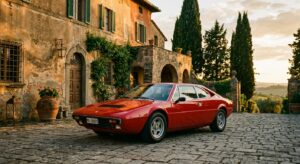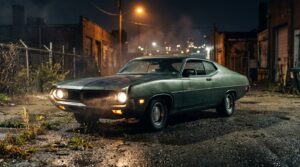
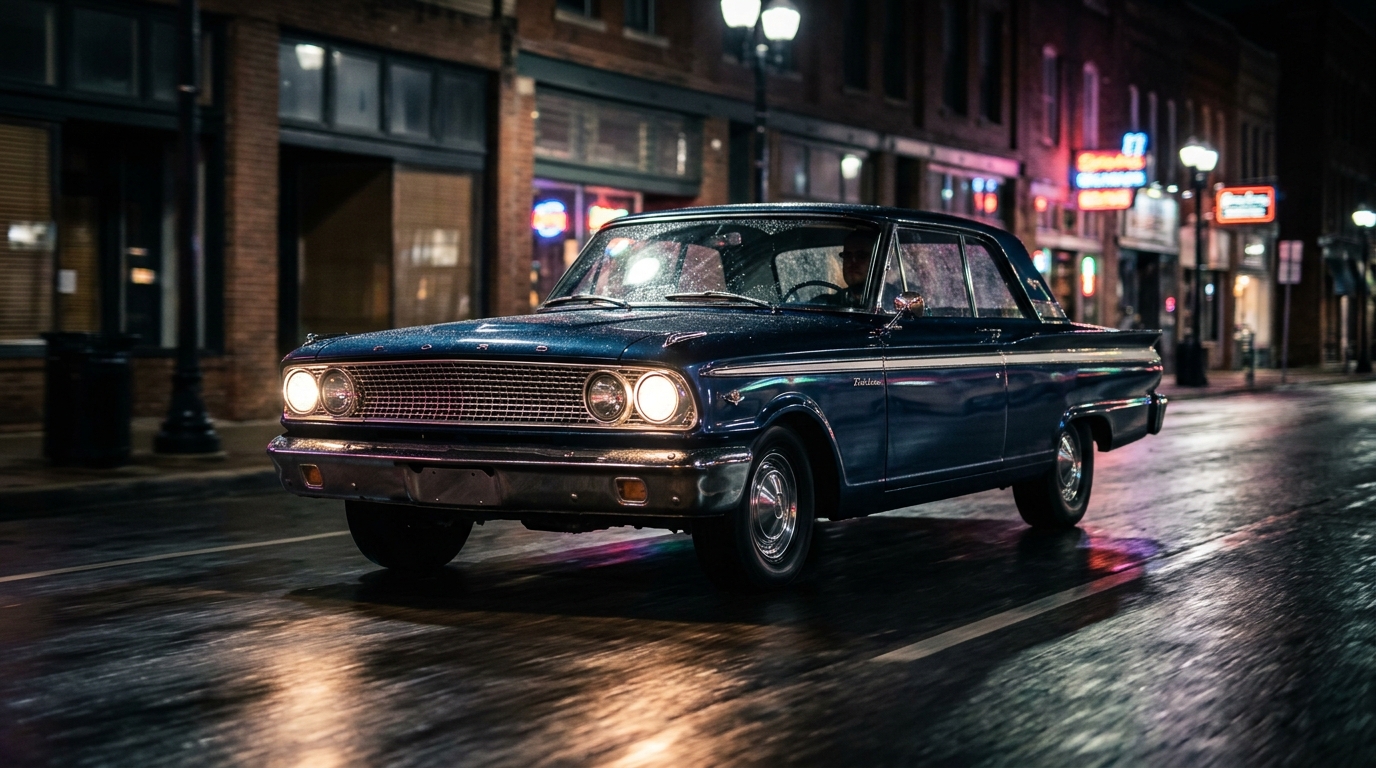
It is a little past midnight and the main drag has gone quiet, the kind of quiet that only exists in the hour after the diners lock up. A sodium streetlight pools amber light across a long hood, and the chrome side spear glows like a strip of warm brass. This is the 1963 Ford Fairlane 500, a car built for exactly this hour.
A Note on the Hook: Full-Size Feel, Mid-Size Frame
Let us get the history straight, because the Fairlane gets mislabeled all the time. In 1963 the Fairlane was Ford’s mid-size line, sitting below the full-size Galaxie. It rode a 115.5-inch wheelbase and measured roughly 197 inches bumper to bumper, which means it felt big on the road in 1963 even though Ford’s own marketing positioned it as the sensible, right-sized choice. After dark, with that long flat hood stretching ahead of you, the car absolutely drives like a full-size Ford. The sensation is of a lot of steel out front and a very relaxed pace behind the wheel.
The Fairlane Story in 1963
The Fairlane nameplate came from Henry Ford’s Fair Lane estate in Dearborn, and the mid-size Fairlane arrived for 1962 as Ford’s answer to the demand for a more compact family car after the full-size cars had grown large. By 1963 the lineup was well established. The Fairlane 500 was the up-trim model above the base Fairlane, adding extra brightwork and nicer interior fittings. Body styles included the two-door and four-door sedans, a two-door hardtop, the Squire station wagon, and the Ranch Wagon. The 1963 refresh brought a cleaner grille and revised trim, and mid-year Ford introduced the Fairlane 500 Sports Coupe, a bucket-seat hardtop that previewed the performance image the nameplate would grow into.
The big engineering story of the era was the Windsor small-block V8. Ford’s thin-wall cast small-block debuted in the Fairlane in 1962 as a 221 cubic-inch V8, and for 1963 the lineup offered the 260 cubic-inch version making 164 horsepower, and, from mid-year, the 289 cubic-inch V8. The 289 became the heart of the Fairlane’s character, and in high-performance form it would later power Mustangs and Cobras. A straight-six was also available for buyers who wanted economy over swagger.
Driving It After Dark
A car from 1963 is a lesson in how far night driving has come. The sealed-beam headlights are small and warm by modern standards, throwing a yellowed pool of light that rewards a slower, more attentive driver. You learn to read the road ahead differently. Streetlights matter. Reflective signs matter. The dashboard glows a soft green-white, and the speedometer sweeps across a wide ribbon that you can read at a glance without ever feeling blinded.
With the 289 V8 and automatic, the car pulls away from a stoplight with a smooth, unhurried shove. It never feels frantic. Ford tuned the Windsor for torque in the middle of the rev range, and the exhaust note is a low, burbling murmur that carries across empty streets without ever shouting. At night, with the windows down and the town asleep, that sound fills the cabin the way a good bass line fills a room.
Ride, Handling and Mood
Do not mistake this for a sports car. The Fairlane’s recirculating-ball steering is light and vague, the front-engine, rear-drive chassis leans in corners, and the drum brakes ask you to plan your stops well in advance. Power steering and power brakes were optional, and a car without them demands real arm and leg effort. What the Fairlane does brilliantly is float. The soft suspension swallows broken pavement, and on a quiet highway the car settles into a gentle, loping rhythm that makes a midnight run feel effortless.
Visibility from the greenhouse is excellent. Thin pillars, big glass and a low beltline make the cabin feel airy even at night, and the bench seat puts you in a relaxed, upright position that suits long, slow miles. It is the opposite of a modern car’s cocooning cockpit, and it is wonderful for it.
Living With a Classic Fairlane
As a classic, the Fairlane is a smart entry point. Parts support for the small-block Windsor is superb, mechanical simplicity keeps ownership affordable, and the cars have a loyal following that values them as an alternative to the better-known Galaxie and later Mustang. Prices remain far friendlier than for the muscle cars that followed, particularly for sedans and wagons. Rust in the lower fenders, rocker panels and floor pans is the main concern, along with tired drum brakes and aging wiring.
The 1963 Fairlane 500 is not fast, sharp or flashy, and that is exactly why it works at midnight. It is a soft-riding, small-block-burbling time machine that turns any empty street into a scene from another era, and it costs a fraction of what the better-known icons of its decade demand. If you want a classic that rewards slow, quiet, after-dark driving, this is the one.