When the Jaguar E-Type made its debut at the 1961 Geneva Motor Show, it didn’t just turn heads – it redefined what the world expected from a sports car. With styling that seemed to flow like liquid mercury and performance that embarrassed cars costing twice as much, the E-Type became an instant icon. Enzo Ferrari himself declared it “the most beautiful car ever made,” and even today, more than six decades later, few would argue with that assessment.
A Revolution in Steel and Aluminum
The E-Type’s genesis lay in Jaguar’s racing program, specifically the D-Type that dominated Le Mans in the mid-1950s. Malcolm Sayer, the aerodynamicist behind both cars, applied wind tunnel science to create the E-Type’s impossibly long hood, swept-back windscreen, and tapering rear end. But unlike its racing predecessor, this was a car you could drive to the office – assuming your office appreciated automotive artistry.
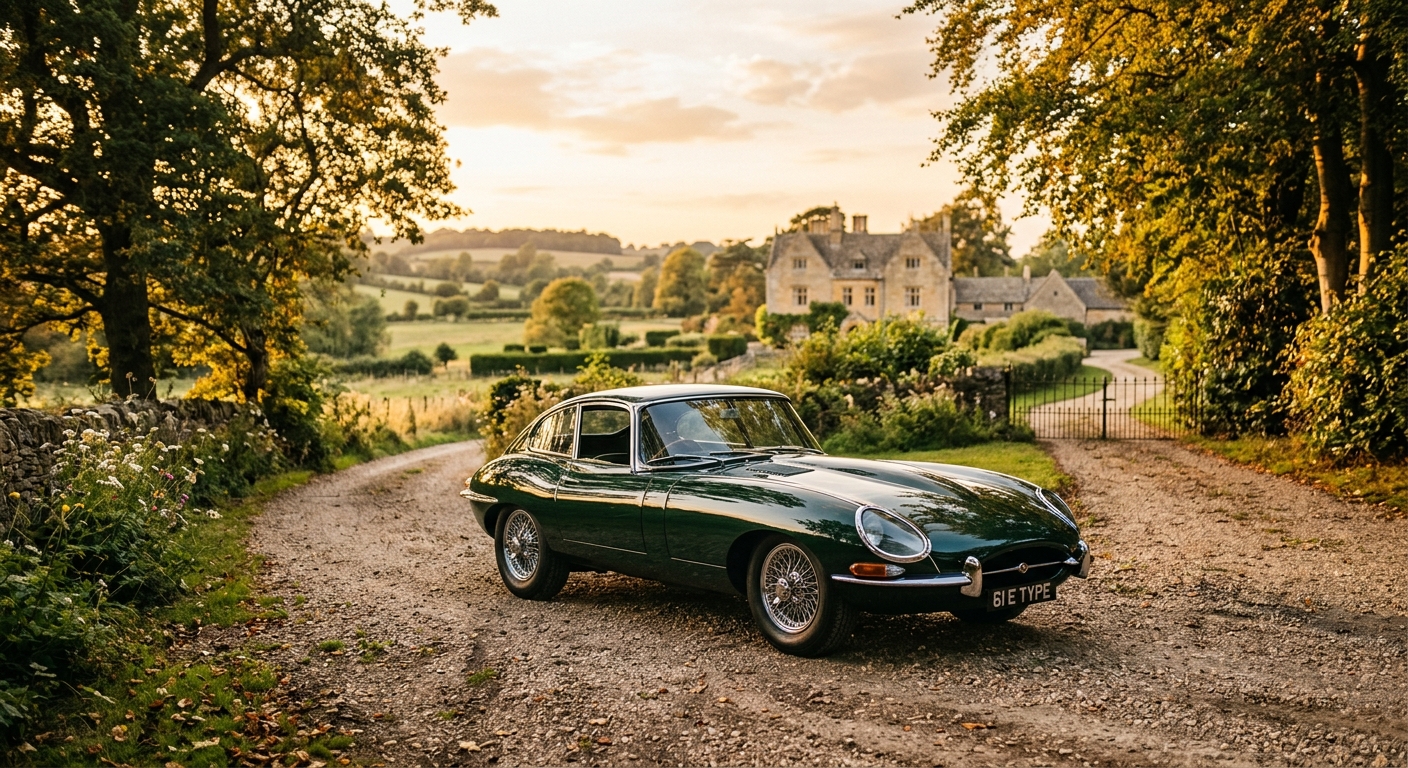
The Series 1, produced from 1961 to 1968, represents the E-Type in its purest form. The covered headlights, flat floor panels, and toggle switches throughout the cockpit speak to an era when function and form existed in perfect harmony. Chrome bumpers bookend the car’s 14-foot length, while those distinctive side vents aren’t just decorative – they actually channel hot air away from the engine bay.
The Beating Heart
Under that endless hood lies Jaguar’s legendary 3.8-liter XK inline-six, an engine that traces its lineage back to the XK120 of 1948. In E-Type trim, it produces 265 horsepower – enough to propel this svelte cat to 60 mph in under seven seconds and on to a genuine 150 mph top speed. Those numbers made it faster than Ferrari’s 250 GT and Aston Martin’s DB4, yet the E-Type cost a fraction of their price.
The engine’s character perfectly matches the car’s personality. It’s smooth and refined at low revs, perfect for cruising through English villages, but becomes increasingly urgent as the tachometer needle sweeps toward the 5,500 rpm redline. The exhaust note is pure music – a cultured growl that builds to a proper howl under full acceleration.
Engineering Excellence
Beyond its stunning looks and potent engine, the E-Type pioneered several technical innovations. Independent rear suspension was still exotic in 1961, yet Jaguar fitted it as standard. The four-wheel disc brakes – developed from the company’s racing experience – provided stopping power that matched the car’s straight-line performance. The monocoque construction kept weight down while maintaining structural rigidity.
The four-speed manual gearbox, while not the smoothest of its era, offers perfectly spaced ratios that make the most of the XK engine’s power band. First gear is good for 45 mph, second will take you past 70, and third stretches all the way to 105 mph. It’s a setup that encourages spirited driving on winding country roads.
The Driving Experience
Sliding into the E-Type’s cockpit is like stepping back in time. The seats are supportive but not restrictive, the steering wheel is perfectly positioned, and every control falls naturally to hand. The view over that impossibly long hood takes some adjustment – you’re essentially aiming the car with the tip of the bonnet as your reference point.
On the road, the E-Type reveals its dual personality. In town, it’s docile and manageable, the engine pulling cleanly from low revs while the light steering makes parking surprisingly easy. But find an empty stretch of tarmac, and the car transforms. The suspension, advanced for its time, keeps the car planted through sweeping curves while providing enough feedback to let you know exactly what’s happening at each wheel.
The E-Type Series 1 isn’t just a classic car; it’s automotive sculpture that happens to move with genuine grace and speed. Despite its age, it still possesses the power to stop traffic and steal hearts. Yes, finding a pristine example requires patience and a healthy budget, but few investments offer such a perfect blend of beauty, performance, and automotive history.