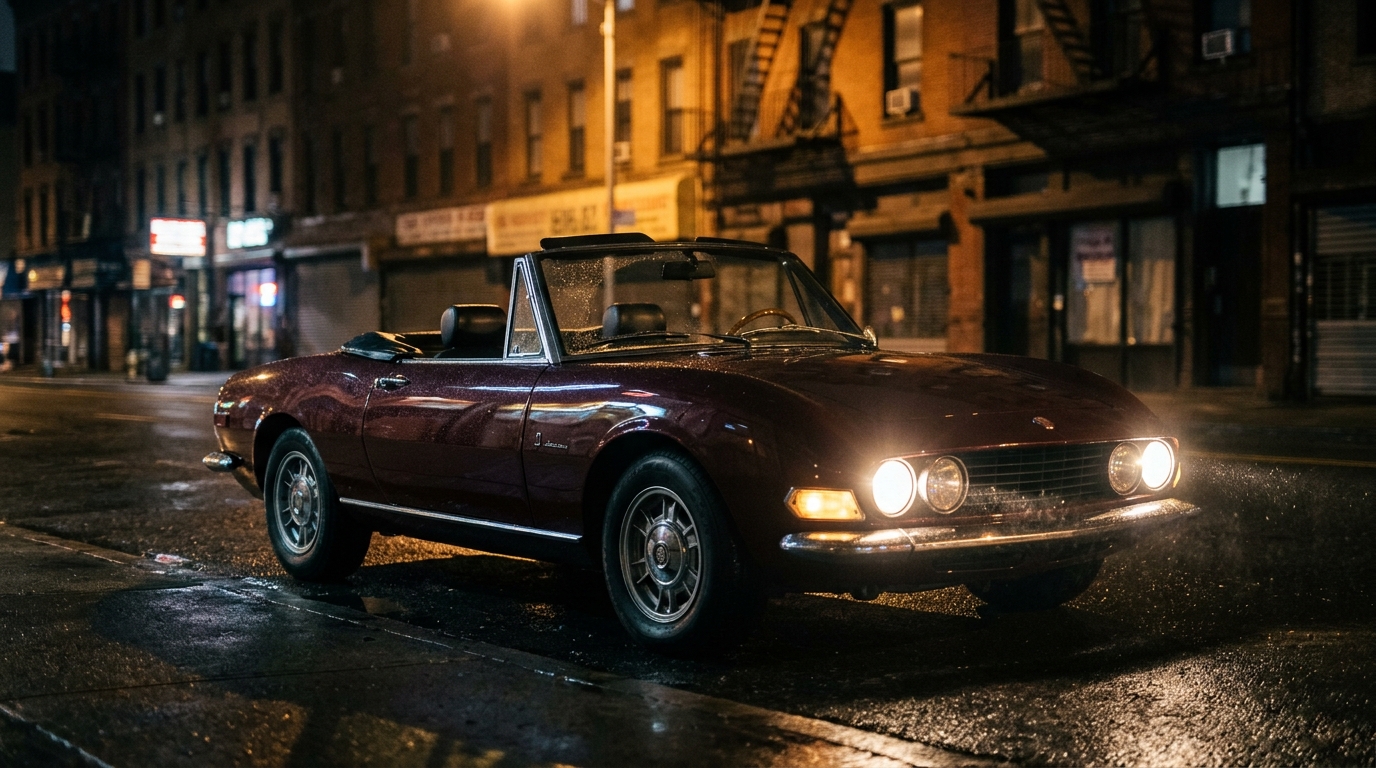
Picture a ribbon of empty two-lane blacktop at 1 a.m., a warm orange streetlight sliding across a long red hood, and a V6 behind your shoulder blades wailing like it escaped from a Ferrari. That is the Fiat Dino Spider after dark, and it remains one of the great overlooked night drivers of the vintage world. A quick note before we go any further: the Dino did not exist in 1963, and we will get to why that matters.
A Car That Missed Its Own Birthday
The ‘1963’ in the title deserves a correction, because accuracy is the whole point of a spec sheet. The Fiat Dino Spider was unveiled at the Turin Motor Show in late 1966, with the Bertone-bodied Coupe following in 1967. No Fiat Dino was built or sold in 1963. What did happen around that time was the seed of the idea. Ferrari needed a high-volume V6 to homologate for Formula 2, which required an engine used in at least 500 road cars. Ferrari could not build that many on its own, so it struck a deal with Fiat, which had the production muscle to do it. The engine was named Dino in honor of Enzo Ferrari’s late son, Alfredo.
So when we say 1963, think of it as the year the Ferrari-Fiat alliance was taking shape, not the year the car rolled out. The spec sheet below reflects the first-generation Fiat Dino Spider, launched in 1966 with the 2.0-liter engine, which is the car this review is truly about.
Why It Was Forgotten in America
Here is the real night-grand-tourer hook. Fiat never officially sold the Dino in the United States in any meaningful volume. Federal emissions and safety rules made the Dino a hard sell for Fiat’s American operation, and the car’s Italian mechanical complexity did not suit a market that wanted cheap and reliable. The few examples that reached American soil mostly came through gray-market and private importers, which is why you almost never see one at a Cars and Coffee. It is an Italian sports car that quietly skipped the country, and that absence is a big part of its mystique.
Driving Impressions After Dark
Slide behind the thin wood-rimmed wheel at night and the first thing you notice is the glow. The instrument cluster is a small constellation of white-lit gauges, easy to read without washing out your night vision. The twin round headlights on the Spider are modest by modern standards, but the beam pattern is wide and friendly on unlit roads. Treat them as vintage lamps and you will be fine: slow your pace on blind corners, because the output is a warm, yellowish pool rather than a laser.
Then you press the throttle and all that restraint evaporates. The 2.0-liter V6, with its four overhead camshafts and three Weber carburetors, builds from a purposeful growl into a hard, metallic howl above 5,000 rpm. At night, with fewer cars around and the top down, the sound bounces off guardrails and stone walls and fills the cabin in a way daylight never allows. Tunnels are cheat codes. Drop a gear, lift, and the crackle on the overrun echoes back like applause.
The Spider rides on a live rear axle with leaf springs, a layout that sounds crude next to the Ferrari it shares an engine heritage with, but it suits the car. It is lively and communicative rather than razor sharp. Steering is light and talkative, the five-speed gearbox has a mechanical snick, and the whole car feels small and tossable on a winding night road. Brakes are discs all round, a real asset when you are hustling through the dark and cannot quite see the apex.
Design and Provenance
Pininfarina drew the Spider, and it shows. The long hood, short deck, and clean flanks wear that mid-1960s Italian elegance without a single wasted crease. The Coupe, by Bertone with Giorgetto Giugiaro’s pen, is a separate and equally handsome machine, but the Spider is the one you want for a midnight run with the stars overhead. In 1969, Fiat updated the lineup with the larger 2.4-liter engine, cast-iron block and independent rear suspension, creating a more refined and more powerful car. The earlier 2.0-liter cars, however, retain the raw character that collectors prize.
Living With One
Reality check: this is a 1960s Italian exotic-adjacent machine. Rust, tricky triple-carb tuning, and sourcing Dino-specific parts all demand patience and a good specialist. But values have climbed steadily as enthusiasts recognize that you can own a car with a genuine Ferrari-lineage V6 at a fraction of the cost of a Dino 246 GT. For a weekend night cruiser, it delivers theater that cars costing three times as much struggle to match.
Editor’s verdict: The Dino Spider is the Ferrari-engined Italian that America never got to meet, and the midnight hour is where its howling quad-cam V6 and Pininfarina curves make the most sense. It asks for patience and a good mechanic, then pays you back with one of the best soundtracks in the vintage world. Find one, drop the top, and chase the taillights of a night that belongs to you alone.