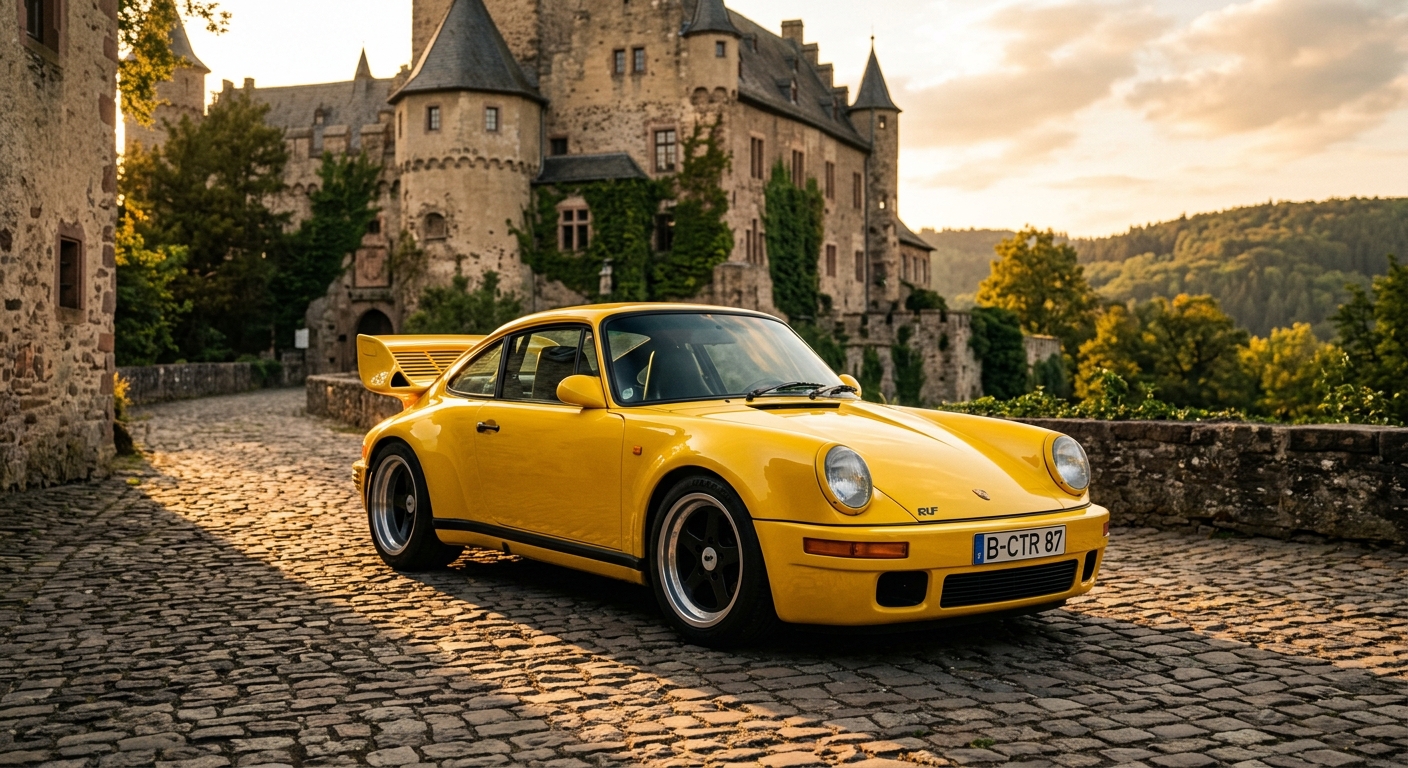
In 1987, a small German company from Pfaffenhausen did something that seemed impossible: they built a car faster than Ferrari, Lamborghini, and Porsche combined. The Ruf CTR, dubbed ‘Yellowbird’ for its canary paint and predatory nature, didn’t just break the 200 mph barrier. It obliterated every assumption about what a modified 911 could achieve, becoming automotive legend in the process.
This wasn’t just another tuner car with bolt-on modifications. Alois Ruf Jr. essentially reimagined the 911 from the ground up, creating what many consider the most significant sports car of the 1980s.
The Birth of a Legend
The CTR story begins with Alois Ruf’s obsession with extracting maximum performance from Porsche’s rear-engine platform. Working from a converted farmhouse in rural Bavaria, Ruf purchased brand-new 911 Carrera 3.2 chassis directly from Porsche and proceeded to transform them into something entirely different.
The heart of the transformation was Ruf’s heavily modified 3.4-liter flat-six engine. Twin KKK turbochargers, intercoolers, and extensive internal modifications pushed output to 469 horsepower and 408 lb-ft of torque. In an era when the flagship Porsche 930 Turbo made 300 horsepower, these numbers were staggering.
But power was only part of the equation. Ruf lightened the car extensively, stripping out unnecessary weight while reinforcing the chassis. The result was a car that weighed just 2,535 pounds, giving it a power-to-weight ratio that wouldn’t be matched by mainstream supercars for another decade.
Breaking Records and Expectations
In April 1987, automotive journalist Paul Frère took a CTR to Volkswagen’s Ehra-Lessien test track and achieved the impossible: 211 mph. This made the CTR the fastest production car in the world, a title it held until the Bugatti Veyron arrived nearly two decades later.
The acceleration figures were equally mind-bending. Zero to 60 mph took just 3.7 seconds, while the sprint to 100 mph required only 8.8 seconds. These were hypercar numbers achieved with 1980s technology and a small-batch production approach.
What made the CTR truly special wasn’t just its straight-line speed, but its ability to handle that power. The car featured Ruf’s own suspension geometry, massive Brembo brakes, and specially developed Dunlop tires. The famous whale tail spoiler wasn’t just for show; it provided crucial high-speed stability.
The Nürburgring Terror
The CTR’s most legendary moment came courtesy of a promotional film shot at the Nürburgring. Watching Stefan Roser pilot the yellow beast through the Green Hell in wet conditions, with the car sliding sideways at triple-digit speeds while remaining completely controllable, became the stuff of automotive folklore.
That video showcased something remarkable: despite its fearsome reputation, the CTR was actually more manageable than Porsche’s own 930 Turbo. The twin-turbo setup reduced lag, while the revised suspension geometry tamed the 911’s notorious snap-oversteer tendencies.
Exclusivity and Legacy
Only 29 CTRs were ever built, making each one extraordinarily rare. Unlike many limited-production supercars, these weren’t garage queens. Owners actually drove them, racked up miles, and experienced what it meant to pilot the world’s fastest car on public roads.
The CTR established Ruf as far more than a Porsche tuner. It proved that with enough engineering brilliance and attention to detail, a small independent manufacturer could not only compete with the world’s biggest names but actually surpass them.
The Ruf CTR remains the ultimate expression of focused engineering over marketing gloss. While modern supercars coddle their drivers with electronic aids and refined interiors, the Yellowbird demanded respect and rewarded skill with an driving experience that remains unmatched nearly four decades later. It’s proof that sometimes the most significant automotive achievements come not from boardrooms, but from passionate individuals with an uncompromising vision.