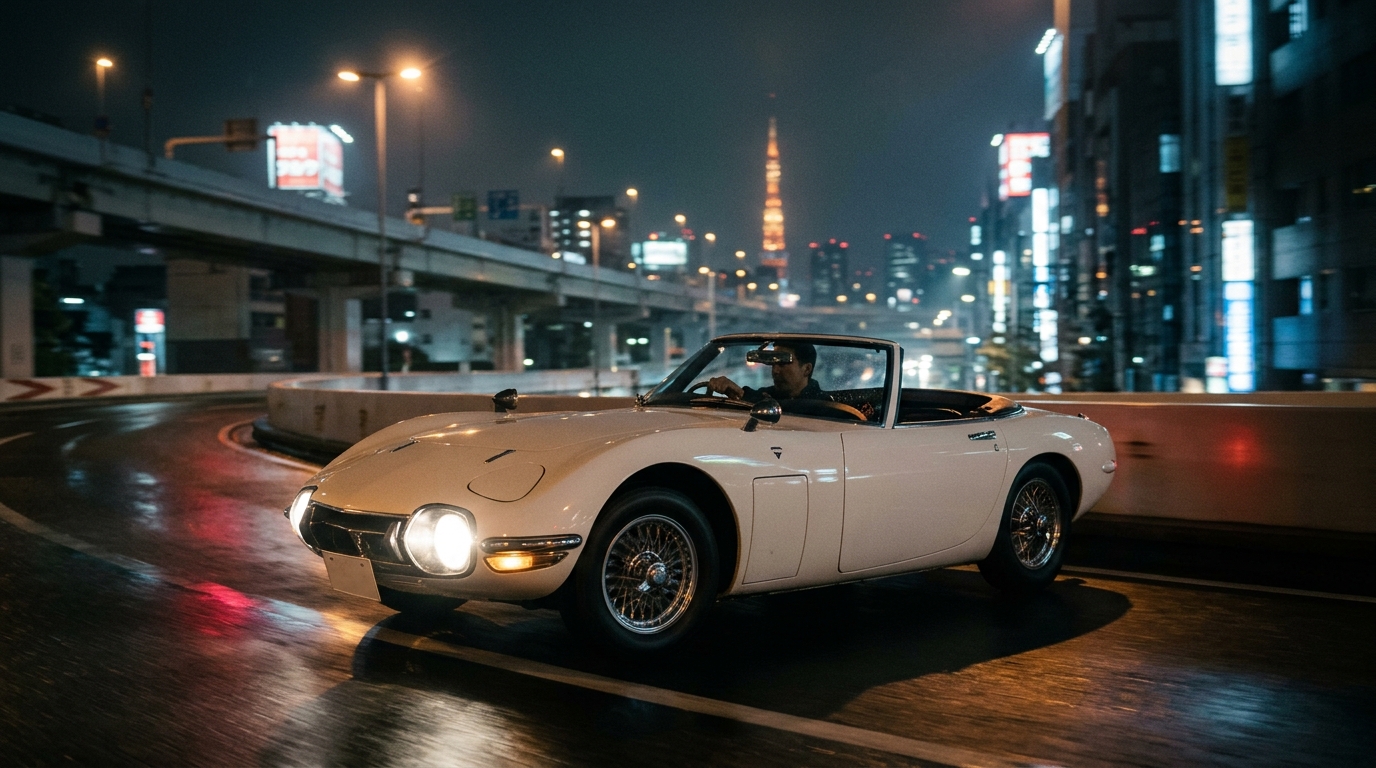
The sodium lamps on the empty road ahead turn the long bonnet of the 2000GT into a river of molten orange, and for a moment it is easy to believe you have wandered onto a film set. This is the car that made the world take Japanese engineering seriously, and it looks its best when the sun is gone and the streetlights do the sculpting. We spent a night with one of the most coveted Japanese cars ever built.
A Legend Forged Out of Ambition
In the mid 1960s, Toyota wanted a halo car that would prove Japan could build a world-class grand tourer. The result, unveiled at the 1965 Tokyo Motor Show and put on sale in 1967, was the 2000GT. Toyota developed it with Yamaha, which supplied crucial engineering muscle and hand-assembled much of the car. The styling is widely credited to Toyota designer Satoru Nozaki, working from a concept shaped by Albrecht von Goertz, the German-American stylist behind the BMW 507. Whatever its precise lineage, the shape is pure 1960s poetry: a long bonnet, a tight fastback cabin, pop-up headlights, and a body that hugs a backbone chassis.
Then came the movies. When Sean Connery proved too tall to fold into the coupe for You Only Live Twice (1967), the filmmakers had Toyota build two open-top versions for the production, and the 2000GT became an instant icon as a Bond car. That convertible was never sold to the public, but the publicity did its job.
The Drive: Sodium Light and Straight-Six Song
Twist the key and the 1,988 cc twin-cam inline-six wakes with a bright, metallic rasp that you feel as much as hear. The 3M engine, derived from Toyota’s Crown unit but heavily reworked by Yamaha with a DOHC head and three Mikuni-Solex carburetors, makes a claimed 150 horsepower at 6,600 rpm. That figure sounds modest today, but in a car weighing roughly 2,300 pounds it translates into brisk, eager performance with a genuine appetite for revs. The five-speed manual is a delight, with a short, mechanical throw and a gate that rewards a deliberate hand.
At night the experience concentrates. The cabin is a beautiful place to be after dark: a rosewood dash with a full set of round gauges glows softly, the small-diameter wood-rimmed wheel falls naturally to hand, and the low seating position puts the road surface close beneath you. The pop-up headlamps are charmingly period-correct, but be honest about the limits of 1960s lighting. The sealed-beam-era output is modest by modern standards, so this is a car you drive with a smooth, patient rhythm rather than attacking dark back roads. That suits it perfectly. Keep the revs singing through a sleeping tunnel and the exhaust note bounces off the walls like a miniature race car.
Handling and Ride
The backbone chassis and four-wheel independent suspension with double wishbones give the 2000GT a poised, communicative feel. Four-wheel disc brakes were advanced for the era and haul the car down confidently. Steering is light and precise, and the whole machine feels more European than anything else coming out of Japan at the time. Tall drivers will quickly understand the Connery problem: headroom and legroom are tight, and the low roofline makes entry an exercise in origami.
Rarity and Value
Toyota built just 351 production cars between 1967 and 1970, including prototypes, which makes any 2000GT a genuine rarity. Because Yamaha hand-built so much of each car, production was slow and costs were high. In Japan it was priced at around 2.38 million yen, roughly the cost of several ordinary family cars of the day, and sales never came close to covering the investment. That scarcity and its Bond connection have turned it into a seven-figure collector item. Well-documented cars have sold for well over a million dollars at auction, and the finest examples have approached or exceeded that mark by a wide margin.
Final Thoughts From the Dark
Park it under a lone streetlamp, shut off the engine, and listen to the metal tick as it cools. The 2000GT is not the fastest classic of its decade, but it carries a story, a face, and a voice that few cars can match. It is the moment Japan announced itself to the world, and it still looks utterly at home after midnight.
The 2000GT is not the quickest car of its era, but it may be the most important Japanese car ever built, and it wears the night like a tailored suit. Priceless in reputation and fiendishly rare, it is a rolling reminder of the moment Japan stopped following and started leading.