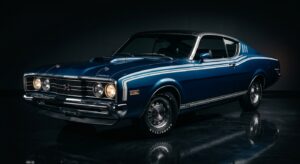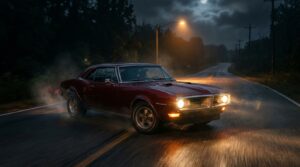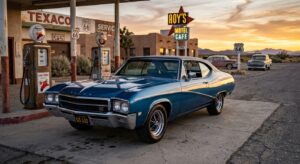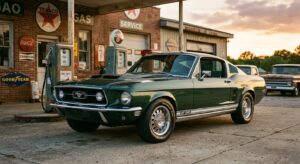
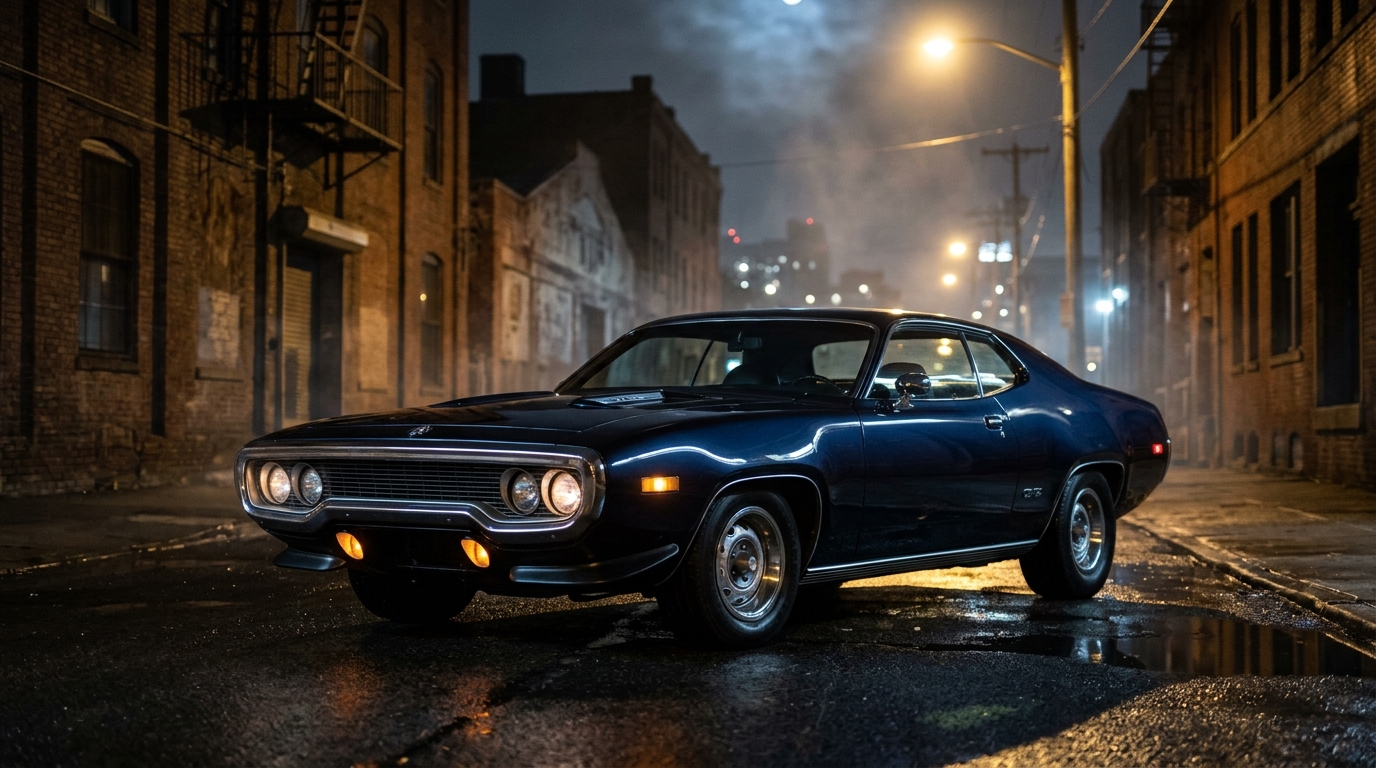
The streets are empty, the sodium lamps hum orange overhead, and somewhere a big-block V8 is idling with that lumpy, unhurried cadence that says it has nothing to prove. The 1971 Plymouth GTX was never the loudest car on the block, and that is precisely what makes it so good after midnight.
The Suit-and-Tie Brawler
When Plymouth introduced the GTX in 1967, the idea was simple: take the intermediate Belvedere, stuff the 440 Super Commando under the hood, and sell it to buyers who wanted Hemi-adjacent power with a bit more refinement than the stripped-down Road Runner. Where the Road Runner was the budget brawler, the GTX was the gentleman’s express, with a nicer interior, standard big-block power, and a more mature personality. By 1971 the GTX rode on a fresh platform, with the sweeping, fuselage-style body shared with the Satellite, and it was a handsome piece of work: long hood, short deck, a blunt grille surround and those signature hood scoops.
That 1971 model year was something of a swan song. Emissions rules and insurance surcharges were already strangling the muscle car market, and compression ratios were being lowered across Detroit to accommodate unleaded-friendly fuels. For 1971 the GTX was no longer a standalone model line in the strictest sense. It was positioned as a Road Runner-based performance option package, and production was tiny, around 2,500 cars, with only a handful of those built with the 426 Hemi. That rarity is a big part of why collectors chase them today.
Driving It After Dark
Climb in at night and the first thing you notice is the glow of the instrument cluster, a warm and simple wash of amber-lit gauges that does not compete with the road. Visibility out of the front is excellent, the hood stretching ahead of you like an airstrip. The sealed-beam headlights are, frankly, the weak link: period halogen-free units throw a dim, yellowish pool of light, and on a dark back road you learn quickly to respect the speed you can actually see. It is the one place where the romance of the era runs into the reality of 1971 lighting technology. Swapping to modern sealed-beam halogen replacements is the single best upgrade for anyone who plans to use one of these after sundown.
The 440 four-barrel in standard form made 370 horsepower in the old gross rating, and the legendary 440 Six Pack with three two-barrel carburetors was rated at 385 horsepower. Both deliver the same thing at night: a deep, rolling torque that makes the car feel relaxed rather than frantic. Roll onto the throttle on an empty road and the sound builds from a baritone burble to a full-throated roar that bounces off the buildings. With the three-carb setup, the center carb handles cruising and the outer two open up when you put your foot down, so the car behaves like a gentleman in traffic and a hooligan when the lane clears.
The ride is soft by modern standards, with a big floaty cushion over expansion joints and a steering box that demands patience. Brakes are drums at the rear and discs up front, adequate for the day and humbling by today’s expectations. This is a car you drive with anticipation, reading the road ahead rather than attacking it. At night, with the town asleep and the radio low, that slower rhythm is part of the appeal.
Why It Still Matters
The GTX of 1971 is a bookend. It represents the last gasp of the unrestrained big-block era, a car built just before the oil crisis and the smog regulations rewrote the rules. It has the presence of a true muscle car without the shout of a Hemi ‘Cuda or a Boss 429. For collectors, the appeal is the quiet confidence, the tuxedo-wearing bruiser that does not need an obnoxious stripe package to announce itself. Values for authentic big-block cars have climbed steadily, and Hemi-equipped examples sit in the stratosphere.
Editor’s verdict: The 1971 GTX is the muscle car for people who prefer a rumble to a shout, a rare and handsome last-of-the-breed big-block that shines brightest on empty roads after midnight. Upgrade the headlights, respect the brakes, and let that 440 do the talking.