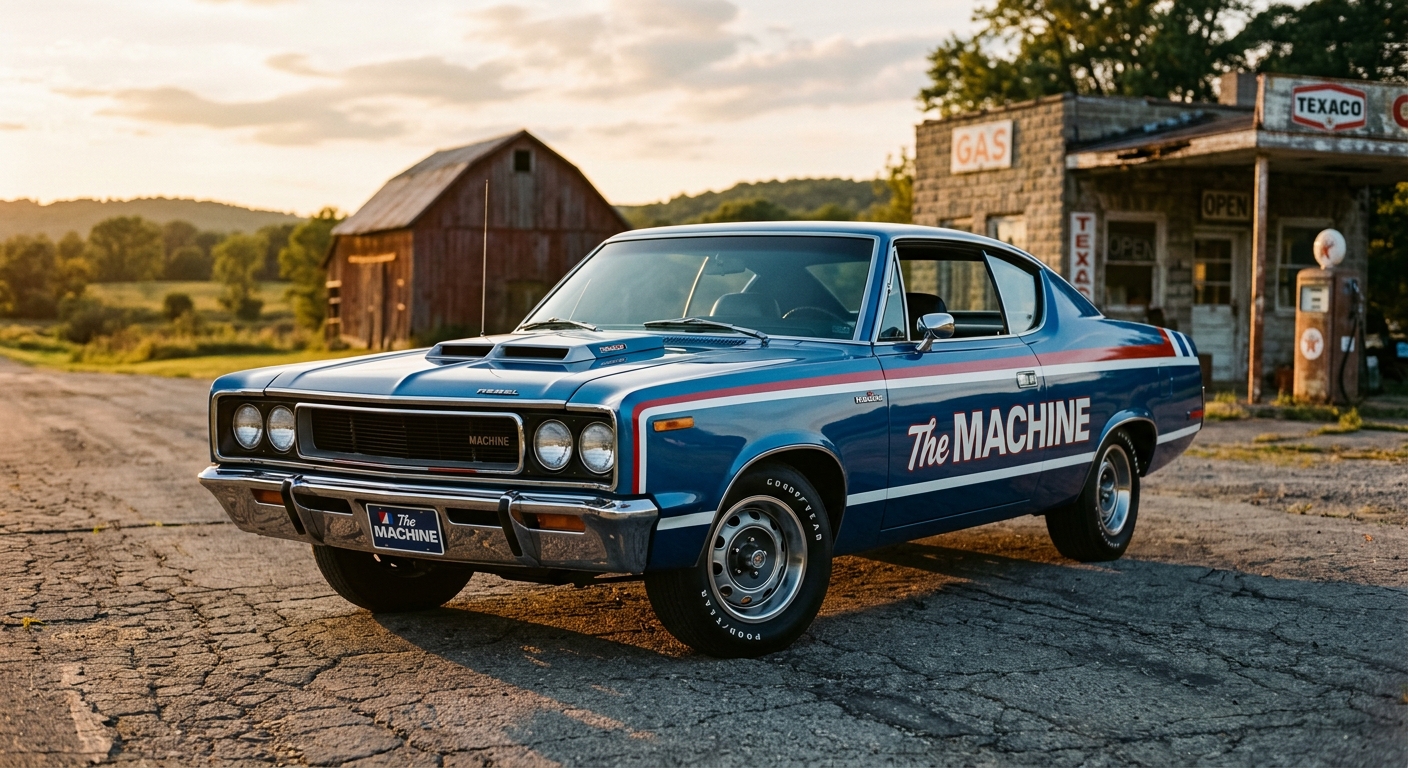
In 1970, when the Big Three were locked in horsepower warfare, American Motors Corporation threw its hat into the ring with perhaps the most audacious muscle car statement ever made. The Rebel Machine wasn’t just about straight-line speed; it was a rolling declaration of independence wrapped in red, white, and blue paint with enough attitude to make a Chevelle SS driver do a double-take.
The Underdog’s Finest Hour
AMC knew they couldn’t compete with General Motors’ budget or Ford’s racing pedigree, so they did what underdogs do best: they got creative. The Rebel Machine was their middle finger to the establishment, a car that dared to be different in an era when conformity meant black stripes on muscle cars. Instead, AMC wrapped their meanest machine in a patriotic paint scheme that screamed American pride from every angle.
The standard livery featured a white body with red and blue racing stripes that flowed from the functional hood scoop all the way to the rear spoiler. It was bold, brash, and completely unapologetic. For buyers who preferred subtlety, AMC offered other colors, but let’s be honest: if you were buying a car called “The Machine,” subtlety probably wasn’t your primary concern.
390 Cubic Inches of Rebellion
Under that distinctive hood scoop lived AMC’s 390 cubic inch V8, tuned to produce 340 horsepower and 430 lb-ft of torque. While those numbers might not have topped a 440 Six Pack or an LS6 Chevelle, the 390 was a stout motor with a personality all its own. The engine featured a radical cam, high-flow heads, and a four-barrel carburetor that gave it a lopey idle and a bark that announced its presence three blocks away.
The Machine came standard with a Hurst-shifted four-speed manual transmission, and AMC didn’t stop there. They fitted it with a Twin-Grip differential, heavy-duty suspension components, and wide F60-15 tires on distinctive Rally wheels. The result was a car that could run low 14-second quarter miles straight off the showroom floor, competitive with anything Detroit was building at the time.
David Among Goliaths
What made The Machine special wasn’t just its performance; it was its character. While other manufacturers were building increasingly sanitized muscle cars for the masses, AMC created something that felt genuinely rebellious. The cockpit featured high-back bucket seats, a floor-mounted shifter, and gauges that actually worked, a rarity in the era of optimistic speedometers and decorative tachometers.
The handling was surprisingly competent for a muscle car of the era, thanks to AMC’s attention to suspension tuning and weight distribution. The Machine felt more balanced than many of its competitors, trading some straight-line brutality for genuine driving enjoyment. It was a car that rewarded skill rather than just punishing tires.
Too Cool for School
Unfortunately, The Machine’s boldness worked against it in the marketplace. Many buyers found the patriotic paint scheme too outrageous for daily driving, while others questioned AMC’s credibility in the muscle car arena. Production lasted just one year, with only 2,326 examples built, making it one of the rarest muscle cars of the golden age.
Today, that rarity has transformed The Machine from market failure to coveted collectible. Surviving examples command serious money at auctions, and the car that was once too radical for mainstream acceptance is now celebrated as one of the most distinctive muscle cars ever built.
The Rebel Machine stands as AMC’s greatest muscle car achievement and perhaps the most distinctive factory hot rod ever built. Its audacious styling and genuine performance capability make it a true original in a field of increasingly similar competitors. For collectors seeking something truly unique, few cars make a stronger statement than AMC’s patriotic rebel.