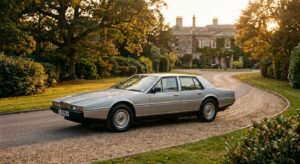
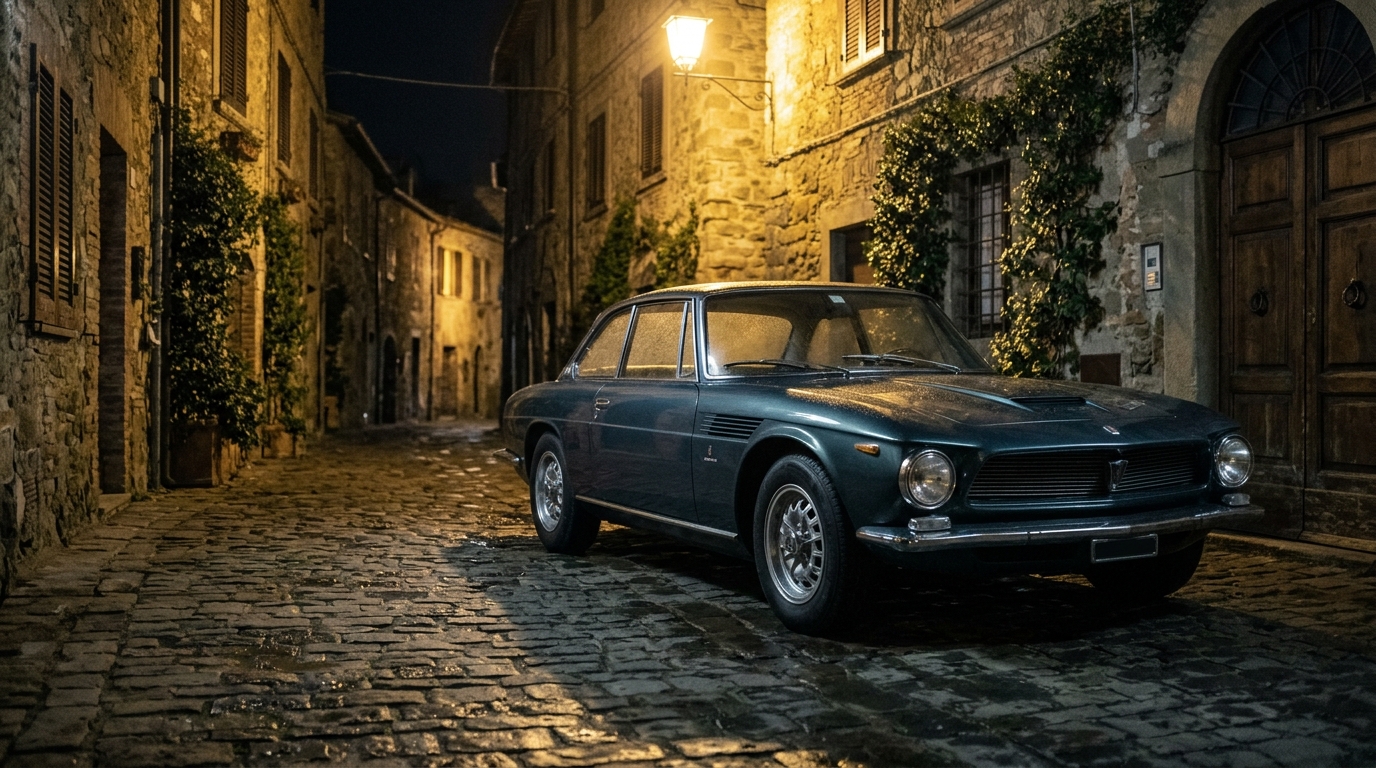
It is well past midnight in a sleeping Italian hill town, and the only light on the cobbles is the amber glow of a sodium streetlamp. Under it sits a long, low coupe with a gently creased nose and a fastback tail, a car most passersby would struggle to name. This is the Iso Rivolta GT, and after dark, when the mythology of louder Italian badges falls away, it may be the most honest grand tourer in the country.
The Italian Body, the American Heart
The Iso Rivolta story begins with refrigerators. Renzo Rivolta ran Isothermos, a company that built heaters, fridges and then the Isetta bubble car that BMW famously licensed. In the early 1960s he wanted to build a true four-seat grand tourer, and he did it with a recipe that was both clever and slightly heretical: Italian style and chassis engineering wrapped around a reliable, cheap-to-service American V8.
The original Rivolta IR 300 arrived in 1962 with a Bertone body penned by a young Giorgetto Giugiaro, and a Chevrolet Corvette 327 cubic inch V8 under the hood. The chassis was engineered by Giotto Bizzarrini, the man behind the Ferrari 250 GTO’s development. That combination of Giugiaro, Bizzarrini and Chevrolet muscle gave Iso a car that was fast, durable and gorgeous without the temperamental exotica that plagued rivals.
By 1973 the lineage had evolved, and so had the name. The model sold in this period is the Rivolta GT, which in later years was fitted with the more powerful Chevrolet 350 cubic inch (5.7 liter) V8. It was a refined, mature evolution of that early recipe, and by now Renzo’s son Piero Rivolta was running the company. Production of the Rivolta family ran from 1962 to 1974, with the factory in Bresso, near Milan, turning out a small number of cars each year.
Night Driving: Where the Rivolta Makes Sense
Daylight flatters louder cars. Night is where the Rivolta’s character reveals itself. Settle into the cabin and the first thing you notice is the glow of the instrument cluster, with its deep-set round dials and a dash trimmed in a way that feels more like a private club than a race car. The seats are broad and supportive, built for crossing a continent rather than lapping a circuit.
Turn the key and the small-block Chevy catches with a low, unhurried burble. It is not a shrieking Italian V12. It is a deep, round, American-voiced rumble that rolls out of the twin exhausts and echoes off stone walls in a tunnel or a narrow village street. At night, with no traffic to mask it, that soundtrack is intoxicating. Dip into the throttle on an empty autostrada and the 350 pulls with the effortless, torque-rich shove that only a big American V8 can deliver.
Headlight performance is where a 1970s car shows its age. The Rivolta’s lamps are period-correct, which means modest output by modern standards. On a dark mountain road the beams feel yellow and narrow, and you learn to drive within them, reading the road a little earlier and braking a touch sooner. Far from being a flaw, it forces a calmer, more deliberate pace, and the car rewards it. The long hood stretches into the darkness ahead, and the glow of the dash behind you makes the whole experience feel like piloting a small, fast yacht through the night.
The ride is the other revelation. A de Dion rear axle, a feature borrowed from higher-end machinery, keeps the wheels planted over rough surfaces, and four-wheel disc brakes give confident stopping for the era. The steering is light and slightly vague by modern standards, but the chassis is composed and predictable. This is a car you can lean on at 2 a.m. when the roads are empty and the mood is right.
Why It Slipped Through the Cracks
So why does almost nobody know the Rivolta? Timing and scale. Iso was a small independent maker competing with Ferrari, Maserati and Lamborghini, all of whom had stronger brand mythology. The 1973 oil crisis hammered demand for thirsty V8 grand tourers just as the company was struggling financially, and Iso went into receivership in the mid 1970s. Total Rivolta production across all variants amounted to only a few thousand cars, with the later GT versions built in far smaller numbers than the early years.
That rarity is precisely what makes it appealing today. A Rivolta offers Giugiaro’s early design genius and genuine Italian grand touring character, with the mechanical simplicity of a Chevy V8 that any competent mechanic can maintain. Parts for the engine are cheap and plentiful, though bodywork and trim pieces take real hunting.
Living With It
Ownership requires realism. Rust is the enemy, as with most Italian cars of the era, and a thorough inspection of the sills, floors and suspension mounting points is essential. The mechanical side, however, is forgiving. The big Chevy is under-stressed and robust, which is half the reason Iso chose it. Fuel economy is poor by any modern measure, so plan on frequent stops, but the long-legged gearing makes relaxed cruising a pleasure.
For a classic grand tourer, it hits a rare sweet spot: exclusive enough to draw curious looks at any gathering, yet practical enough to actually use. Park it under a streetlight at night and the lines tell the whole story.
The Iso Rivolta GT is the grand tourer you buy when you want Italian drama without Italian drama. Giugiaro’s early brilliance, a bulletproof Chevy V8 and a chassis built for long, quiet night runs make it one of the most undervalued classics on the market. Find a rust-free one and you will have the coolest car under any streetlight.