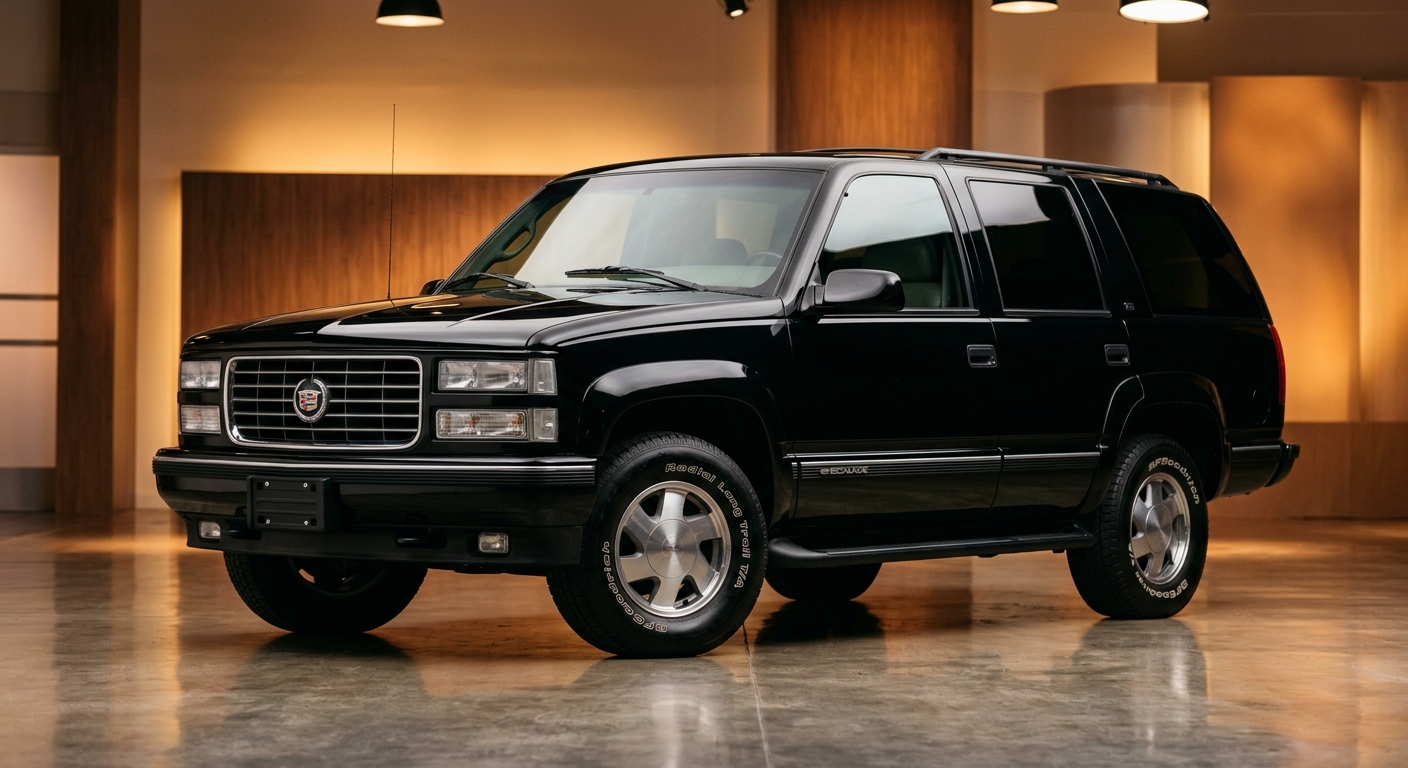
When Cadillac unveiled the Escalade in 1999, it wasn’t just launching another SUV: it was making a statement about American luxury’s future. Born from necessity as Lincoln Navigator sales soared, the first-generation Escalade would accidentally create a cultural phenomenon that redefined what luxury transportation could be.
What started as a rushed response to Ford’s success became the foundation for an entirely new segment of premium American SUVs, one that would influence everything from hip-hop culture to suburban driveways.
American Luxury Meets Truck Practicality
The original Escalade wasn’t subtle about its origins. Built on the GMT400 platform shared with the Chevrolet Tahoe and GMC Yukon, it made no apologies for being a luxury truck first and a refined cruiser second. The 5.7-liter Vortec V8 delivered 255 horsepower and 330 lb-ft of torque, numbers that felt substantial in 1999 but were really about moving the Escalade’s considerable 5,500-pound curb weight with authority rather than urgency.
Behind the wheel, the Escalade’s character revealed itself immediately. The driving position was commandingly high, offering a view of the road that sedan drivers could only dream of. The steering was light but vague, typical of truck-based SUVs of the era, requiring constant small corrections on the highway. But that wasn’t really the point. This was about presence, about arriving in style, about making a statement that couldn’t be ignored.
Interior Luxury Meets Truck Bones
Step inside the 1999 Escalade and you’d find Cadillac’s interpretation of truck luxury. Leather seats with distinctive diamond-pattern stitching, real wood trim, and chrome accents throughout created an atmosphere that was undeniably premium, even if some of the switchgear betrayed the vehicle’s GMC DNA. The front seats offered reasonable comfort for long journeys, though the ride quality was decidedly truck-like, with impacts from road imperfections transmitted directly through the body-on-frame construction.
The second row provided limousine-like space, while the third row was best reserved for children or very short trips. With all seats in use, cargo space was minimal, but fold the rear seats flat and the Escalade transformed into a luxury hauler capable of swallowing everything from airport runs to Home Depot expeditions.
Performance and Capability
The Escalade’s 5.7-liter V8 moved the big SUV from 0-60 mph in about 9.5 seconds, respectable for its size and era. More importantly, it delivered the low-end torque that made city driving effortless and highway passing maneuvers confident, if not exactly thrilling. The four-speed automatic transmission was smooth enough, though it occasionally hunted for the right gear when faced with hills or sudden throttle inputs.
Available in both rear-wheel and four-wheel drive configurations, the Escalade offered genuine capability when the pavement ended. The four-wheel-drive system was a traditional part-time setup, robust and simple, designed more for snow and light off-road duty than serious trail work. Ground clearance was generous, and the truck’s substantial weight provided excellent traction in slippery conditions.
Cultural Impact and Legacy
What Cadillac couldn’t have predicted was how the Escalade would transcend its intended market. Within a few years, it became the vehicle of choice for everyone from suburban executives to entertainment industry stars. The Escalade’s bold styling, imposing presence, and Cadillac badge created a perfect storm of aspiration and accessibility that resonated far beyond traditional luxury car buyers.
The truck’s influence on automotive culture was immediate and lasting. It proved that Americans wanted luxury vehicles that didn’t apologize for their size or presence, paving the way for everything from the Hummer H2 to today’s ultra-luxury pickup trucks. More than that, it established Cadillac as a relevant brand for younger buyers, something the division had struggled with for decades.
The 1999 Cadillac Escalade wasn’t perfect, but it was perfectly timed. It proved that luxury could be bold, that American brands could define new segments, and that sometimes the most influential vehicles are the ones that dare to be different. This was the SUV that started a revolution.