In 1968, Lamborghini faced an unusual challenge: how do you make a four-door supercar that doesn’t betray everything your brand represents? The answer came in the form of the Espada, a radical departure that somehow managed to be both completely wrong and absolutely brilliant. This wasn’t just Lamborghini’s attempt at practicality; it was their middle finger to conventional automotive wisdom.
The Unlikely Genesis
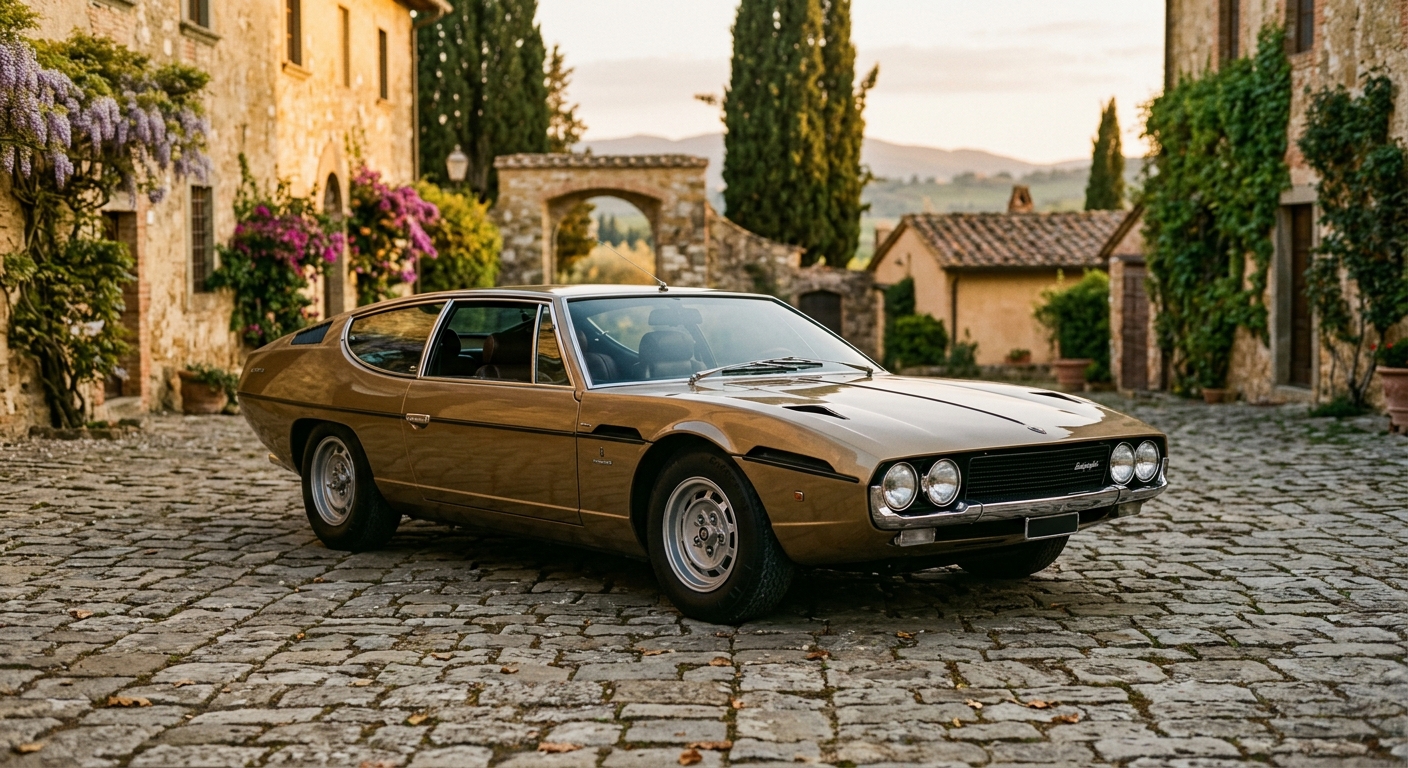
The Espada emerged from Lamborghini’s collaboration with Bertone, specifically from the mind of Marcello Gandini, the same designer who would later pen the Countach. But where the Countach was all sharp angles and aggression, the Espada was something different: a low-slung, wide-bodied four-seater that looked like a spaceship designed by someone who actually understood aerodynamics.
The proportions were shocking. At just 47 inches tall but nearly 77 inches wide, the Espada looked like it had been stepped on by a giant. Yet somehow, Gandini made it work. The dramatic fastback roofline, the distinctive side windows that wrapped around like a fighter jet’s canopy, and the bold front end with its integrated headlights created something that was undeniably exotic yet surprisingly practical.
Heart of the Bull
Under that dramatic hood sat Lamborghini’s magnificent 3.9-liter V12, the same basic engine architecture that powered the Miura. In the Espada, it produced 325 horsepower, channeled through a five-speed manual transmission to the rear wheels. This was supercar power wrapped in grand tourer packaging, capable of genuine 150-mph performance while carrying four adults in relative comfort.
The engine note was pure Lamborghini: a growling, mechanical symphony that built to a screaming crescendo as the V12 approached its 7,000-rpm redline. Unlike the Miura’s transverse-mounted engine, the Espada’s V12 sat conventionally longitudinal, providing better weight distribution and more predictable handling characteristics.
Driving the Impossible
Behind the wheel, the Espada delivered an experience unlike anything else. The driving position was low and commanding, with excellent visibility through that dramatic greenhouse. The steering was heavy at parking speeds but perfectly weighted once moving, providing genuine feedback from the road surface.
What surprised most drivers was how civilized the Espada could be. Unlike the temperamental Miura, the Espada started reliably, ran smoothly in traffic, and didn’t try to kill you at the first sign of wet pavement. The suspension struck a remarkable balance between comfort and control, soaking up highway miles while still providing the sharp responses expected from a Lamborghini.
Yet when pushed, the Espada revealed its exotic DNA. The V12 would pull cleanly from 2,000 rpm all the way to redline, the chassis remained balanced and predictable even when provoked, and the overall experience was undeniably special. This was a car that could embarrass dedicated sports cars on a mountain road, then comfortably cruise to dinner with three passengers aboard.
The Numbers Game
Performance figures were impressive for the era: 0-60 mph in under 7 seconds, a genuine 150-mph top speed, and quarter-mile times that put it ahead of contemporary Ferraris and Porsches. More importantly, it achieved these numbers while offering rear seat space that could actually accommodate adults, something no other supercar manufacturer had managed.
Legacy of the Oddball
Production ran from 1968 to 1978, with 1,226 examples built across three series. The Espada proved that Lamborghini could build more than just uncompromising supercars; they could create something genuinely practical without sacrificing their exotic character.
Today, the Espada represents one of the most undervalued classics in the Lamborghini lineup. While Miuras command seven figures and Countaches have soared past half a million, good Espadas can still be found for six figures. It’s a situation that won’t last forever, as enthusiasts are beginning to recognize the Espada for what it truly was: Lamborghini’s most successful attempt at building a real-world supercar.
The Espada remains Lamborghini’s most successful production car and perhaps their most underappreciated achievement. It proved that exotic performance and real-world practicality weren’t mutually exclusive, wrapped in a package that still looks like nothing else on the road. For those seeking an entry into vintage Lamborghini ownership without the Miura’s compromises or the Countach’s histrionics, the Espada represents the sweet spot of the marque.