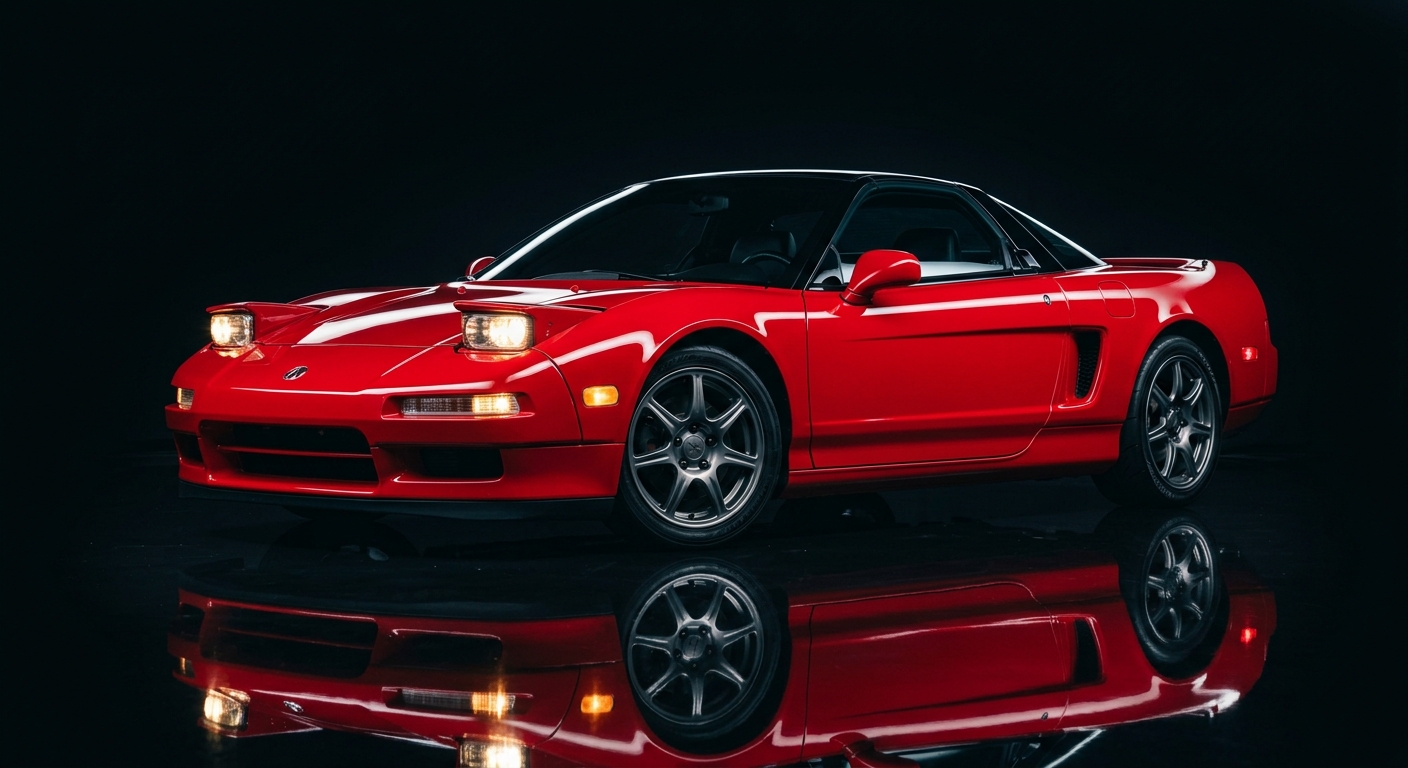
When Honda’s engineers set out to build a supercar in the late 1980s, they didn’t just want to match Ferrari’s performance, they wanted to humiliate the Italians with something that actually worked every day. The result was the NSX, a mid-engine masterpiece that rewrote the rules of exotic car ownership. By 2001, after more than a decade of refinement, Honda’s aluminum athlete had evolved into something approaching perfection.
This wasn’t just another pretty face with a temperamental soul. The NSX represented a fundamentally different philosophy: what if a supercar could be as reliable as a Civic, as easy to drive as an Accord, yet still deliver the kind of performance that made Ferraris sweat?
The VTEC Symphony
At the heart of the 2001 NSX lies Honda’s 3.2-liter C32B V6, a naturally aspirated jewel that proves displacement isn’t everything. This all-aluminum engine produces 290 horsepower at a screaming 7,100 RPM, but the real magic happens when VTEC kicks in at 5,800 RPM. The sound transforms from a cultured hum to an urgent, metallic wail that builds to a crescendo most Ferrari V8s would envy.
The power delivery is linear and predictable, building progressively rather than arriving in violent surges. It’s an engine that rewards commitment, demanding you explore those upper reaches where the real performance lives. Peak torque of 224 lb-ft arrives at 5,500 RPM, which means you need to work for your thrills, but the reward is a connection between driver and machine that few modern supercars can match.
Precision Engineering
The NSX’s aluminum space frame was revolutionary in 1991 and remained impressive a decade later. Weighing just 3,153 pounds, the car feels impossibly light and nimble compared to its contemporaries. The all-aluminum construction provides exceptional rigidity while keeping weight low, contributing to the car’s supernatural balance.
Honda’s attention to detail borders on obsessive. The titanium connecting rods, forged pistons, and individual throttle bodies for each cylinder demonstrate the kind of engineering typically reserved for Formula One. Every component serves a purpose, and nothing is included merely for show.
The Driving Experience
Behind the wheel, the NSX reveals its true character. The driving position is perfect, with controls that fall naturally to hand. Visibility is excellent for a mid-engine car, though the pop-up headlights do create blind spots when raised. The steering is communicative without being heavy, providing constant feedback about what’s happening at the contact patches.
On the road, the NSX feels alive in a way that modern supercars, with their electronic safety nets, simply cannot match. There’s no traction control, no stability management, just pure mechanical feedback. The car talks to you through the steering wheel, the seat of your pants, and the pedals, creating an intimate dialogue that builds confidence lap after lap.
The suspension, revised for 2001 with stiffer springs and dampers, strikes an remarkable balance between comfort and control. The car remains composed over rough surfaces while providing the kind of precision that makes you hunt for the perfect line through every corner.
A Different Kind of Exotic
What separated the NSX from its Italian rivals wasn’t just reliability, though that was revolutionary enough. It was Honda’s refusal to compromise usability for drama. The clutch is light enough for daily driving, the gear change is crisp and mechanical, and the engine will happily idle in traffic without overheating or stalling.
Yet none of this civility comes at the expense of performance. The 2001 NSX could sprint from 0-60 mph in just 4.8 seconds and reach a top speed of 175 mph, numbers that remained competitive with far more expensive rivals.
The 2001 NSX represents the culmination of Honda’s supercar dream, a machine that proved exotic performance didn’t require exotic problems. Today, as values climb toward six figures, it stands as perhaps the last pure, analog supercar that you could actually live with every day.