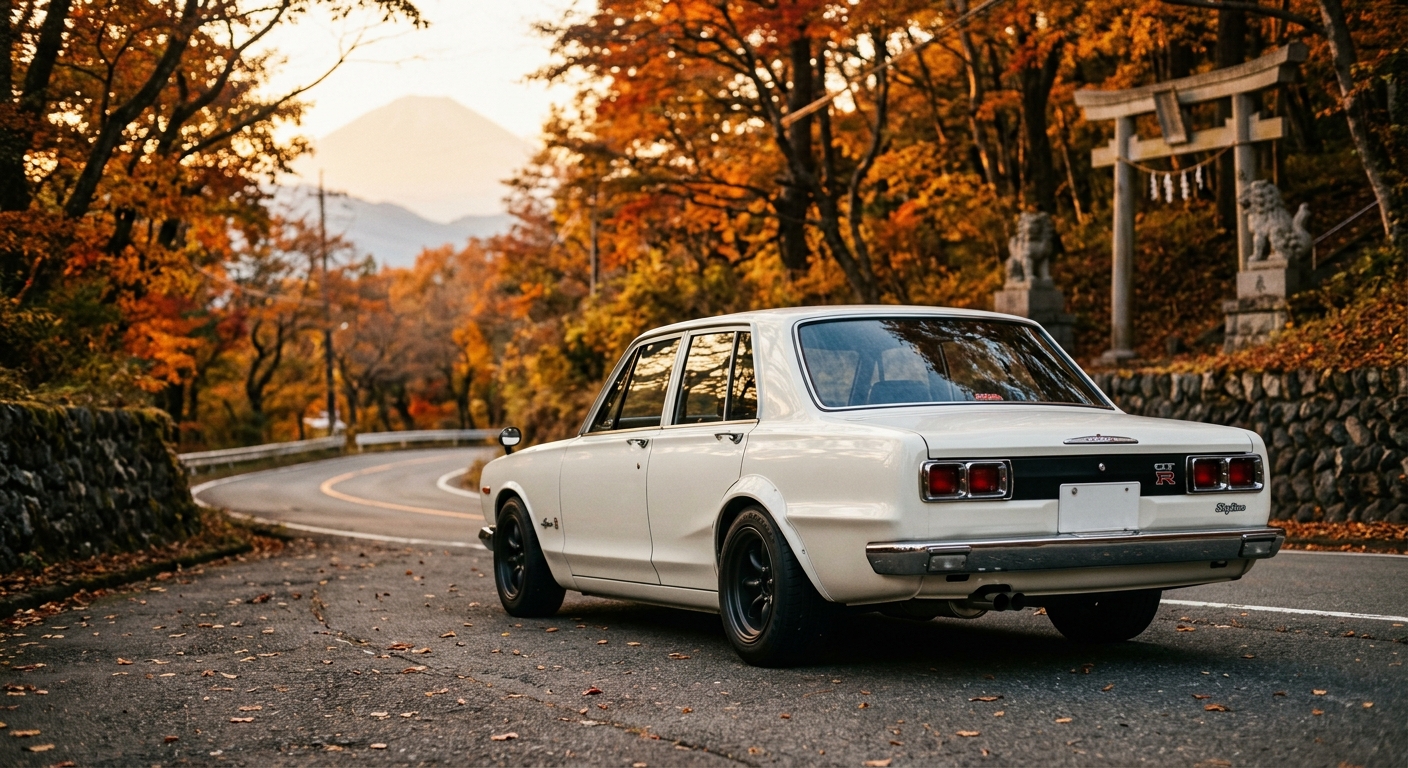
Long before the GT-R became a global supercar icon, there was the Hakosuka. The 1971 Nissan Skyline GT-R represents the birth of Japan’s most revered performance nameplate, a machine bred from racing necessity rather than marketing ambition. With its legendary S20 inline-six and track-focused engineering, this unassuming sedan would lay the foundation for a dynasty that continues to this day.
Racing DNA Encoded
The original GT-R wasn’t born in a boardroom but on the race tracks of Japan. Nissan needed a homologation special to compete in touring car racing, and the result was the C10 Skyline GT-R. The heart of this machine was the S20 engine, a 2.0-liter naturally aspirated inline-six that shared its DNA with the powerplant in Nissan’s R380 prototype racer.
This wasn’t just marketing speak. The S20 featured dual overhead cams, four valves per cylinder, and individual throttle bodies, technology that was genuinely exotic in 1969 when the GT-R first appeared. By 1971, Nissan had refined this formula into one of the most potent naturally aspirated engines of its era, producing 160 horsepower in an age when most Japanese cars struggled to break triple digits.
The Hakosuka Experience
Behind the wheel, the original GT-R feels nothing like its modern descendants. The steering is heavy and unassisted, requiring genuine effort at parking speeds but providing remarkable feedback once moving. The suspension, tuned for circuit work, delivers a firm ride that would be considered harsh by today’s standards but offers exceptional body control through corners.
The S20 engine is the star of the show, delivering its power through a narrow but intoxicating band. Unlike modern turbocharged engines with their broad torque curves, the S20 demands to be worked. Keep it above 4,000 rpm and it sings with a mechanical symphony that modern engines, for all their efficiency, simply cannot match.
Cultural Impact and Legacy
The Hakosuka’s influence extends far beyond its impressive specifications. In Japan, it became a symbol of the country’s emerging automotive prowess, proving that Japanese manufacturers could build cars that were not just reliable and economical, but genuinely exciting. The GT-R’s dominance in touring car racing cemented its reputation among enthusiasts.
Production numbers were deliberately limited, with just 1,945 examples of the four-door GT-R built between 1969 and 1972. This rarity, combined with the car’s legendary status, has made pristine examples extraordinarily valuable. What once sold for the equivalent of a Toyota Corolla now commands six-figure sums at auction.
Engineering Excellence
Every aspect of the GT-R was engineered with performance in mind. The limited-slip differential, sourced from the racing program, provided exceptional traction for a rear-wheel-drive sedan. The close-ratio five-speed transmission allowed drivers to keep the S20 in its optimal power band. Even details like the lightweight body panels and competition-inspired interior reflected the car’s serious intent.
The original Skyline GT-R represents automotive purity in its most concentrated form, a machine built without compromise for the singular purpose of going fast. While modern GT-Rs may be faster and more refined, none capture the raw, mechanical soul of the Hakosuka. This is where legends are born, and legends never die.