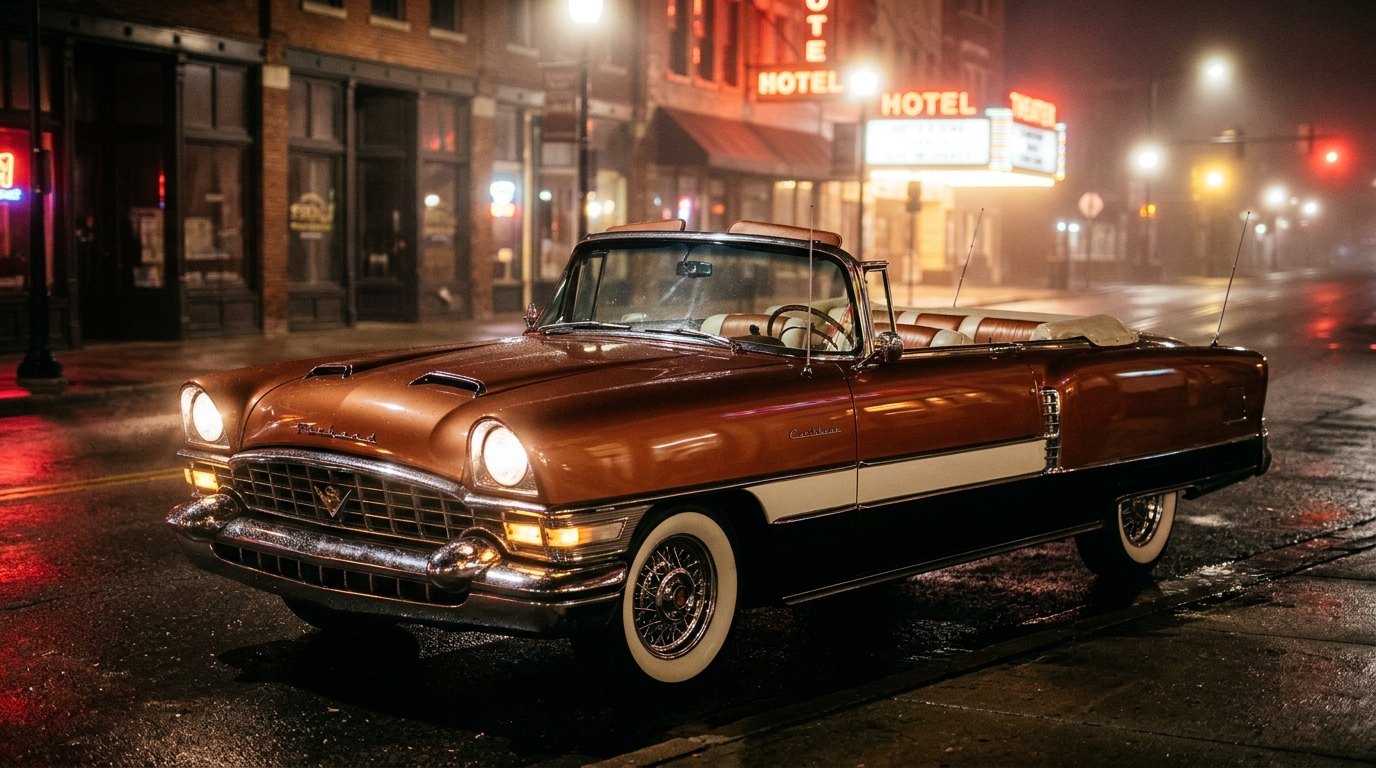
It is well past midnight on an empty boulevard, and the sodium lamps are throwing amber pools across a hood the size of a pool table. The top is folded away, the stars are out, and a 374 cubic inch V8 is turning over with the unhurried confidence of a car built when Packard still believed it could outlast Cadillac. This is the 1956 Caribbean, and it may be the most glamorous way an American ever got home late.
The Last Real Packard
The 1956 Caribbean was the final year for the true, Detroit-built Packard. By the end of 1956 the company’s East Grand Avenue plant had closed, and the 1957 and 1958 Packards that followed were Studebaker-based cars with the badge but little of the soul. That makes the 1956 Caribbean the last chapter of a story that began in 1899, and it wrote that chapter in chrome and two-tone paint.
The Caribbean nameplate debuted on a 1953 convertible show car and went into limited production that same year. By 1956 the formula had matured. The convertible rode on the senior Packard platform and wore a heavily revised face and tail, including the signature cathedral taillights that glowed like stained glass when the sun went down. A hardtop version was offered alongside the convertible, but it is the open car that earned the legend.
Torsion-Level Ride After Dark
The big engineering story was Packard’s Torsion-Level suspension, introduced for 1955. Long torsion bars linked the front and rear wheels on each side, and an electric motor adjusted the rear bars to keep the car level regardless of load. The practical effect at night is remarkable. On a dark, patched-up two-lane road, the Caribbean floats over imperfections that would have rattled a contemporary Cadillac or Lincoln. The car stays flat, the long hood never pitches, and the whole experience feels closer to a slow glide than a drive.
Power came from a 374 cubic inch overhead-valve V8 fitted with two four-barrel carburetors on the Caribbean, rated at 310 horsepower, and torque is a muscular 405 lb-ft. The factory quoted performance in the neighborhood of 9 to 10 seconds to 60 mph. That is not startling today, but on a quiet midnight road the delivery is what matters: a deep, syrupy surge, then a low, mechanical hum that never feels strained.
Headlights, Sound, and Mood
Night driving in 1956 meant sealed-beam headlamps and a lot of faith. The Caribbean’s lights deliver a warm, yellowish wash that reaches only so far, so you drive the way these cars want to be driven: unhurried, reading the road a few hundred feet at a time. The upside is atmosphere. The dash glows softly, the chrome catches every passing streetlight, and the curved-glass windshield gives you that wide, panoramic view of the world sliding by.
The sound is the other half of the experience. With the top down, the twin-carb V8 produces a smooth, restrained rumble through the dual exhaust, more velvet than thunder. At a red light in a quiet town, the engine settles into a barely perceptible tick, and people on the sidewalk turn to look. At night, the whole car becomes a rolling lantern of chrome, color, and glowing red lens.
Living With It
Be realistic: this is a nearly 5,000 pound convertible with drum brakes, slow manual-feeling steering despite the power assist, and a turning circle that demands planning. It is a car to savor rather than hustle. Packard’s Twin Ultramatic automatic does the job smoothly, with a shift character that suits the car’s relaxed nature.
Interior appointments were lavish for the day: leather and fabric upholstery, a full complement of power accessories, and a dash that looks like a jewelry box. The Caribbean was Packard’s flagship statement, and it priced accordingly, at roughly $5,995 when new. Few people bought them. Fewer than 600 convertibles left the factory, which makes survivors rare and prized today.
Why It Matters
The 1956 Caribbean convertible represents the end of an era. It was Packard’s last gasp as an independent American luxury builder, and it went out with real engineering ambition, not a whimper. Driving one after dark, with the top down and the cathedral taillights trailing behind you, you understand what was lost when this company disappeared.
Editor’s verdict: The 1956 Packard Caribbean convertible is not fast and it is not nimble, but it is a rolling piece of American ambition, and at night with the top down it is untouchable. Its Torsion-Level ride, glowing taillights, and sheer rarity make it one of the most atmospheric classics you can own. Find one, wait for midnight, and drive until the gas runs low.