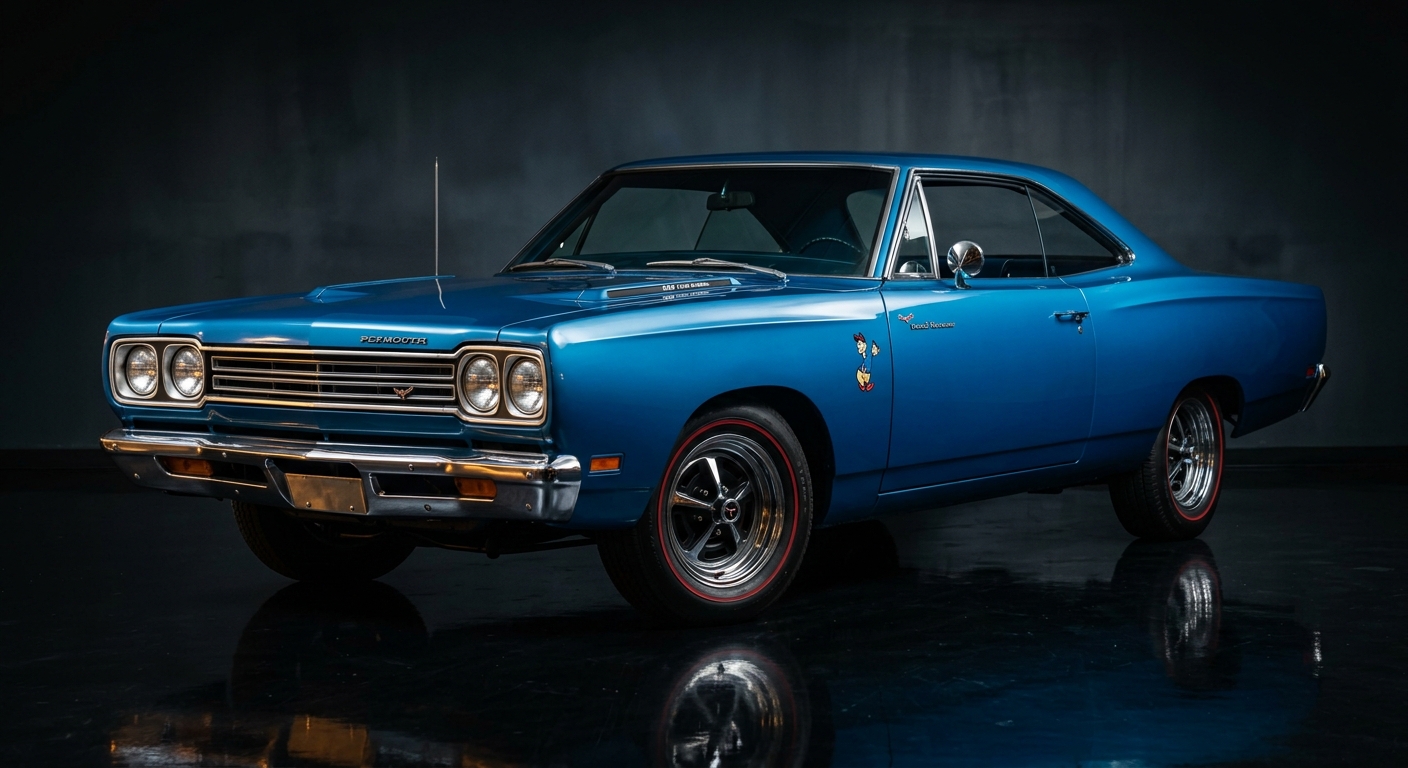
In 1968, Plymouth threw down the gauntlet with a simple proposition: real muscle car performance at a price that wouldn’t break the bank. The Road Runner was born from the frustration that genuine performance was becoming the exclusive domain of the wealthy, wrapped up in luxury packages that added thousands to the sticker price. Plymouth’s answer was brutally elegant, strip away the frills, keep the firepower, and let the engine do the talking.
The Genesis of Affordable Fury
The Road Runner concept emerged when Plymouth’s product planners realized they were pricing themselves out of their core market. While competitors loaded their muscle cars with power windows, plush interiors, and convenience features, Plymouth took a different approach. They started with the intermediate Belvedere platform, added the 383 cubic inch V8 as standard equipment, and kept everything else refreshingly simple.
The base 383 engine produced a conservative-on-paper 335 horsepower, though dyno tests suggested the actual output was considerably higher. Plymouth was notorious for underrating their engines, partly for insurance reasons and partly to keep the NHRA happy in drag racing classifications. The 383 featured a four-barrel carburetor, dual exhausts, and an aggressive cam profile that gave it a menacing idle.
Driving the Original Beep Beep
Behind the wheel, the Road Runner reveals its blue-collar personality immediately. The steering is heavy at parking lot speeds, the clutch pedal requires a firm left leg, and the suspension setup prioritizes straight-line acceleration over cornering finesse. This is a car built for one primary mission: getting from point A to point B as quickly as possible in a straight line.
The 383 pulls strongly from low RPMs, building to a crescendo as it approaches its 5,200 RPM redline. The sound is pure American V8 symphony, with aggressive cam overlap creating a lumpy idle that settles into a smooth, powerful pull under acceleration. The Hurst-shifted four-speed manual transmission requires deliberate, firm shifts, but rewards the driver with precise gear changes and excellent durability.
Performance That Delivered
Magazine tests of the era consistently showed the Road Runner 383 capable of low-15-second quarter-mile times, with 0-60 mph acceleration in the high-6-second range. These were impressive numbers for 1968, especially considering the Road Runner’s budget positioning. The car’s relatively light weight, around 3,400 pounds, helped the 383 deliver performance that embarrassed more expensive competitors.
The Road Runner’s handling reflected its drag strip priorities. The rear suspension featured heavy-duty leaf springs and shock absorbers optimized for weight transfer under hard acceleration. The front suspension used heavy-duty torsion bars and anti-roll bar, providing adequate control for spirited street driving while maintaining the compliance needed for straight-line traction.
Cultural Impact and Legacy
Beyond its performance credentials, the Road Runner captured the zeitgeist of late-1960s America. The Warner Brothers licensing deal that gave Plymouth the rights to use the Road Runner name and cartoon graphics was brilliant marketing that connected with young buyers. The cartoon horn that played the Road Runner’s signature “beep beep” sound became an instant cultural touchstone.
The Road Runner’s success sparked the entire “budget muscle” segment. Competitors scrambled to create their own stripped-down performance cars, but few matched the Road Runner’s perfect balance of performance, price, and personality. The car proved that enthusiasts would gladly sacrifice luxury features for raw performance and lower prices.
The 1968 Plymouth Road Runner remains the perfect example of American automotive democratization, proving that serious performance didn’t require a premium price tag. With its no-nonsense approach and surprising capability, it’s the muscle car that made the genre accessible to working-class heroes. Today, it stands as perhaps the most honest muscle car ever built, where every dollar went toward making it faster, not fancier.