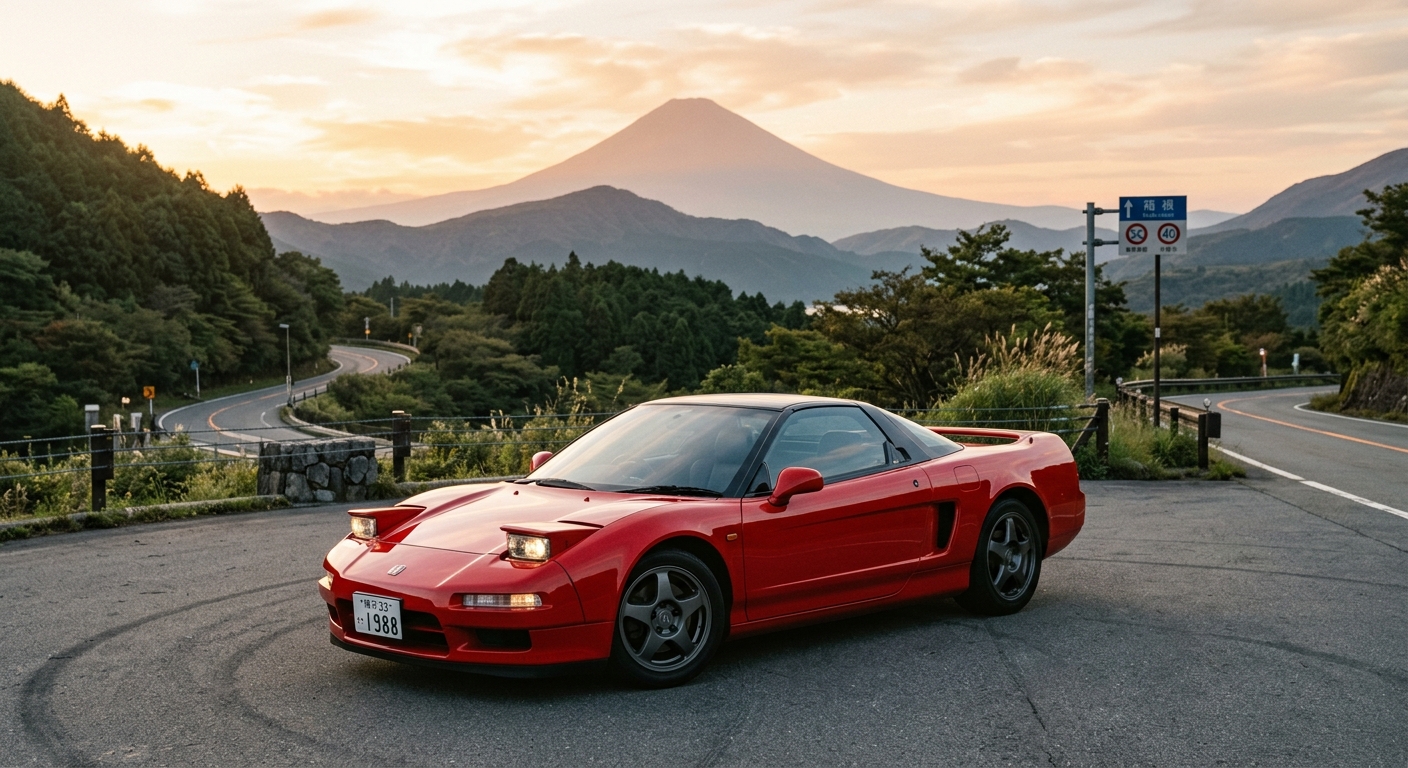
When Honda’s engineers first fired up the NSX prototype in 1988, they weren’t just testing another sports car. They were validating a philosophy that would challenge the very foundations of what a supercar could be. While Ferrari and Lamborghini built temperamental thoroughbreds that demanded constant attention, Honda dared to ask: what if a supercar could be as reliable as a Civic?
Revolutionary Engineering Philosophy
The NSX prototype represented Honda’s most ambitious project to date. Unlike the established supercar formula of heavy steel construction and unrefined power delivery, Honda’s team created an all-aluminum space frame that weighed just 462 pounds. This wasn’t just about saving weight; it was about reimagining how a mid-engine sports car should behave.
The prototype’s naturally aspirated 3.0-liter V6 produced a modest 270 horsepower, significantly less than contemporary Ferraris. But Honda’s engineers understood that peak power numbers told only part of the story. The VTEC system delivered linear, predictable power delivery, while the aluminum construction distributed weight with surgical precision.
Ayrton Senna’s Influence
The NSX prototype’s development benefited from an unlikely consultant: three-time Formula 1 World Champion Ayrton Senna. During testing sessions at Honda’s Suzuka circuit, Senna provided feedback that fundamentally altered the car’s character. His input led to stiffer suspension settings and more direct steering response, transforming what could have been a comfortable grand tourer into a precision instrument.
“The car feels like it’s reading my mind,” Senna reportedly said after an early prototype session. This telepathic connection between driver and machine became the NSX’s defining characteristic, setting it apart from the dramatic but unpredictable Italian competition.
Design Revolution
Penned by Ken Okuyama at Pininfarina, the NSX prototype’s design struck a perfect balance between aggression and restraint. The low, wide stance communicated serious performance intent, while clean surfaces and minimal ornamentation reflected Honda’s functional approach. Pop-up headlights provided the dramatic flair expected of a supercar, yet the overall aesthetic remained timelessly elegant.
Inside, the prototype featured a driver-focused cockpit that prioritized ergonomics over ostentation. Every control fell naturally to hand, every gauge provided essential information without visual clutter. It was supercar minimalism executed with typical Honda attention to detail.
Aluminum Construction Breakthrough
The NSX prototype’s aluminum space frame represented a technological leap that wouldn’t be matched by competitors for years. Honda developed new welding techniques and assembly methods to work with the lightweight material, creating a structure that was both incredibly rigid and remarkably light. This construction method would later influence everything from the Audi A8 to modern Ferrari models.
The NSX prototype didn’t just preview a new car; it announced a paradigm shift that forced every supercar manufacturer to reconsider their priorities. Honda proved that precision engineering could deliver thrills without the traditional compromises, creating a template that influences high-performance car development to this day. Sometimes the most revolutionary act is simply making something work perfectly.