In 1969, while Detroit’s Big Three were stuffing ever-larger engines into ever-bigger bodies, American Motors Corporation took a radically different approach. The Hurst SC/Rambler proved that sometimes the most devastating punch comes in the smallest package, cramming serious muscle car performance into a compact body that caught the competition completely off guard.
David Among Goliaths
The SC/Rambler emerged from AMC’s partnership with Hurst Performance, the shifter specialists who had been helping automakers create limited-edition muscle cars throughout the late 1960s. But where previous Hurst collaborations focused on luxury and exclusivity, the SC/Rambler was pure performance aggression wrapped in an unassuming compact car body.
AMC’s engineers took their lightweight Rambler American platform and shoehorned in the 315-horsepower 390 cubic inch V8 from the AMX sports car. The result was a power-to-weight ratio that embarrassed many full-size muscle cars, with the SC/Rambler weighing nearly 500 pounds less than a Chevelle SS or GTO.
Patriotic Thunder
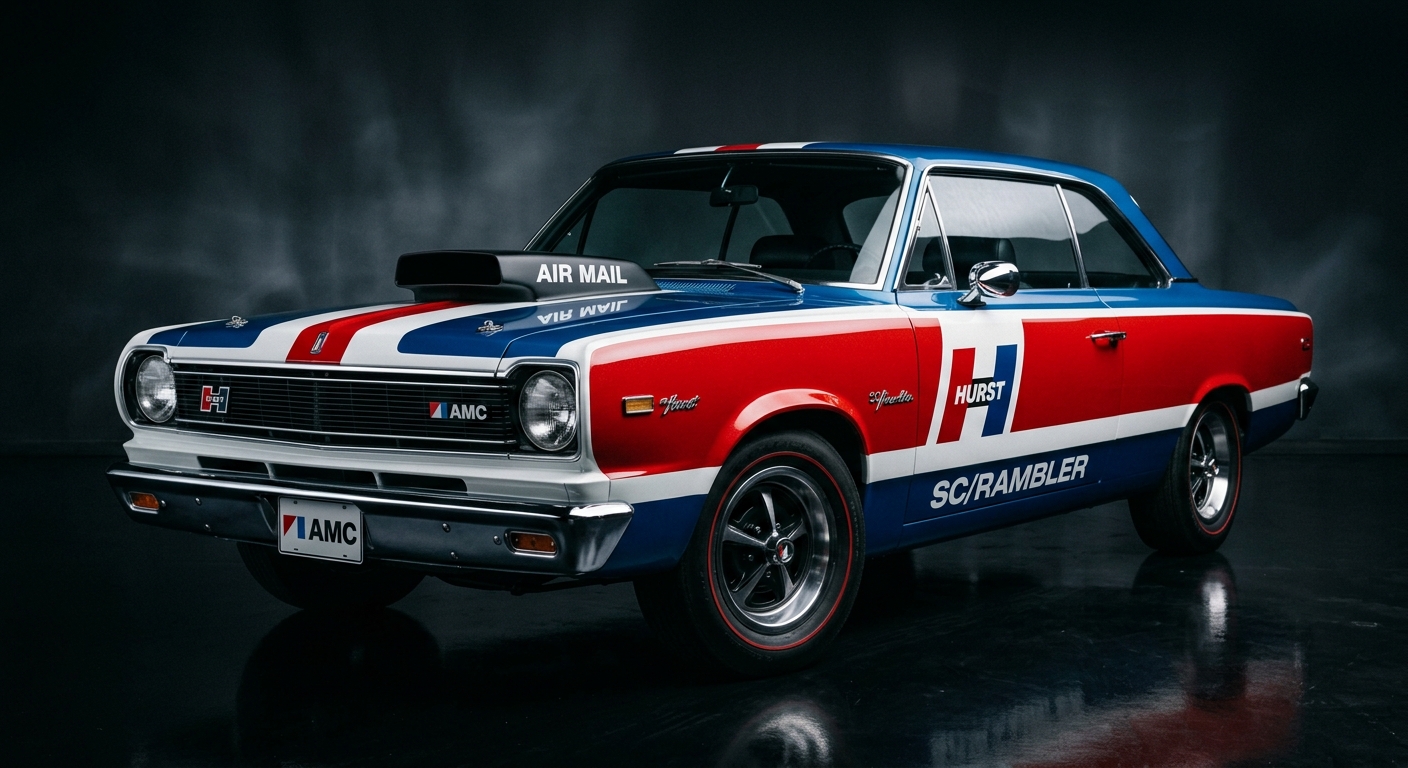
Visually, the SC/Rambler was impossible to ignore. Hurst specified a bold patriotic paint scheme with a white body, blue hood and rear deck, and red side stripes. The look was completed with a functional hood scoop, side exhaust outlets, and Hurst’s signature mag wheels. It was loud, brash, and completely at odds with the Rambler’s sensible reputation.
Inside, the performance theme continued with Hurst’s competition shifter controlling a Borg-Warner T-10 four-speed transmission. Bucket seats and a tachometer completed the sporting interior, though creature comforts remained minimal in keeping with the car’s street fighter persona.
Giant Killer Performance
Behind the wheel, the SC/Rambler delivered shocking performance. The combination of the potent 390 V8 and lightweight body resulted in quarter-mile times in the mid-14-second range, competitive with cars costing significantly more. The short wheelbase and rear weight bias made for lively handling characteristics, though the primitive suspension meant drivers needed to respect the car’s limits.
The exhaust note was pure muscle car theater, with the side pipes delivering an unmistakable roar that announced the SC/Rambler’s presence from blocks away. This was no sleeper despite its compact dimensions.
Rarity and Legacy
Only 1,512 Hurst SC/Ramblers were produced, making them among the rarest of all muscle cars. Production ended after just one year as AMC shifted focus to other projects and emissions regulations began tightening. Today, survivors command serious money from collectors who appreciate the car’s unique position in muscle car history.
The SC/Rambler represented AMC’s brief moment as a serious performance player, proving that innovation and creativity could compete with raw displacement and corporate budgets.
The Hurst SC/Rambler remains one of the most audacious experiments in muscle car history, proving that David could indeed slay Goliath with the right combination of power, weight, and attitude. While it may have been a commercial footnote, its legacy as the ultimate compact muscle car is secure, representing AMC’s brief but brilliant moment in the performance spotlight.