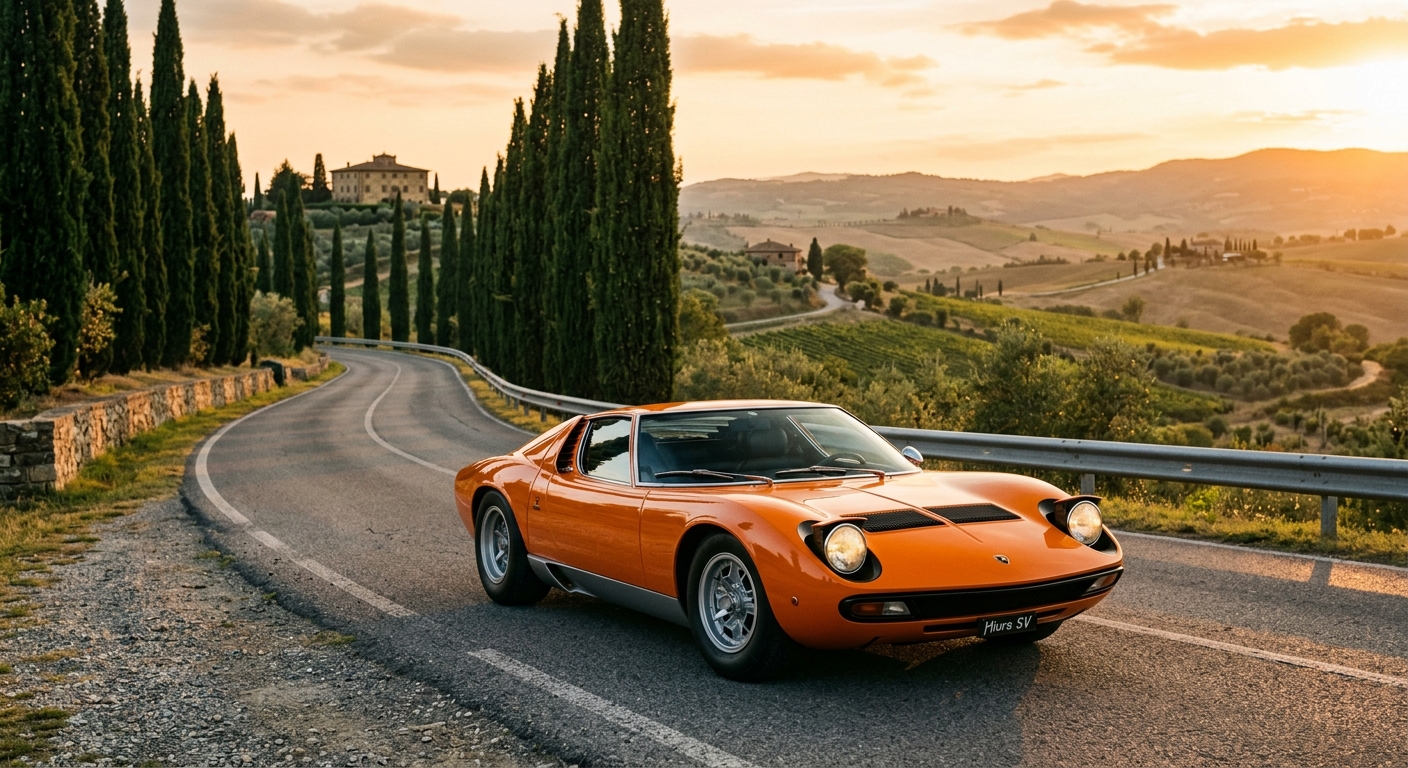
Before the Miura, supercars didn’t exist. Sure, there were fast cars and beautiful cars, but nothing that combined mid-engine architecture, supermodel looks, and earth-shaking performance into one package. The 1973 Miura SV represents the final evolution of Lamborghini’s groundbreaking masterpiece, and five decades later, it remains one of the most significant automobiles ever built.
The Ultimate Miura
By 1973, Lamborghini had refined the Miura formula to near-perfection. The SV (Super Veloce) addressed many of the handling quirks that made earlier Miuras as dangerous as they were beautiful. The rear suspension was completely redesigned, the chassis was stiffened, and the fuel tank was relocated to improve weight distribution. The result was a car that could finally match its stunning appearance with competent road behavior.
The 4.0-liter V12 engine received its most potent tune yet, producing 385 horsepower at 7,850 rpm. This was serious power in 1973, delivered through a soundtrack that remains unmatched in automotive history. The Miura’s transversely-mounted V12 sits just inches behind the driver’s head, creating an intoxicating symphony of mechanical music that builds to a crescendo as the tachometer sweeps toward its 8,000 rpm redline.
Driving Experience
Piloting a Miura SV is like conducting an orchestra while riding a barely-tamed stallion. The steering is heavy but communicative, the clutch requires a strong left leg, and the gearbox demands deliberate, forceful shifts. This is analog driving at its most pure, where every input matters and the car rewards skill while punishing complacency.
The forward visibility is surprisingly good for such a low car, but the rear view is essentially non-existent. The famous ‘eyelash’ headlights pop up with a theatrical flourish, while the side windows can be lowered completely into the doors, creating an almost motorcycle-like connection to the environment.
Design Legacy
Marcello Gandini’s design for Bertone created automotive sculpture that transcends time. Every surface flows with purpose, from the dramatic nose to the distinctive rear haunches. The Miura’s proportions are mathematically perfect, creating a visual tension between aggression and elegance that has influenced every mid-engine supercar since.
The interior is surprisingly spacious for such a compact car, though comfort takes a back seat to drama. The dashboard is a festival of toggle switches and round gauges, while the seats hold you in place for spirited driving while remaining tolerable for longer journeys.
The Miura SV stands as automotive perfection frozen in time, a car that looks as futuristic today as it did revolutionary in 1973. Yes, it’s demanding, impractical, and worth more than most people’s homes, but it remains the purest expression of the supercar dream. Every drive is an event, every startup a celebration of mechanical artistry that modern cars, for all their competence, simply cannot match.