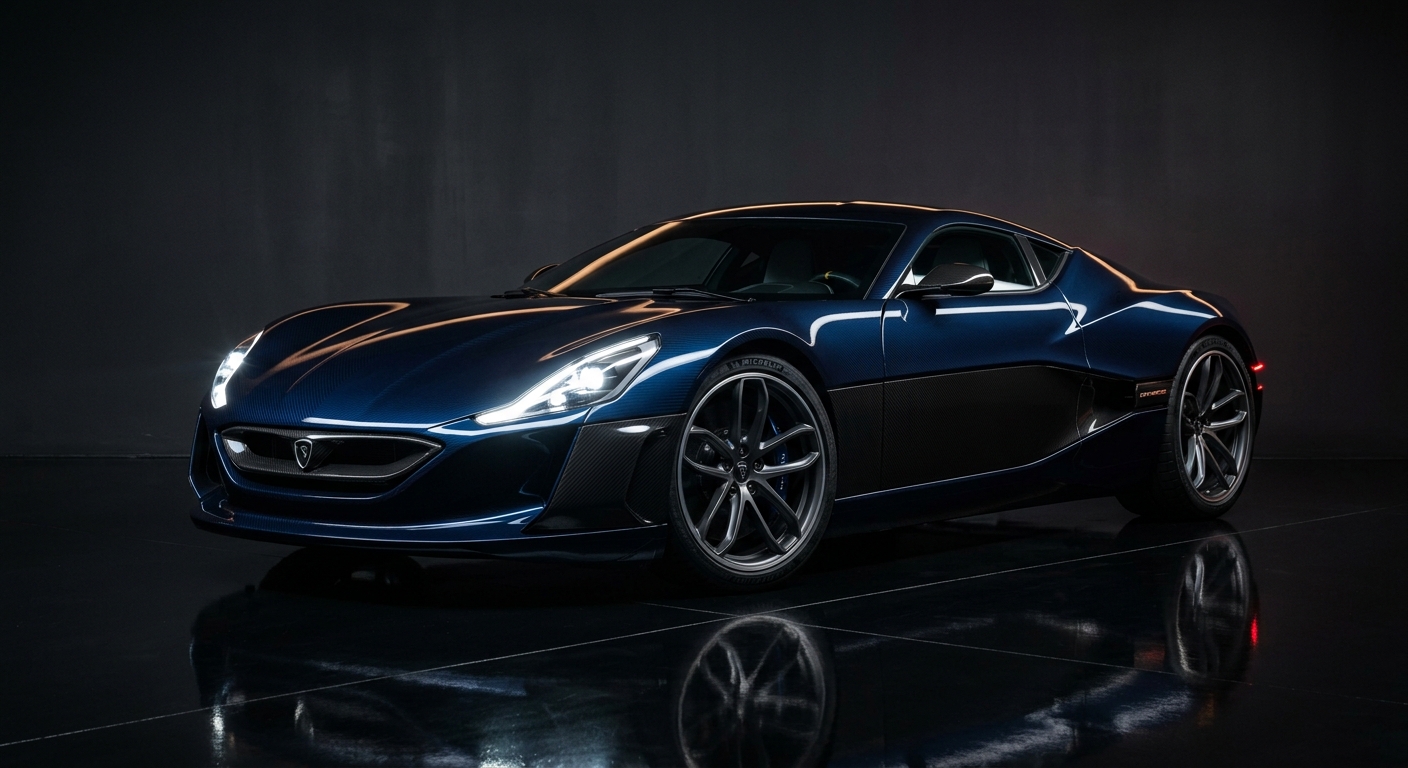
When a small Croatian company announced it would challenge the established supercar order with an all-electric hypercar, the automotive world took notice. The Rimac Concept One didn’t just promise to be different, it promised to be faster, more advanced, and more technologically sophisticated than anything from Maranello, Sant’Agata, or Woking.
The Birth of Electric Performance
Founded by Mate Rimac when he was just 21, Rimac Automobili emerged from humble beginnings in a Croatian garage. The Concept One represents the culmination of years of electric vehicle development, battery technology advancement, and a singular vision to prove that electric power could not only match internal combustion performance but surpass it entirely.
With 1,224 horsepower distributed across four electric motors, the Concept One generates torque figures that would make a Bugatti Veyron weep: 1,180 lb-ft available instantly. This isn’t just impressive on paper, the real-world acceleration is genuinely shocking. The sprint to 60 mph takes just 2.5 seconds, while 100 mph arrives in 6.2 seconds, figures that embarrass most traditional supercars.
Engineering Marvel
The Concept One’s party piece isn’t just its raw power, but how that power is delivered. Each wheel is driven by its own electric motor, allowing for torque vectoring that makes the car’s handling characteristics adjustable in real-time. The system can send power precisely where it’s needed, creating a level of traction and control that combustion-engine supercars simply cannot match.
The 82 kWh battery pack is mounted low in the carbon fiber monocoque chassis, creating an incredibly low center of gravity. The result is a hypercar that feels planted and composed even when unleashing its full fury. The regenerative braking system works in conjunction with traditional carbon-ceramic brakes to provide stopping power worthy of the acceleration on offer.
Technology Pioneer
Beyond the drivetrain, the Concept One showcases technology that would later influence the entire automotive industry. The advanced battery management system, the sophisticated torque vectoring, and the integration of high-performance electric motors with traditional supercar construction methods all pointed toward the future of high-performance automobiles.
The interior blends traditional luxury materials with cutting-edge digital interfaces. Carbon fiber, leather, and aluminum create an environment that feels appropriately special, while the infotainment system provides detailed information about power delivery, battery status, and performance parameters.
Limited Production Legacy
With only eight examples produced, the Concept One was always destined to be more than just a car, it was a proof of concept that electric vehicles could occupy the very pinnacle of automotive performance. Each car was essentially hand-built, with extensive customization options allowing owners to create truly unique examples.
The car’s development directly led to Rimac’s current success as a technology supplier to major automotive manufacturers and the creation of the even more advanced Nevera hypercar. The Concept One proved that a small, passionate team could challenge the established order and win.
The Rimac Concept One stands as automotive proof that small companies with big ideas can reshape entire industries. It’s not just an electric hypercar, it’s the car that proved electric hypercars could exist at all. With only eight examples ever made, owning one means possessing a piece of automotive revolution.