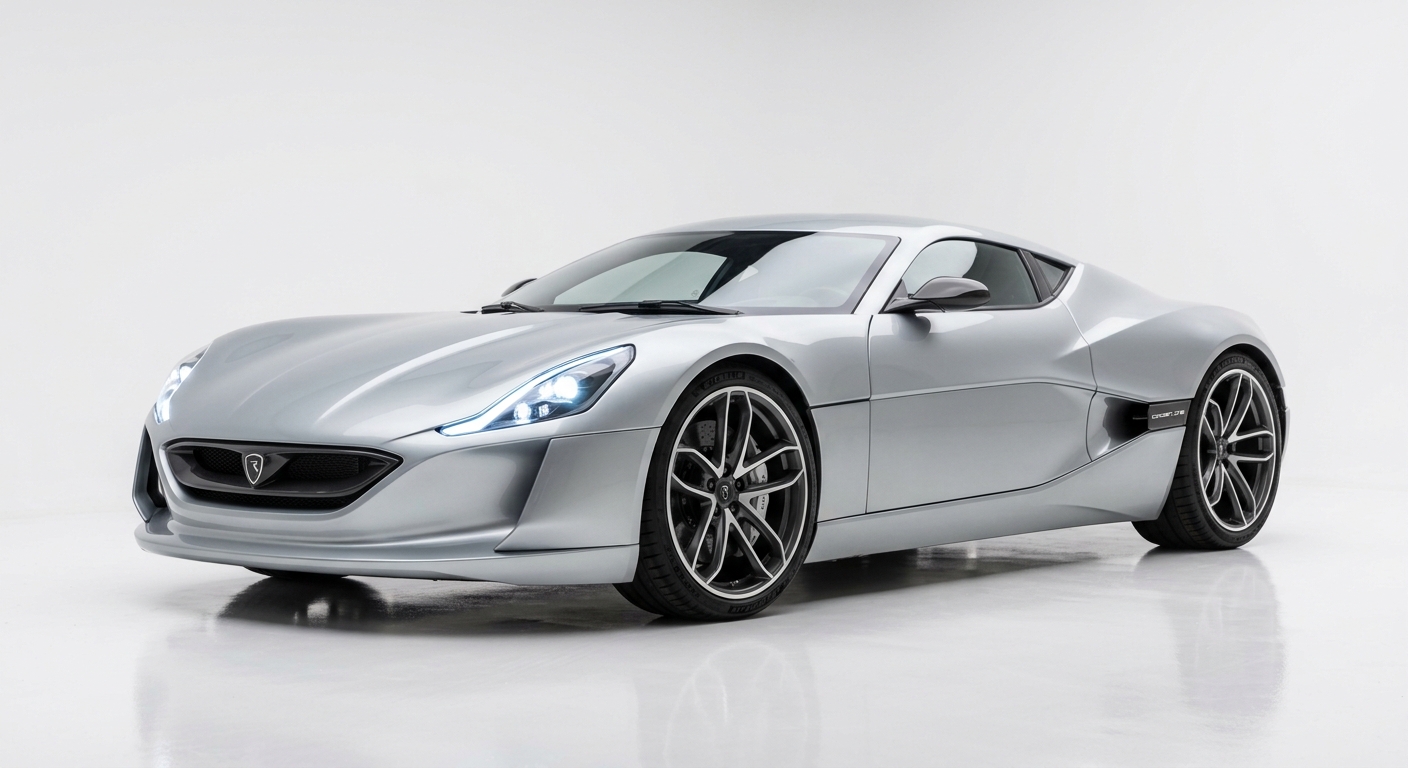
In 2011, while the automotive world was still skeptical about electric performance cars, a young Croatian entrepreneur named Mate Rimac unveiled something that would change everything. The Concept_One wasn’t just Croatia’s first supercar: it was a manifesto written in carbon fiber and electricity, proving that the future of hypercars wouldn’t sound like a screaming V12.
This wasn’t some Silicon Valley tech demo or established manufacturer’s electrification experiment. This was a startup from Zagreb taking on Ferrari, McLaren, and Bugatti with nothing but audacity and 1088 electric horsepower. The automotive establishment laughed, until they saw the numbers.
The Birth of Electric Fury
The Concept_One’s specifications read like science fiction in 2011. Four electric motors, one for each wheel, delivering torque vectoring that could make any corner feel like a video game. While other manufacturers were still figuring out how to make electric cars go 200 miles on a charge, Rimac was building something that could hit 62 mph in 2.8 seconds and keep accelerating to 190 mph.
The 82 kWh battery pack was state-of-the-art for its time, though by today’s standards the 372-mile range seems almost quaint. What wasn’t quaint was the way this car delivered power. No lag, no turbo delay, no waiting for the engine to hit its powerband. Just instant, overwhelming acceleration that redefined what driving fast could feel like.
Engineering Beyond Its Years
Rimac didn’t just electrify a conventional chassis and call it revolutionary. The Concept_One featured active aerodynamics, adaptive suspension, and a torque vectoring system so sophisticated that it could make novice drivers look like racing heroes. The carbon fiber monocoque was designed specifically for the electric powertrain, with the battery pack integrated into the structure for optimal weight distribution.
The regenerative braking system wasn’t just an efficiency feature: it was a performance tool. Drivers could adjust the regeneration levels on the fly, effectively changing the car’s character from smooth grand tourer to aggressive track weapon with the twist of a dial.
A Vision Made Real
Only eight Concept_Ones were ever built, making it one of the rarest hypercars in existence. Each one was hand-assembled in Rimac’s Croatian facility, representing not just a car but a proof of concept that a small startup could challenge the automotive establishment and win.
The Concept_One’s influence extends far beyond its production numbers. It showed the world that electric hypercars weren’t just possible but inevitable. Today, every major manufacturer has electric performance cars in development, but Rimac got there first, and they got there with style.
The Concept_One proved that the future of supercars wouldn’t sound like a Ferrari, and that was perfectly fine. With performance that humbled established hypercars and technology that wouldn’t look out of place today, Rimac’s first creation remains one of the most important cars of the 21st century. It didn’t just start a company; it started a revolution.