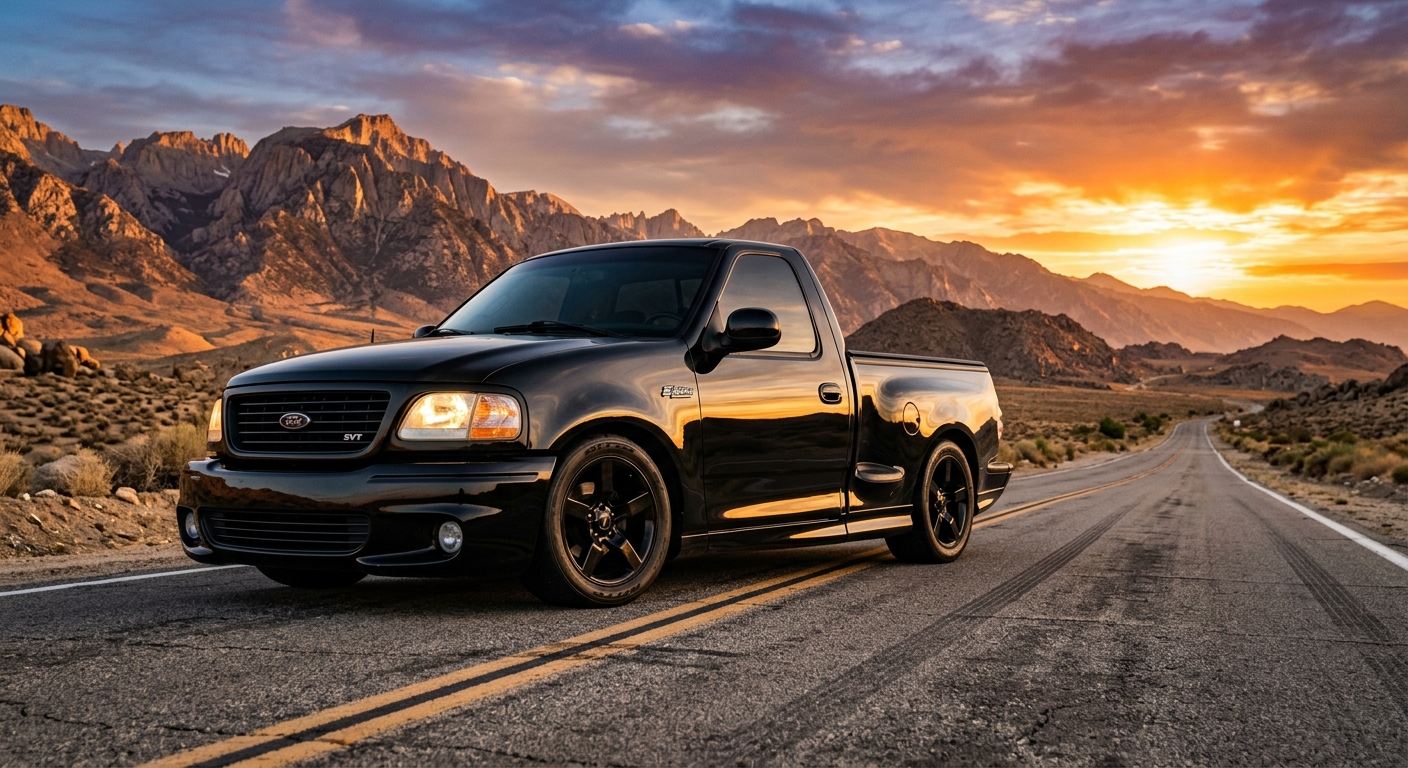
In the early 2000s, when most pickup trucks were focused purely on hauling capacity and off-road capability, Ford’s Special Vehicle Team had a different vision. The 2004 F-150 Lightning proved that a truck could haul your boat to the lake on Saturday and embarrass sports cars at the drag strip on Sunday. This wasn’t just a truck with an attitude problem, it was America’s answer to the question nobody asked: what happens when you give a pickup truck the heart of a Mustang Cobra?
Supercharged Street Fighter
The Lightning’s party piece was hiding under the hood in the form of a 5.4-liter supercharged V8 that delivered 380 horsepower and 450 lb-ft of torque. This wasn’t some mild performance upgrade, Ford’s SVT engineers had taken the blown motor from the Mustang SVT Cobra and adapted it for truck duty with a more aggressive tune. The Eaton M112 Roots-type supercharger sat atop the iron-block V8 like a mechanical statement of intent, complete with an intercooler to keep intake temperatures in check during hard acceleration runs.
Behind the wheel, the Lightning delivered a driving experience that defied every expectation of what a pickup truck should feel like. Plant your right foot and the supercharger whine builds to a crescendo while the truck launches forward with shocking urgency. The 4R100 four-speed automatic transmission, though not the most sophisticated unit, proved robust enough to handle the blown V8’s torque output while delivering crisp shifts under full acceleration.
Street Truck Handling
Ford didn’t just bolt a big engine into a regular F-150 and call it a day. The Lightning received a comprehensive suspension overhaul that lowered the truck’s stance by nearly three inches compared to a standard F-150. Up front, a sport-tuned independent suspension with performance shocks and springs provided more precise handling, while the rear featured a lowered leaf-spring setup designed to plant the rear tires during hard acceleration.
The result was a truck that handled more like an oversized muscle car than a traditional pickup. The lowered center of gravity and sport suspension tuning allowed the Lightning to carve through corners with surprising composure, though the laws of physics meant it would never be mistaken for a sports car in the twisties. Where it truly excelled was in straight-line performance, with many examples capable of high-13-second quarter-mile times straight from the factory.
Daily Driver Capability
Despite its performance credentials, the Lightning remained a functional pickup truck. The regular cab configuration provided seating for three, while the full-size bed could still handle Home Depot runs and weekend projects. The sport suspension meant a firmer ride than a standard F-150, but it was hardly punishing for daily driving. Interior appointments were typical early-2000s Ford fare, with the main concessions to the Lightning’s performance mission being sport seats and unique gauge cluster with a boost gauge.
Fuel economy was predictably abysmal, with most owners reporting mid-teens MPG under normal driving conditions. Push the truck hard and those numbers would drop into single digits quickly. But buyers of 380-horsepower trucks weren’t exactly cross-shopping Priuses, and the Lightning’s thirst was simply part of the experience.
Market Impact and Legacy
The 2004 Lightning represented the second generation of Ford’s performance truck formula, following the original 1993-1995 Lightning that had introduced the concept of the factory hot rod pickup. This generation ran from 1999 to 2004 and represented the pinnacle of the breed, with the 2004 model year receiving the most powerful engine configuration.
Production numbers remained relatively low, with Ford building just over 28,000 Lightnings during the entire second-generation run. This exclusivity has helped maintain strong resale values, particularly for well-maintained examples. The Lightning also spawned a cottage industry of aftermarket support, with many owners pushing power levels well beyond the factory specifications through pulley swaps, tune modifications, and other bolt-on upgrades.
The 2004 F-150 Lightning remains one of the most successful interpretations of the performance truck formula, delivering genuine sports car acceleration in a package that could still haul your weekend projects. Today, clean examples command strong money on the used market, and for good reason. In an era of increasingly complex and electronically managed performance vehicles, the Lightning’s supercharged simplicity feels refreshingly analog and brutally effective.