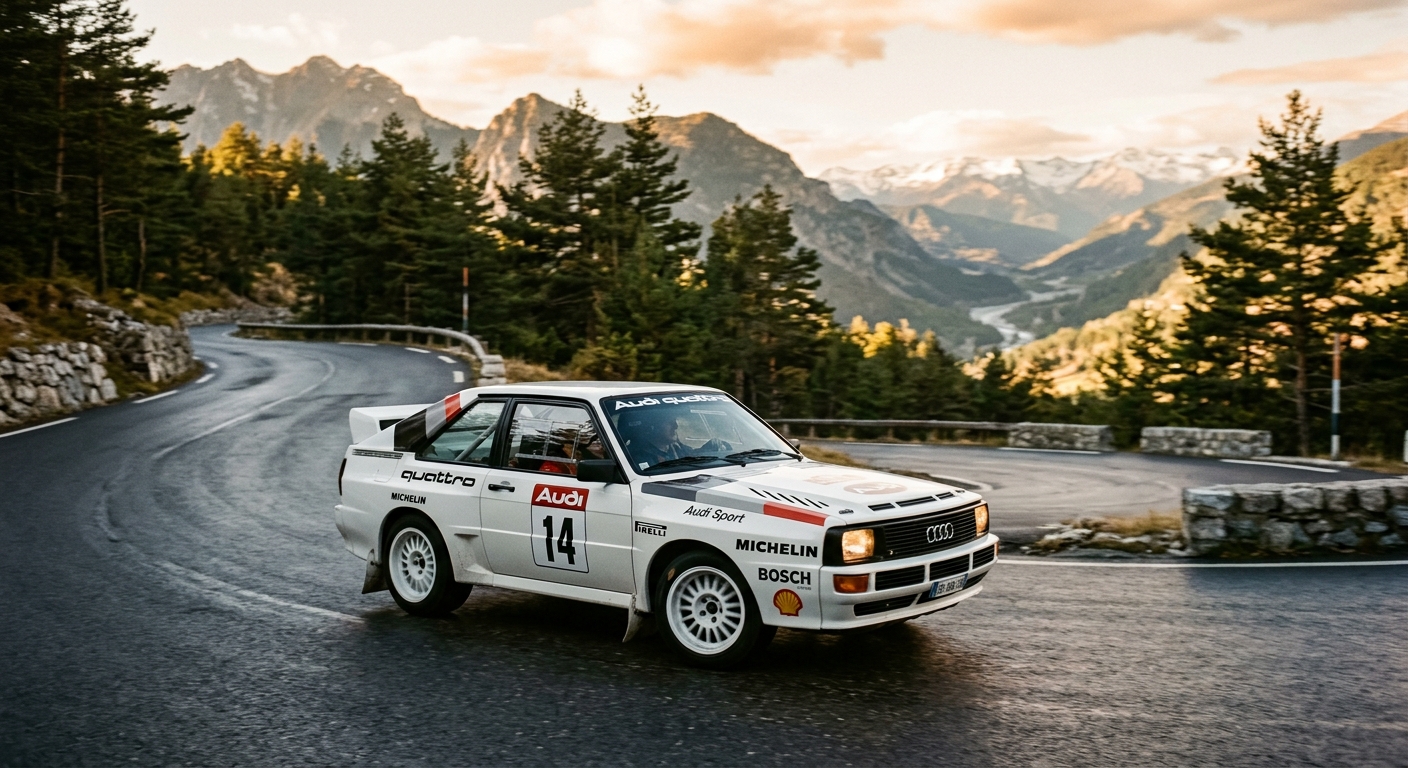
In 1985, Audi created one of the most focused road cars ever built. The Quattro Sport wasn’t just another sports car; it was a homologation special born from the brutal world of Group B rallying. With only 224 examples built, this was Audi’s uncompromising answer to the question: what happens when rally technology meets road car regulations?
The Group B Connection
The Quattro Sport emerged from Audi’s dominance in the World Rally Championship. To homologate the short-wheelbase Quattro for Group B competition, Audi needed to build 200 road-going examples. What they created was essentially a rally car with number plates, featuring a wheelbase shortened by 12.6 inches compared to the standard Quattro.
The transformation went far beyond simple measurements. Audi fitted wider wheel arches to accommodate the broader track, installed a more aggressive front splitter, and added a prominent rear spoiler. The result was a car that looked like it had been sculpted by the wind tunnel and shaped by competition.
Heart of a Rally Car
Under the hood lived a heavily modified version of Audi’s turbocharged five-cylinder engine. The 2.1-liter unit produced 306 horsepower in its mildest tune, though many examples left the factory with significantly more power. The distinctive five-cylinder warble became the Quattro Sport’s calling card, a sound that rally fans could identify from miles away.
The engine’s character matched its origins perfectly. Turbo lag was pronounced but predictable, with power delivery that required commitment and respect. This wasn’t a car for the faint-hearted; it demanded active participation from its driver at all times.
Quattro Revolution
The Quattro Sport’s party piece was its all-wheel-drive system, revolutionary for its time. While other manufacturers were still perfecting rear-wheel drive, Audi had already moved to the next frontier. The center differential could be locked manually, and the torque split favored the rear wheels under normal conditions.
This system transformed the driving experience. Where other high-performance cars of the era could be treacherous in poor conditions, the Quattro Sport simply found grip and moved forward. It was this capability that made Audi’s rally cars nearly unbeatable and gave the road car its legendary status.
Uncompromising Interior
Inside, the Quattro Sport made no pretense about its mission. The cabin was stripped of luxury items to save weight, featuring racing-style Recaro seats and minimal sound deadening. Every surface spoke of serious intent, from the metal shift knob to the purposeful gauge cluster.
Creature comforts were secondary to performance. Air conditioning was optional, and many owners specified their cars without it to save weight. This was a car built for drivers who prioritized the experience over convenience.
Living With the Legend
Daily driving the Quattro Sport required dedication. The short wheelbase made highway cruising nervous, while the stiff suspension transmitted every road imperfection directly to the occupants. Fuel consumption was heroic, and the turbocharged engine demanded high-quality oil and frequent maintenance.
Yet those willing to accept these compromises were rewarded with one of the most engaging driving experiences of the 1980s. The steering was heavy but communicative, the brakes were powerful and progressive, and the overall sense of connection between car and driver was extraordinary.
The Quattro Sport represents automotive history in its purest form: a rally car forced to masquerade as a road car. Its uncompromising nature means it’s not for everyone, but for those who appreciate its mission, few cars offer such an authentic connection to motorsport’s golden era. This is the car that proved all-wheel drive wasn’t just about bad weather, it was about going faster everywhere.