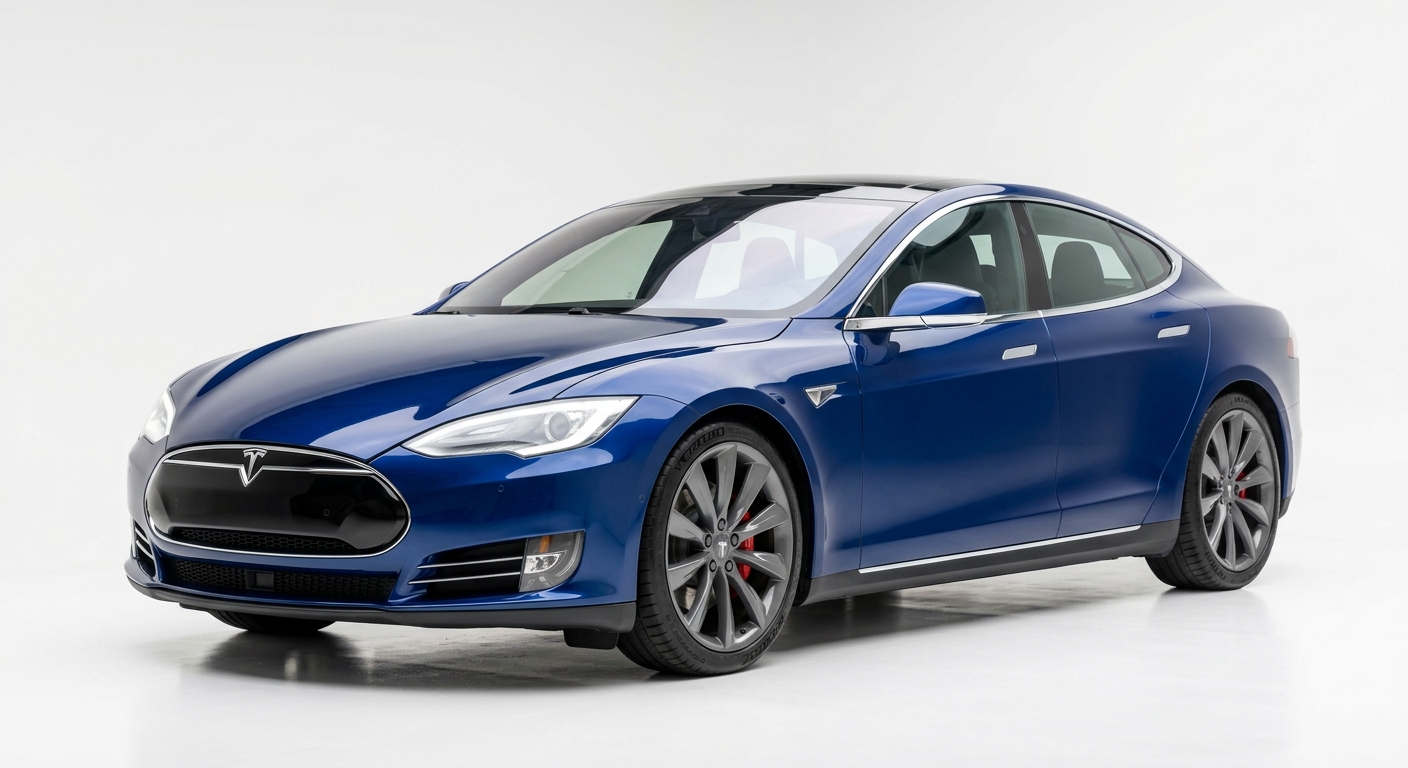
When the 2015 Tesla Model S P90D arrived with its infamous “Ludicrous Mode,” it didn’t just raise eyebrows, it rewrote the rulebook entirely. This wasn’t merely another electric car trying to justify its existence with environmental credentials. This was a 762-horsepower statement that the future had arrived, and it was blindingly fast.
Performance That Redefined Expectations
The P90D’s party trick remains one of the most visceral experiences in modern motoring. Engage Ludicrous Mode, plant your right foot, and watch the world blur past in an eerily silent surge of torque. The 0-60 mph sprint takes just 2.8 seconds, a figure that embarrassed supercars costing three times as much. Unlike traditional performance cars that build drama through sound and fury, the Model S delivers its violence with surgical precision and minimal fanfare.
The dual-motor setup places one electric motor on each axle, creating an all-wheel-drive system that responds faster than any mechanical differential ever could. Power delivery is instantaneous and relentless, with maximum torque available from zero rpm. It’s a fundamentally different driving experience that makes conventional engines feel antiquated by comparison.
Luxury Meets Technology
Step inside the P90D and you’re greeted by Tesla’s minimalist philosophy taken to its logical extreme. The massive 17-inch touchscreen dominates the dashboard, controlling everything from climate settings to suspension adjustments. While some criticized the lack of physical buttons, there’s no denying the cabin feels genuinely futuristic in a way that established luxury brands struggled to match.
The interior quality marked a significant improvement over earlier Model S variants, with premium materials and improved fit and finish. The panoramic glass roof creates an airy atmosphere, while the near-silent operation at highway speeds rivals the best luxury sedans. Rear passengers enjoy limousine-like space, though the sloping roofline does compromise headroom slightly.
Range Anxiety Becomes Range Confidence
The P90D’s 90kWh battery pack delivered an EPA-rated range of 270 miles, finally putting electric vehicle range anxiety to rest for most drivers. Tesla’s growing Supercharger network meant long-distance travel was not only possible but practical. The onboard navigation system would automatically route drivers through charging stations, calculating optimal stopping points based on battery level and driving conditions.
Charging at home via a Tesla Wall Connector could replenish the battery overnight, while Supercharging sessions could add 200 miles of range in about 30 minutes. This infrastructure advantage gave Tesla a commanding lead over traditional automakers still struggling with charging logistics.
Autopilot: The Future Arrives
Perhaps more revolutionary than the performance was Tesla’s Autopilot system, introduced as standard equipment on the P90D. While not fully autonomous, the combination of cameras, radar, and ultrasonic sensors enabled the car to steer, accelerate, and brake automatically in highway conditions. It represented the automotive industry’s first serious attempt at semi-autonomous driving for the masses.
The system worked remarkably well on highways, maintaining lane position and following distance with human-like smoothness. However, it required constant driver attention and occasional intervention, leading to some unfortunate misunderstandings about its capabilities. Still, experiencing Autopilot for the first time felt genuinely magical, offering a glimpse of the autonomous future Tesla promised was coming.
The 2015 Tesla Model S P90D didn’t just accelerate like a hypercar, it accelerated the entire automotive industry toward an electric future. Nearly a decade later, its blend of performance, luxury, and technology still feels remarkably modern. This was the car that made electric vehicles undeniably cool, proving that the future of motoring would be both faster and cleaner than anyone imagined.